Selectmen review lawsuits, long-term debt and Beecher project during five-hour special meeting
Board also approves additional Community & Cultural Center costs, reviews Town campus infrastructure needs, and advances several other initiatives


The Woodbridge Board of Selectmen spent more than five hours in a special meeting Aug. 26, beginning with an extended executive session concerning four pending land-use lawsuits before moving into discussions of unexpected additional costs at the Community & Cultural Center, the Town’s current and projected debt, the proposed $118.5 million Beecher Road School project, and other ongoing capital needs.
The meeting, which began at 5:00 p.m. and adjourned shortly after 10:00 p.m., also included the first Administrative Officer report from Scott Roberts, discussion of the Country Club of Woodbridge master-plan next steps, ordinance and conservation items, an update involving the Police Renovation Building Committee and adoption of the Board’s strategic work plan (see agenda).
Board spends more than an hour in executive session on lawsuits
The meeting opened with the Board immediately entering executive session to discuss strategy related to four pending lawsuits involving the Town Plan and Zoning Commission. The cases identified on the meeting agenda include litigation brought by Open Communities Trust, LLC, as well as three more recent cases brought by Adam Lewandowski and others, Stephen G. Mason and others, and the Woodbridge Land Trust and others. The latter three cases involve the Town Plan and Zoning Commission and relate to the Fountain Street area. Joining the Selectmen in executive session were TPZ Chairman Jeff Kennedy; attorneys Peter Nolan, Robert Taylor and Tom Gerard; Town Counsel Nick Bamonte; and Roberts.
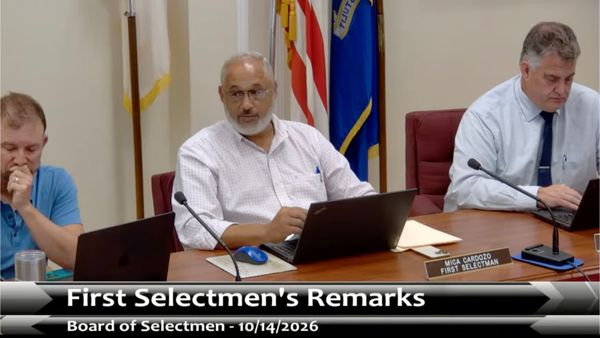
The public meeting recording resumes approximately 86 minutes after the meeting began. Upon returning to open session, First Selectman Mica Cardozo reported that no motions had been made and no votes taken during the executive session.
Cardozo then briefly reported that proposed transfer-station fee increases would be coming to the Board, that both neighbors of the Acorn Hill ballfields and the Beth-Wood baseball organization had provided information regarding the continuing discussion of possible field lighting, and that the Milford-Orange Times plans to begin mailing its newspaper to Woodbridge residents with Woodbridge news included.
Additional work needed before Community & Cultural Center can open
The Board next approved approximately $24,700 in additional spending for the Community & Cultural Center project after two items not included in the original construction plans were identified as necessary for the renovated building to receive a certificate of occupancy. Finance Director Anthony Genovese told the Board that one change order, for approximately $17,400, covers sprinkler heads and associated piping in the elevator shaft. A second, for approximately $7,300, is for construction of a wall beneath new stairs at the direction of the Fire Marshal. Genovese said the requirements emerged during review of the building for its certificate of occupancy.
The money will be transferred from funds previously allocated for a separately planned boiler-replacement project in the Center Building. Officials said that work is now expected to become part of the larger police and campus infrastructure planning. It is hoped the existing boiler could “survive another few winters” despite funding for its replacement having been included in the annual budget process completed just three months earlier.
The additional costs prompted questions about why the requirements had not been identified by the project architect during design. “This is another example of something that an architect should have been aware of and should have put in the original plans,” Selectman Amey Marrella said during the discussion.
Cardozo pointed to the role of his Building Officers — two volunteers with construction expertise serving informally to review capital projects — saying their additional review is intended in part to reduce the likelihood of similar problems in the future.
The discussion also revealed that the work had already been authorized before the Board approved the funding transfer. When questioned about the First Selectman’s authority to authorize work before funding approval, Cardozo pointed to circumstances in which emergency spending had previously been necessary. Marrella drew a distinction between a health-and-safety emergency and the need to complete the work so the renovated facility could open, saying the Town should establish a policy governing emergency expenditures and dollar limits. “I would respectfully object to having it go forward prior to funding,” she said. The Board ultimately approved the $24,754 after-the-fact transfer unanimously.
Debt presentation looks ahead to major capital borrowing
Genovese then presented a broader review of the Town’s existing debt and projected capital borrowing — an analysis that takes on particular significance as Woodbridge considers the Beecher school project alongside police, road, roof, HVAC and other infrastructure needs.
Before beginning his presentation slides, Genovese emphasized both the seriousness of the decisions ahead and his willingness to expand the analysis. “There’s a lot of information and it’s a big decision that you have to make,” Genovese told the Selectmen. “So, if you need any information, additional information, or would you like me to present anything in addition to this or you have questions, if I can’t answer them, I’ll get back to you.”
Cardozo similarly cautioned that the analysis was not intended to be the final word. He said it was based on the information available to Genovese as he prepared it and acknowledged that “it doesn’t include everything that I would like to see it include.” Additional iterations could follow, he said, based on questions and comments from the Board.
Current Town debt service for FY2026-27 is approximately $1.88 million, Genovese said. Existing debt includes borrowing associated with the Public Works facility, earlier Beecher projects, the Town’s radio upgrade, the Country Club of Woodbridge purchase and more recent Beecher roof and grounds work. Woodbridge currently owes approximately $12.1 million in principal on that direct debt. Including the Town’s share of Amity Regional School District debt brings outstanding direct and overlapping principal to approximately $13.8 million, with combined annual debt-service payments of approximately $2.4 million.

The prospective capital schedule presented to the Board contemplates $76.48 million in new Town borrowing between 2027 and 2032. That includes $55.48 million in borrowing for the proposed $118.5 million Beecher project, based on an assumed 53.18 percent state reimbursement; $8 million for the police facility; $5 million for the Center Building; $2.5 million for HVAC improvements; $2 million each for facility roofs and roads; and $1.5 million for the former Country Club of Woodbridge.
Importantly, the $55.48 million Beecher figure represents principal, not the total debt service taxpayers would ultimately fund. The Chronicle has independently confirmed that the financing model projects approximately $20.93 million in interest on the Beecher borrowing, bringing projected principal and interest for Beecher alone to approximately $76.41 million over the life of the debt.
For perspective, that projected principal-and-interest cost for the Beecher borrowing alone is nearly equal to the $76.48 million in principal contemplated for all of the Town projects included in the six-year borrowing plan.
Under the broader borrowing scenario presented to the Board, annual direct Town debt service would increase by more than $5 million during the first six years, rising from approximately $1.88 million in FY2027 to $7.24 million in FY2032. The largest year-over-year increase in direct debt service would be approximately $2.2 million in 2030, following an approximately $1.7 million increase in 2029. As the Board worked through the chart, members emphasized that those increases are cumulative — each year’s higher debt-service level builds on the increase that came before it.
Genovese said the borrowing assumptions were developed with the Town’s financial adviser using recent borrowing by similarly rated communities and comparable projects. The model assumes interest rates ranging from 3.5 to 3.75 percent for six planned debt issuances between 2027 and 2032. Selectmen questioned whether the analysis should also model potentially higher rates, noting that actual borrowing would occur over several years. Genovese acknowledged that rates could rise, and members suggested showing a range or alternative scenario.
When projected Amity debt is added, Genovese estimated that direct and overlapping debt service would reach approximately 11.5 percent of the Town budget in 2031, assuming the overall budget grows by 3 percent annually. Marrella asked whether 10 percent had previously been discussed as a level the Town should seek not to exceed. “Well, 10% is typically an industry standard that you try to use,” Genovese responded.
The presentation also translated the proposed direct Town debt into estimated tax impact. Genovese calculated an average impact of 2.9 mills over the first 10 years, peaking at 3.31 mills in 2034. For a home with the Town’s stated average market value of $651,130, the presentation estimated an average additional tax cost of $1,324 per year during the first decade — or approximately $13,240 over those 10 years. That calculation does not include Woodbridge’s overlapping share of Amity debt.
The use of averages itself prompted discussion. Board members noted that the tax increases would not arrive evenly and asked that residents also be shown the actual year-by-year impact, particularly during the years when new debt service rises most sharply. Genovese said that information could be provided.
The presentation then prompted an extended discussion about what is not yet included in those projections.
Marrella repeatedly pointed to a 2024 facilities assessment that identified approximately $40 million in needs at the Center Building, arguing that the debt picture residents see should account for known work that may become necessary even if it is not presently scheduled for borrowing.
Cardozo noted that portions of those needs are already represented elsewhere in the model — including campus HVAC and roof work and some work associated with the police project. But Marrella calculated that even after accounting for those items, substantial needs identified in the earlier assessment remained outside the borrowing scenario. The discussion also identified other potential future needs not reflected in the model.
Marrella argued that leaving known needs outside the projection risks giving residents an incomplete picture. “People need to understand this is a generational increase in debt,” she said.
Cardozo pushed back on the idea that the model should assume all $40 million identified in the Center Building study would be borrowed within the period under review. The Town, he said, was not proposing to spend that entire amount in the next two or three years, and the analysis was intended to focus on projects the administration currently anticipates could move forward with borrowing rather than every expenditure Woodbridge might encounter over a much longer period.
The exchange underscored an important limitation of the figures: the 11.47 percent projection is not a ceiling or a comprehensive forecast of all future capital obligations. It is the result of a particular set of projects, borrowing amounts, interest rates, reimbursement assumptions and budget-growth assumptions currently being modeled. Some projects are still being developed, while other known or potential capital needs remain outside the analysis.
Debt analysis introduces a Beecher “repair” scenario
For the first time in the Town’s financial presentations surrounding the Beecher proposal, Genovese also presented a long-range debt comparison based on repairing the existing school rather than constructing the proposed $118.5 million replacement.
The scenario is based on a draft 10-year capital plan totaling approximately $44.94 million from FY2028 through FY2037. Of that amount, approximately $16.77 million is identified as direct repair costs, while another $28.16 million is attributed to indirect or soft costs, multiple mobilizations and escalation. The repair schedule includes building-envelope and roof work, HVAC and mechanical projects, security and fire-protection work, site infrastructure, interior improvements and hazardous-material abatement.
For purposes of comparing the two alternatives, Genovese's debt model assumes that essentially the entire repair program would be financed through borrowing, with $15 million issued in 2028, $12 million in 2032 and $18 million in 2035. The resulting projections show the repair scenario producing substantially less debt than new construction, but still raising Woodbridge's debt measures significantly above their current levels (see presentation slide, above).
That comparison provides residents with a financial alternative to new construction that had not previously appeared in the Town's broader debt presentations. But it also introduces a new assumption that warrants examination: whether Woodbridge would actually borrow the full cost of a 10-year repair program.
Under the municipal financing approach commonly known as pay-as-you-go, or “PayGo,” capital expenses are funded from current revenues rather than through borrowing. Municipalities can also use a combination of PayGo and debt financing, depending on the size and useful life of the expenditure.
Major, long-lived projects such as roof replacements may appropriately be financed through bonds, while smaller recurring capital and lifecycle work can be funded through annual capital budgets as it occurs. A hybrid scenario — bonding major, long-lived improvements while paying for smaller scheduled work through annual capital funding — was not included in the analysis presented Aug. 26.
Such an approach would not reduce the underlying cost of repairing and maintaining Beecher. But it could reduce the amount borrowed, along with associated interest and issuance costs, and therefore produce a different comparison of the two alternatives' effects on Town debt.
Beecher discussion turns to retained South Building
Following his financial presentation, Genovese departed the meeting. The Board then moved to the next agenda item, an update on the Beecher Road School project, with Selectman Maria Madonick presenting and fielding questions in her capacity as the Board of Selectmen’s non-voting liaison to the Beecher Road School Building Committee.
Madonick began with a proposed calendar leading to an Oct. 13 referendum on the $118.5 million new-school proposal. Under the schedule presented, the Board of Selectmen would meet Sept. 23 to call an Oct. 6 Special Town Meeting, which would then be adjourned to referendum Oct. 13. Polls would be open from 6 a.m. to 8 p.m.; absentee ballots would be available, but there would be no early voting.
A substantial portion of the discussion, however, centered on a less visible feature of the new-construction proposal: approximately 13,600 square feet of the existing Beecher South Building would remain standing after most of the present school is demolished.
The retained area includes the pool structure, south gym, south assembly and office space. Approximately $780,000 is included in the $118.5 million project to mechanically separate and preserve that portion of the existing building, allowing it to operate independently from the new school. Madonick stressed that the money would not renovate the retained building or the pool itself. It would leave the structure capable of occupancy, with independent mechanical systems, while the Town decides its longer-term future.
The approach was described during the discussion as essentially “mothballing” the building. Madonick said the Building Committee's role had been to preserve that option, but whether Woodbridge ultimately wants to retain the facility is a decision for the Town. She also acknowledged that keeping it would leave the Town with a building that “may need infrastructure investment in the future.”
That future investment is not entirely hypothetical. An October 2022 Weston & Sampson evaluation report estimated $865,269 in repairs and improvements to keep the Beecher pool operational. The report documented structural deterioration, leaking and corroding main drains, aging and failing filtration equipment, drainage problems and code-compliance issues. It recommended a partial rehabilitation rather than continued patchwork repairs and warned that the approximately 50-year-old pool had reached a “critical point” in its service life. Without improvements, the consultant estimated in 2022 that it had approximately two to three years of remaining service life before significant damage occurred. Those estimates are now four years old and the pool is no longer being used.
The roof over the retained Beecher South section appears to date to about 2004, which would make it approximately 22 years old. No current replacement estimate was presented, and it is unclear whether a future replacement is included in the repair schedule discussed earlier.
Taken together, the retained-building issue creates an unusual feature of the new-construction proposal: the Town would spend approximately $780,000 within the school project to preserve and mechanically separate a portion of the existing building whose pool already had an estimated $865,269 rehabilitation need in 2022 and whose roof appears to be approximately 22 years old. The pool rehabilitation is not included in the current $118.5 million project cost, and no separate allowance for eventual replacement of the retained South Building roof has been identified.
Board members discussed whether retaining the structure provides enough future value to justify the expense compared with demolishing it along with the remainder of Beecher. Madonick explained that demolition of most of the existing school is already included in the $118.5 million estimate, but the cost would have to be recalculated if the South Building were also demolished.
Reimbursement rate may not apply to every project cost
The discussion also highlighted another important distinction: the $118.5 million project cost is not the same as the amount eligible for state reimbursement.
Madonick said state school-construction rules make some project expenses non-reimbursable and said understanding those exclusions is “incredibly important” so the Town can appropriately plan both its capital program and its borrowing. She identified the retained pool space as among the costs not included in the reimbursement calculation.
That distinction is significant in light of the financial presentation immediately preceding the Beecher update. Genovese's debt model assumes $55.48 million in Town borrowing for Beecher, based on an estimated 53.18 percent state reimbursement. But that reimbursement rate applies only to eligible project costs; it does not mean the state will reimburse 53.18 percent of every dollar of the $118.5 million project.
Madonick also said bonding costs are not reimbursable by the state. The discussion therefore left an important number still to be established: how much of the $118.5 million project will ultimately qualify for state reimbursement — and how much will remain entirely the Town's responsibility.
The Board also returned to the need for the Board of Finance to review the developing capital plan before the referendum process moves forward, and to the importance of clearly distinguishing for residents the tax impact of Beecher itself from the cumulative effect of the Town's broader capital program.
As the Board concluded its consideration of the Beecher Road School plan, it also unanimously referred the proposed project to the Town Plan and Zoning Commission for the 8-24 review and report required for improvements to Town-owned property — a statutory process through which the commission considers whether the proposed project is consistent with the Town’s Plan of Conservation and Development (POCD).
Roberts begins broader campus infrastructure review
In his first Administrative Officer report, Roberts presented work underway to assemble the Town’s various building needs into a more comprehensive capital plan. Roberts said he had spent roughly his first four weeks working with staff to understand the Town’s capital needs outside the school project. Volunteer building officer Nigel Light also spoke to describe how he has begun developing a project-management schedule intended to show how the various projects fit together over time.
This planning includes Town Center campus-wide roof and mechanical, electrical and plumbing work, alongside the police renovation. Officials discussed whether bundling similar work across buildings could produce better pricing and more consistent materials and systems for future maintenance.
Other business
The Board also voted to schedule public hearings on proposed changes to the Town’s citation notice and hearing procedures and on an Emergency Medical Services Commission ordinance. Both are expected to take place either at the Board’s Sept. 9 meeting or soon thereafter.
Under the consent agenda, Selectmen approved tax refunds and property-use requests for Woodbridge Like Me Day and a Girl Scout bat-box replacement project. Proposed amended Personnel Committee minutes were instead referred back to that committee for approval.
The Board authorized Cardozo to sign documents needed for a Conservation Commission forestry grant application due Aug. 31. Five Selectmen voted in favor, with Andrea Urbano recusing herself.
Cardozo also presented a draft Request for Expression of Interest (RFEI) associated with the Country Club of Woodbridge master plan. He said that unlike a formal request for proposals, the document is intended to identify potential development partners interested in working with the Town on concepts for the property. Selectmen raised questions about some of the proposed uses and language, and Cardozo agreed to accept additional comments before the document moves forward. The topic is expected to reappear on the next BOS meeting agenda.
The Board voted unanimously to add Roberts as a non-voting member of the Police Renovation Building Committee. Cardozo said he ultimately expects the Administrative Officer to serve in that capacity on Town building committees generally, but because this was a special meeting the Board limited its action to the Police Renovation committee specifically listed on the agenda.
Finally, the Board unanimously adopted its strategic work plan, which officials said was substantively the same as the version previously presented, with organizational and grammatical revisions. With that, the Board moved to adjournment at 10:10 p.m.
The meeting was streamed live on the town’s YouTube channel, WGATV79. Click below to watch the full recording of the August 26, 2026 special meeting of the Board of Selectmen.