Board Watch: Charter Commission splits 4–3 on key votes, Building Committee plans final referendum outreach
Charter votes track Commission appointment divide; Beecher committee considers final voter mailing, cost messaging and remaining community outreach


Board Watch is a recurring feature designed to provide a concise walk-through of activity as we keep track of the week's civic work. Longer-form articles will appear when issues warrant deeper coverage.
Charter Revision Commission — September 2, 2026
The Charter Revision Commission took two significant votes at its Sept. 2 meeting, recommending no changes to two provisions governing the power and composition of the Board of Selectmen (see agenda).
Both decisions came by identical 4–3 votes, with the same four members in the majority and the same three opposed — a division that tracked the lines of the Commission's contentious appointment process earlier this year.
During public comment at the outset of the meeting, former First Selectman and current Selectman Amey Marrella urged the Commission to support both changes under consideration: eliminating the First Selectman's second, tie-breaking vote on the Board of Selectmen and allowing an unsuccessful candidate for First Selectman to take a Selectman seat if that candidate received more votes than at least two candidates running for Selectman.
Marrella also raised several other Charter issues in written comments submitted to the Commission. Among them, she asked for an opportunity, as a minority member of the Board of Selectmen, to address questions the Commission had previously posed to First Selectman Mica Cardozo. She noted that Cardozo appeared before the Commission July 1 and discussed Board of Selectmen recommendations, and said she disagreed with some of his statements (see minutes with attached public comment).
Opening the Commission's discussion, Chair Susan Jacobs said she wanted a “robust discussion” and did not believe members necessarily needed to vote that evening if they still had questions, wanted additional information or needed more time to consider the issues.
The Commission first considered Charter §5-3B, which gives the First Selectman a regular vote as one of the six members of the Board of Selectmen and a second vote to break a 3–3 tie. Discussion centered largely on whether eliminating that second vote would encourage consensus and cooperation or risk leaving the Board unable to move business forward.
Commissioner Melissa Durso, who ultimately provided one of the four votes to leave the provision unchanged, described herself during the discussion as “conflicted and a little perplexed.” She said she liked the premise of encouraging collaboration but was concerned about whether eliminating the tie-breaker could instead prevent Town business from moving forward. “Are we in a stalemate situation or are we forcing people to collaborate?” Durso asked.
First Selectman's second vote retained
Jeff Ginzberg ultimately moved to recommend no change to the provision. The motion carried 4–3.
Following the vote, the Commission returned to Pat Madden's proposal to remove the First Selectman's tie-breaking vote on the Board of Finance. Madden withdrew it, saying the proposal no longer made sense after the Commission had voted to retain the First Selectman's tie-breaking vote on the Board of Selectmen. He reserved the right to return with more information about practices in other towns and other possible solutions.
Losing First Selectman provision also left unchanged
The Commission next considered whether an unsuccessful candidate for First Selectman should be eligible for a seat on the Board of Selectmen if that candidate received more votes than at least two candidates running specifically for Selectman.
Durso again raised a concern, this time about what voters would understand their ballots to mean. “Well, I have a concern just from a voter perspective,” she said. Durso said it was her understanding that a candidate could not run for two offices at once — while also saying she needed clarification from Town Attorney Nick Bamonte — and questioned whether voters choosing someone for First Selectman would understand themselves to also be voting for that person as a Selectman. She described the proposal as “kind of a work-around” and potentially “smoke and mirrors for voters.”
The discussion also revealed questions about how such a provision would interact with Connecticut election statutes and minority-representation requirements. Bamonte said he wanted to conduct additional research into the applicable statutes and return with more information.
The Commission nevertheless proceeded with a motion from Ginzberg to recommend no change to the existing Charter provision. That motion also passed 4–3.
Votes track appointment divide
The identical votes were notable because they followed the lines of the dispute over how the seven-member Commission was constituted in January. Selectmen Marrella and Andrea Urbano had sought to place three nominees on the Commission as the Board's minority-party selections. Following a contentious appointment process, they ultimately secured those three seats. The remaining four members were selected by the Board's Democratic majority, although one of those four — Durso — was described at the time as a registered Republican. The final seven-member slate was approved by the Board of Selectmen 4–2, with all four Democrats voting in favor and both minority party members opposed (see WTC article 01/19/2026).
At the September 2 Charter Revision meeting, the four Commission members selected by the Democratic BOS majority voted together on both questions, while the three members nominated by the Republican minority voted together in opposition.
The Commission's votes are recommendations made as part of its ongoing Charter review and do not themselves amend the Charter. The Charter revision process itself remains underway.
Click below to watch WGATV's full recording of the September 2, 2026 Charter Revision Commission meeting.
Beecher Road School Building Committee — September 1, 2026
The BRSBC met Sept. 1 to plan its final round of community outreach and a final Town-wide mailing before the proposed $118.5 million school project goes to voters Oct. 13. The Committee's official agenda included its outreach calendar, discussion of a final newsletter and public comment (see agenda).
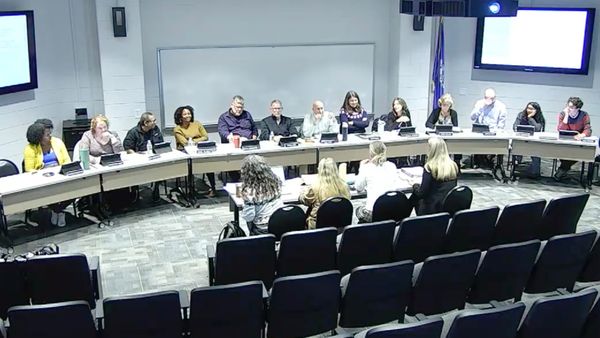
The meeting was conducted remotely via Webex, with no in-person component listed on the agenda. Under the state's remote public meeting law (Public Act 22-3), meetings held entirely remotely generally must be recorded, with the recording posted on the municipality's website within seven days. The Town Attorney has advised, however, that this recording requirement does not apply to special meetings. No official recording of the Sept. 1 meeting appears to have been made available. The Woodbridge Town Chronicle independently recorded the meeting; our full recording appears below.
The Committee plans appearances at upcoming school open houses, the Beecher Road School PTO's Ice Cream Social on Sept. 10, and the Woodbridge Senior Center Sept. 9. The Committee's own Sept. 15 meeting will be held in the South Assembly Room at Beecher, with tours beginning at 6 p.m. followed by another community forum. Members described that as the final opportunity currently planned for residents to tour the school before the referendum.
Final mailing focuses on cost and need
Much of the Sept. 1 discussion focused on what the Committee should emphasize in its final Town-wide mailing before the referendum. Rather than another six-page newsletter, members discussed using an oversized postcard with a limited number of key messages.
The discussion focused largely on how to present several of the Committee's existing messages to voters in the final weeks before the referendum, including projected state reimbursement, estimated taxpayer cost and the amount the Town might otherwise need to spend repairing the existing school. Some of those estimates depend on assumptions or details that have not yet been fully documented publicly.
WBOE Chairman and BRSBC member Stephen Lawrence said the final mailing should continue repeating several of the Committee's central messages, including its position that the Town will have to spend substantial money on Beecher regardless of whether voters approve the proposed project. “The fact is the town's going to have to spend this much money whether we construct a new building or patch up the one we've had,” Lawrence said, describing that as one of the Committee's “core messages.”
Later in the discussion, Lawrence summarized the proposed framing: “It's not a question of will we spend the money. It's a question of how we will spend the money.”
Members also discussed again highlighting the monthly household tax-impact estimate used in the Committee's previous newsletter. Committee member Justin Rehm described the approximately $80-per-month figure as particularly effective in making the project's cost appear more relatable than either the full project price or the estimated Town-funded portion. “When it's watered down to $80 a month, it's like it's less than a gym membership at some gyms,” he said.
Lawrence similarly said that when residents see a large overall project figure, “all you're thinking is, what does this mean for me?” Breaking the figure into a monthly amount, he said, could make it comparable to what someone might spend on “one to two subscriptions” to entertainment or other services.
The Committee also discussed again emphasizing its projected state reimbursement and the opportunity members believe the current reimbursement program presents. Chairman Martin Halprin suggested reminding voters of “the grant percentage that we're getting from the state,” characterizing it as an unusually high amount that Woodbridge “more than likely would not get” in subsequent years.
Repair estimates discussed
Members also considered how to present the Committee's estimate that maintaining the existing Beecher buildings could require $30 million to $60 million in future spending. Rehm suggested breaking that range into several major repair categories, but also noted that the Committee had not received a complete breakdown of the expected remaining life of the school's various systems. “We never got a full breakdown of what the life expectancy is on the rest of the maintenance items in the school,” he said.
The discussion touched on roofs, HVAC, paving, windows, the building envelope and boilers. Maria Madonick pointed to Finance Director Tony Genovese's Aug. 26 presentation to the Board of Selectmen, which she said included approximately $44.5 million in projected repair-only borrowing over the next 10 years and a schedule for when that borrowing might occur (see WTC article 8/31/2026).
Members ultimately returned to the idea of keeping the final mailing simple, while potentially directing residents seeking greater detail to information posted online. The postcard will be developed with the Committee's communications consultant, Tall Timbers. Because the next regular Committee meeting is Sept. 15, members said another special virtual meeting may be necessary to approve the mailing in time.
The meeting also clarified two timing questions related to the referendum. Madonick confirmed that Genovese's financial model assumes a 20-year repayment period for the proposed school borrowing. She also said the Town's pre-referendum “quiet period” would begin after the Board of Selectmen acts Sept. 23 to call the Town Meeting and referendum.
Superintendent Christopher Montini asked whether he could attend a regularly scheduled PTO meeting Sept. 30. Madonick said the restriction does not mean officials “can't say anything,” but relates to the expenditure of public funds. She said providing factual information at a routine meeting would be permissible. Montini said he would confirm the matter with the Town Attorney.
Current use of school space detailed
A discussion later in the meeting provided additional information from school administrators about how existing space at Beecher is currently being used. Montini said three teachers — two music teachers and a health teacher — currently work from carts, rotating among available spaces.
The discussion then broadened to staff members who share rooms or other instructional spaces. Montini and other administrators worked through several examples, including math and literacy specialists, special education staff, a speech-language pathologist, psychologist and social worker. By the end of the discussion, they counted approximately a dozen educators using five shared spaces, while noting that “rooms may be generous” as a description of some of those locations.
Montini said current space needs also reflect changes in educational programming over time. He reported that 14.4% of Beecher students currently receive special education services, compared with approximately 10% a decade ago, which he characterized as a 43% increase over the 10-year period. Montini also reported that multilingual learners had increased 407% during that period and that the percentage of students qualifying for free and reduced-price lunch had increased from 8% to 12%.
The special education discussion followed questions committee members said they had been asked at a recent public forum. Madonick said the project “did not come about solely to make space for special education,” but described appropriate space for those programs as one of the challenges the project is intended to address. Montini also said operating programs within the district can be less costly than placing students in programs outside the district.
As the agenda concluded, members noted the information discussed at the meeting would help them respond to questions at the remaining public events before the referendum.
Click below to watch the WTC's full recording of the Sept. 1, 2026, Beecher Road School Building Committee meeting.