After Beecher referendum defeat, Woodbridge boards confront what comes next
Selectmen discuss the building committee’s future and the need for a less costly plan; finance board members call for earlier involvement in major capital projects.

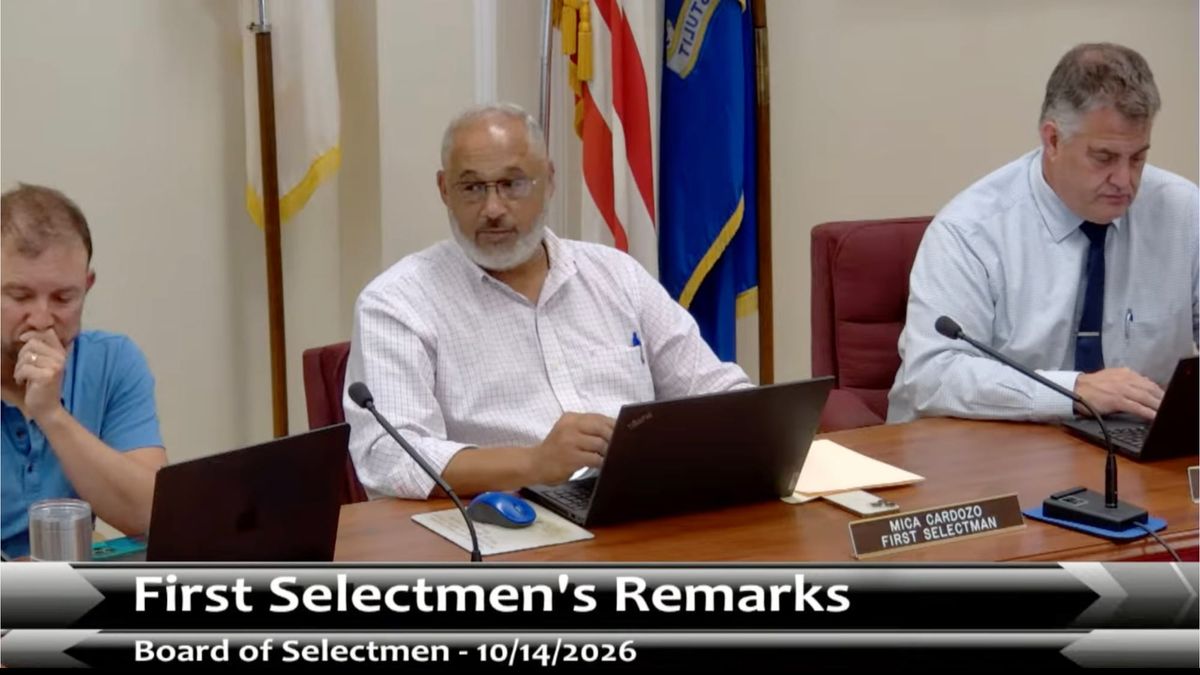
One day after Woodbridge voters decisively rejected the proposed $118.5 million Beecher Road School construction project, members of the Board of Selectmen began debating how the Town should proceed — and whether the committee that developed the defeated proposal should continue under its existing charge.
The discussion continued the following evening at the Board of Finance, where members acknowledged the need to address the school’s facilities while calling for better communication, earlier financial oversight and a more affordable approach to future capital projects.
The October 13 referendum failed by more than two to one, with 1,847 residents voting against the proposal and 919 in favor. A total of 2,766 votes were cast (see companion WTC article for full details and analysis of the referendum results).
Although members of both boards expressed appreciation for the volunteers and professionals who worked on the project, they offered differing interpretations of the result and different prescriptions for what should happen next. No replacement school proposal was discussed or approved at either meeting.
Selectmen divided over the next steps for Beecher
At the October 14 regular meeting of the Board of Selectmen, First Selectman Mica Cardozo acknowledged the referendum’s overwhelming result and thanked the volunteers who had worked on the project. He also recognized state Rep. Mary Welander’s efforts to help secure potential state reimbursement (see agenda).
The published agenda also included an item concerning a possible second referendum on October 27, but the October 13 defeat ruled out that possibility. Under the Town Charter, a second vote would have been required only if the proposal had received majority support but less than two-thirds approval in the first referendum.
Discussion at that point in the evening instead turned to the future of the Beecher Road School project and the building committee's next steps. Selectman Maria Madonick, the Board's liaison to the Beecher building committee, said the school's infrastructure and educational needs remained despite the rejection of the proposed project. She cited inadequate classroom space, accessibility barriers and special education programs operating in improvised spaces, and argued that accommodating more students in-district could produce substantial savings.
Madonick also outlined plans for a building committee meeting on October 20, at which she said members would consider grant-writing assistance, conceptual design and cost estimating, potentially followed by a request for additional funding in November to support further planning. That timetable prompted concerns about allowing the committee to continue work under its existing charge before the Board reconsidered its direction.
Selectman Amey Marrella emphasized the referendum result's message about affordability and called for a more modest follow-up approach, including reconsideration of the committee's charge and membership, broader consultation and clearer financial limits before further planning. The exchange echoed the Board's September 23 discussion, when members raised similar questions about costs, alternatives and financial uncertainty before voting 4–2 to send the proposal to referendum (see WTC article 9/28/2026).
Cardozo defended the committee's work, saying the proposal had been developed with professional guidance to meet educational needs and maximize state reimbursement. He characterized the rejected plan as a middle-of-the-road solution rather than a high-end building and asserted that the committee had recommended the lowest-cost option meeting the educational specifications. He also suggested that the way the project's costs and tax impacts had been portrayed contributed to its rejection.
Selectmen also discussed involving the Board of Finance earlier in capital planning, examining relevant Town Charter provisions and exploring economic development to ease the burden on residential taxpayers. Selectman Lauren Francese, who described herself as the Board's only educator, emphasized increasingly complex educational needs and cautioned that the referendum result should not be interpreted as diminished support for teachers or students. Members emphasized the importance of maintaining educational quality and public confidence while developing a financially sustainable approach.
The Selectmen took no action to revise the building committee's charge or authorize a new project, leaving the committee's existing authority unchanged for the time being.
Click below to watch WGATV's full recording of the October 14, 2026 BOS meeting.
Finance board also discusses Beecher project
The following evening, the Board of Finance took up many of the same questions, focusing particularly on affordability, financial oversight and how the Town should approach future capital projects (see agenda). Members voted to add discussion of the Beecher referendum to their agenda.
Board member Thomas Handler said the referendum sent a clear message that Woodbridge values education but wants a less costly solution to Beecher's facilities problems. He urged the Town to move quickly, warning that further delays could increase the cost of necessary improvements.
Members generally agreed that the vote should not be interpreted as a rejection of public education, but differed over why the proposal failed. Some emphasized its cost and tax implications, while others questioned whether voters had fully understood the financing or received sufficient information during the process.
The discussion also exposed concerns about the Board's involvement in capital planning. Several members favored earlier financial review, stronger communication between boards and committees, and a more comprehensive assessment of the Town's borrowing needs. They noted that newly appointed members had not participated in earlier project discussions.
Those concerns extended beyond Beecher to the proposed police station renovations and other capital projects. Members raised the importance of considering the combined burden of existing and anticipated debt, rather than evaluating each project separately. They also called for a clearer public explanation of Beecher's next steps and timetable.
Cardozo, who participated in the meeting in his capacity as ex-officio member, said the building committee would meet the following week and suggested awaiting its recommendations. He defended the Town's public outreach efforts, including forums, school tours and project updates, while questioning what additional communication might be effective.
The Board of Finance took no action to establish a new Beecher budget or recommend a particular building alternative.
Police station tour reinforces capital planning concerns
The finance board’s meeting had opened with a tour of the Woodbridge Police Department facility, where members examined conditions that have prompted consideration of a major renovation.
The police project had also been discussed at the October 14 Board of Selectmen meeting, when Police Department Building Committee Chair Kris Wuestefeld provided an update.
The police facility was repeatedly cited as an example of why the Town needs a coordinated approach to its capital obligations.
Members of the finance board suggested that lessons from the Beecher referendum should inform the planning, financing and public presentation of the police project before any proposal reaches voters.
The Town also faces other capital requirements, making the question of how to prioritize and schedule borrowing particularly consequential.
Other discussions and action by the BOF
Beyond the referendum, the Board of Finance reviewed the Town’s financial position and preparations for the next budget cycle. Finance Director Anthony Genovese reported no significant first-quarter surplus or deficit. He also updated members on the fiscal 2026 audit, with work continuing on fixed assets and a draft expected later in the fall.
Following approval the previous evening by the Selectmen, the finance board approved a $99,400 budget transfer to purchase and install a dump body and plow for a previously purchased Public Works cab and chassis. The funding had originally been allocated for a Parks Department pickup truck.
Members also discussed the fiscal 2027–28 budget calendar, departmental guidelines and longer-range capital planning, including how to build upon the Town’s existing five-year capital planning requirements to create a ten-year look ahead. Potential efficiencies through shared services between the Town and Beecher as well as consolidation of technology spending were also raised.
The Board also considered possible recommendations to the Charter Revision Commission concerning financial oversight and the budget process but took no formal action.
Click below to watch WGATV's full recording of the October 15, 2026 BOF meeting.
The October 14 Board of Selectmen meeting also covered several other matters, including environmental concerns, capital projects and Town operations.
Landfill runoff concerns draw extended discussion
The Board of Selectmen devoted substantial time to concerns about the former municipal landfill at Acorn Hill and the condition of its retention ponds. Environmental consultant Joseph Santovasi of Advanced Environmental Interface reviewed monitoring information and discussed the significance of test results, including elevated chloride levels and specific conductance.
Residents living near the landfill have raised concerns about the condition of the ponds, possible movement of contaminated water and whether existing monitoring adequately addresses risks to nearby streams and private wells.
Santovasi discussed the available environmental data, while Selectmen questioned the monitoring history and the interpretation of the results. The discussion did not establish that nearby drinking water is contaminated. Cardozo said the Town would arrange another session involving representatives of the Connecticut Department of Energy and Environmental Protection, allowing residents to ask questions directly.
Public comments address Beecher, landfill, and Town history
During public comment, several residents spoke about the landfill, seeking more extensive testing, greater attention to downgradient private wells, maintenance of the ponds and clearer information about the landfill’s potential effects on nearby waterways. They also questioned the available monitoring records and the selection of private wells previously tested.
Public participation at the Selectmen’s meeting extended beyond the landfill discussion. Several residents spoke to express contrasting views of the Beecher referendum. Some welcomed the result as an opportunity to develop a more affordable approach. Others expressed disappointment and defended the work of the building committee and the educational rationale for the rejected proposal.
Offering his own public comment, Building Committee Chair Marty Halprin thanked the Town for its support and encouraged residents, regardless of how they voted, to remain engaged as the Town considered its next steps.
Other speakers raised specific concerns about conditions at the school, including instructional space, maintenance, and the adequacy of facilities for current educational programs.
The public comment period also included an announcement about the annual Scouting for Food collection benefiting Woodbridge Human Services, as well as comments about a proposed historical sign commemorating Roger Sherman.
Community and Cultural Center opens; CCW planning continues
The Selectmen received an update on the newly opened Community and Cultural Center, including upcoming programming and opportunities for community involvement. Cardozo reported that Gov. Ned Lamont had visited the facility and credited a $2 million state grant with helping complete the project.
The Board also reviewed progress on implementing the former Country Club of Woodbridge master plan. Work includes a Request For Expressions of Interest from potential partners or developers (see the RFEI as posted at the Town website) and further examination of possible uses for the property. Cardozo said a new intern from the South Central Regional Council of Governments would assist with implementation and public engagement.
Roger Sherman sign deferred
A separate discussion concerned a proposal from the Amity and Woodbridge Historical Society for a sign recognizing U.S. founding father Roger Sherman’s historical connection to the land now comprising the former Country Club of Woodbridge property.
During discussion by the Selectmen, supporters of the proposal said the sign would help residents and visitors recognize an important, little-known connection to the Town’s colonial history. Other Selectmen urged a broader historical interpretation, including attention to slavery and the context of Sherman’s role in the nation’s founding. Members also discussed whether the sign should be planned in conjunction with the master plan’s proposed historical and educational uses for part of the property.
The Board reached no final decision on the sign. Cardozo suggested further planning and coordination with local historical organizations.
A new proposal for Beecher remains to be defined
The two meetings left important questions unanswered. The existing Beecher Road School Building Committee is preparing to consider further professional services, while some Selectmen want to reconsider its membership, charge and financial parameters before additional work proceeds.
The Board of Finance, meanwhile, expressed interest in becoming involved earlier in major capital decisions and evaluating projects within the broader context of Town debt and taxpayers' ability to pay.
Neither board identified a replacement proposal, established a target cost or settled how the next planning process would be organized. The October 13 referendum did not end the discussion about Beecher Road School, but it clearly changed the terms under which that discussion will continue.