Beecher project Special Town Meeting reveals new details about costs, state grants, and alternatives
Residents question the $118.5 million proposal’s financial assumptions, cost of maintaining the existing school, enrollment projections, and consequences of rejecting the plan

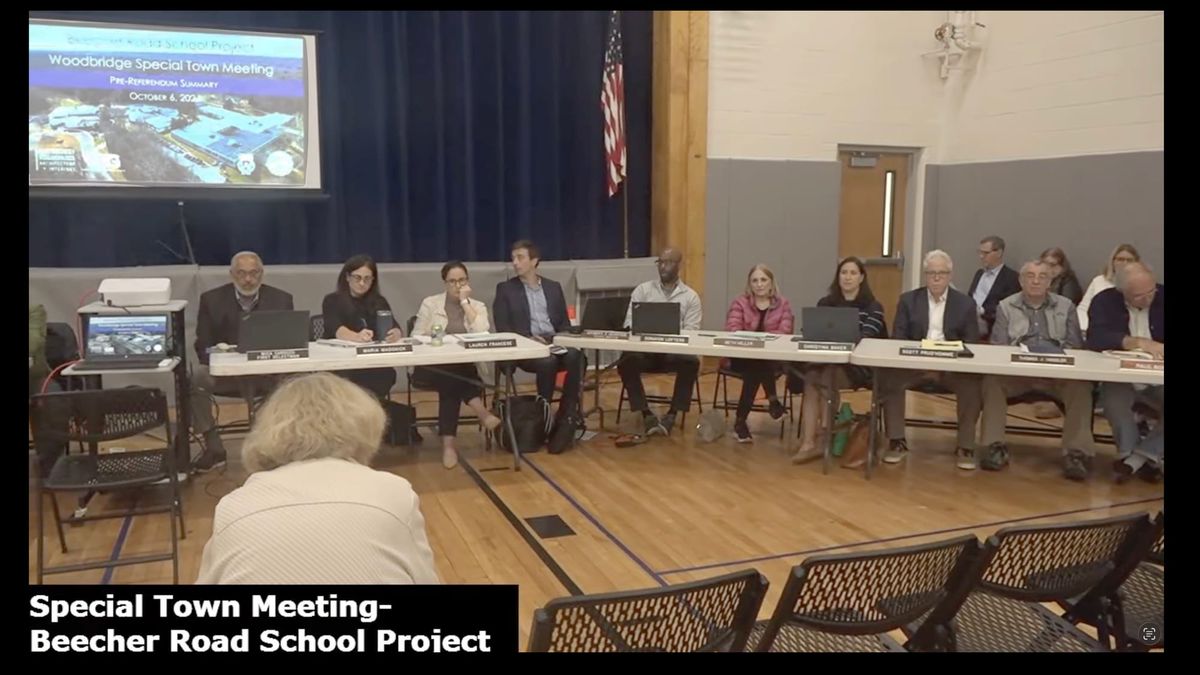
More than 100 residents attended Woodbridge's October 6 Special Town Meeting to hear presentations and question Town officials and consultants about the proposed $118.5 million Beecher Road School and Central Office project, which goes before voters in an October 13 referendum (see meeting notice).
The meeting lasted more than three hours, with questions ranging from the reliability of anticipated state reimbursement to the cost of maintaining the existing school, the need for expanded preschool facilities and the Town's capacity to finance other capital projects.
Officials defended the proposal as the result of several years of study, saying a new school would better accommodate educational programs, address deficiencies in the existing building, and take advantage of state construction grants.
Residents, meanwhile, pressed for more information about the financial risks, the basis for comparisons with less expensive alternatives, and the long-term costs of operating the proposed facility.
State reimbursement and the Town's financial exposure
One of the most consequential discussions concerned how much of the project's cost the State of Connecticut would ultimately reimburse — and how much Woodbridge taxpayers could ultimately be required to pay.
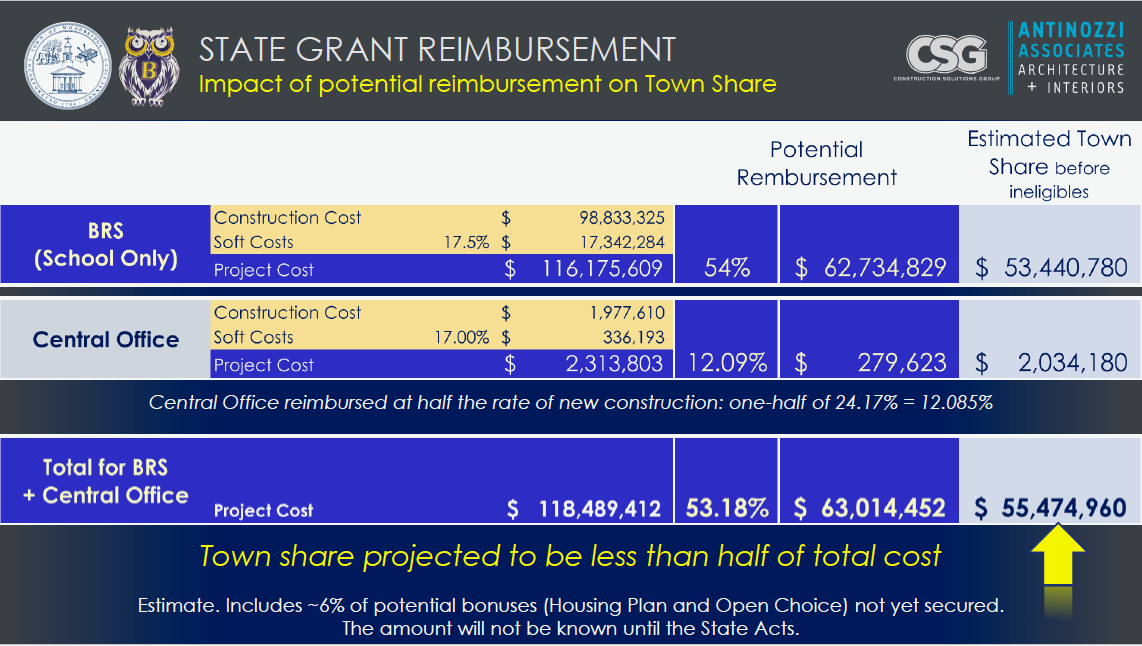
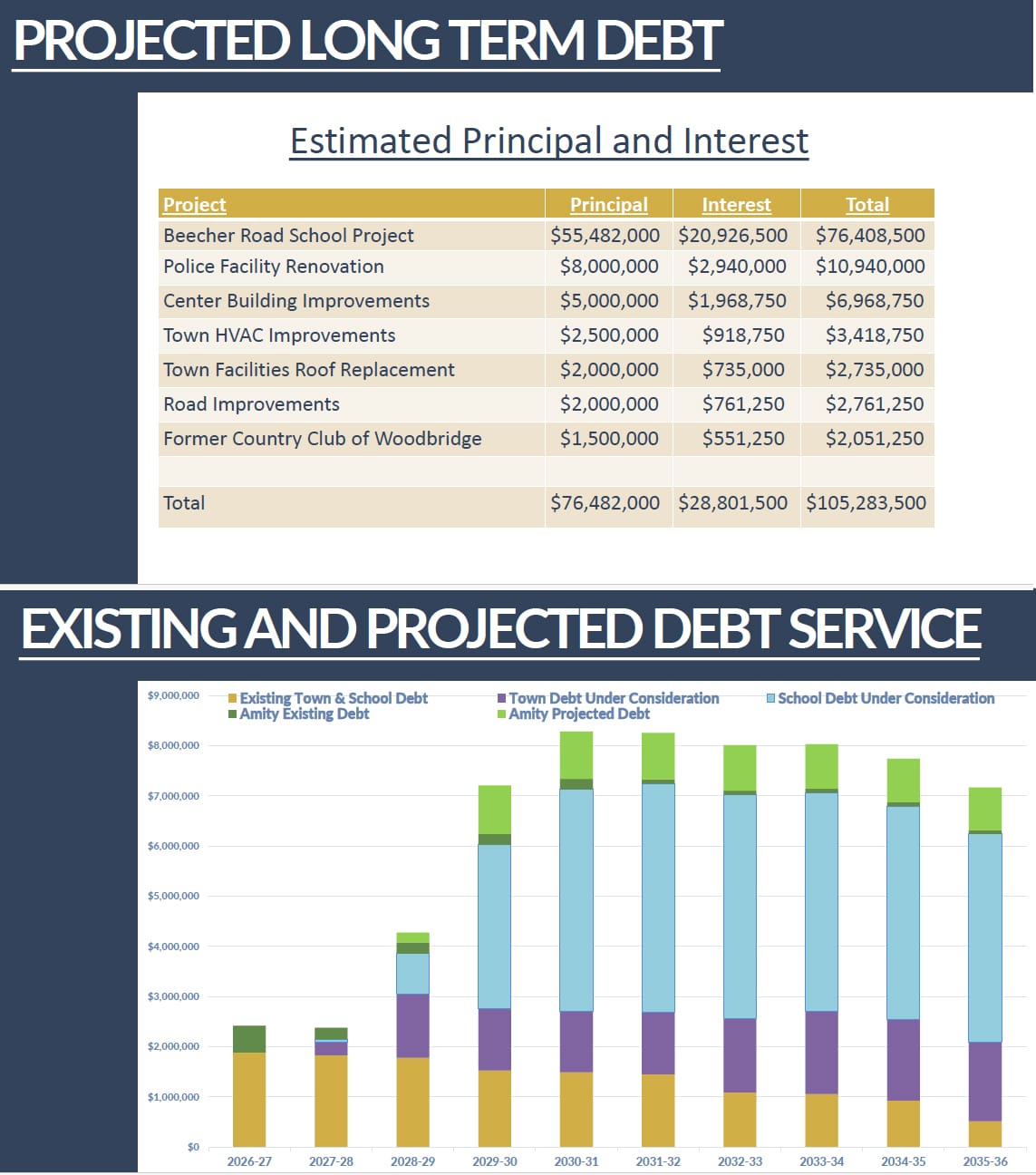
The Town's financial presentation assumes a blended reimbursement rate of 53.18%, producing approximately $63 million in state grants and leaving Woodbridge to finance about $55.5 million in construction costs, plus an estimated $20.9 million in borrowing interest.
But none of the anticipated state reimbursement has yet been formally committed by the Department of Administrative Services (DAS), which is expected to make its grant commitment in summer 2027, assuming voters approve the referendum. And the Town's explanatory materials explicitly acknowledge that approximately six percentage points of the projected reimbursement depend on additional requirements, including affordable housing and Open Choice participation.
State Rep. Mary Welander, who helped secure special legislation for the project, explained that several reimbursement incentives are established by statute, provided the project satisfies the applicable conditions. She said the legislation also includes a waiver allowing the replacement of Beecher's relatively new roof to qualify for reimbursement. However, she acknowledged that she would need to investigate whether the waiver extends to other improvements made during the earlier renovation and whether the project could be subject to a state grant repayment, or “clawback,” requirement. Consultants previously identified approximately $1.5 million in potential penalties associated with the earlier work. Whether those penalties would apply remains unresolved, pending clarification from the State.
Another important consideration is that the projected reimbursement rate applies only to eligible project expenditures, not necessarily the entire $118.5 million appropriation.
The Town's June grant application identified approximately $6.6 million in costs as ineligible at that stage, including contingency funds that could become eligible depending on how they are eventually spent.
DAS has not yet determined how it will treat those expenditures, and some costs currently classified as ineligible could ultimately qualify for reimbursement. However, if the entire $6.6 million remained ineligible, the effective state reimbursement rate would fall from the projected 53.18% to approximately 50.2% of the total project cost. That would leave Woodbridge taxpayers responsible for roughly $59 million instead of the projected $55.5 million — an additional $3.5 million in local costs, before borrowing interest.
The financial risk falls on taxpayers
If the State ultimately reimburses less than projected, the Town would have to cover the difference, potentially increasing both local borrowing and interest costs.
Residents also pressed officials on whether the Town would proceed if state reimbursement fell substantially below expectations. Officials expressed confidence in the projected grants and indicated they would be reluctant to proceed without the anticipated funding, including benefits available under special legislation applicable only this year.
Asked whether those assurances were legally binding, Town Attorney Nick Bamonte answered unequivocally. “There is no legally binding obligation that is conditioned upon a certain grant percentage coming back from the state,” he said.
“What approval permits, but does not require, is that the town can spend up to the $118.5 million,” Bamonte continued. “The resolution doesn't make the appropriation or the borrowing contingent on that amount of any grant.”
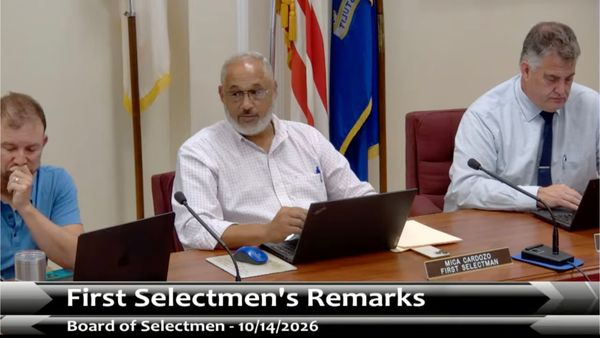
Later in the meeting, First Selectman Mica Cardozo indicated that he personally would be comfortable with local borrowing of up to approximately $60 million — about $4.5 million more than the $55.5 million currently projected, before interest. He emphasized that he was speaking only for himself, not for the Board of Selectmen or Board of Finance, and that the figure was not a binding limit.
Despite those qualifications, voter approval would authorize the full $118.5 million project even if state reimbursement fell short of projections. It was explained that the Board of Selectmen would retain authority over whether and how to proceed, including whether to borrow more than the $55.5 million currently projected. Spending beyond the authorized appropriation ($118.5 million), however, would require additional Town approval.
What would repairing Beecher actually cost?
Several residents questioned the Town's comparison between a new school and the estimated $30 million to $60 million required to repair and maintain the existing building over approximately 20 years. One resident asked what was included in the estimate, whether some work could be deferred and whether the figures accounted for state reimbursement.
Officials explained that $45 million represents the midpoint of a broad planning range, rather than a fully developed repair proposal. The estimate includes future building-system replacements, accessibility improvements, inflation and the additional costs associated with performing construction while the school remains occupied.
Importantly, consultants confirmed that the repair estimate does not deduct potential state reimbursement, although some of the work could qualify for grants. That makes a direct comparison between the gross repair estimate and the projected net local cost of new construction incomplete.
A resident also asked about Beecher's current annual maintenance expenditures and how they compare with the projected repair costs. Officials could not provide a specific figure during the meeting. A follow-up question concerned future maintenance expenses for the proposed school. Officials pointed to its smaller footprint and more efficient design but did not provide a detailed long-term operating-cost projection.
The questions highlighted a continuing distinction between maintaining the existing building, making targeted improvements and undertaking a comprehensive renovation to satisfy the educational specifications developed for the project.
Could a less expensive alternative meet the school's needs?
Residents also questioned whether the Town had sufficiently explored less expensive construction and renovation approaches. The consultants reviewed several alternatives, including comprehensive renovation, renovation with additions and new construction. They said the recommended new-building option performed best when evaluated against the educational specifications and projected costs.
Architect Lisa Yates acknowledged that one renovation-and-addition alternative, designated B1, would have cost less if evaluated as a conventional extension-and-alteration project rather than under the more demanding renovate-as-new standards. No revised estimate for that approach was presented.
Woodbridge architect and former Board of Education member David Barkin asked whether, if the referendum failed, the Town would consider a less expensive alternative that retained more of the existing school while addressing its educational and infrastructure needs.
Several Selectmen indicated that such an approach could be considered, while others emphasized that the building's existing problems would still need to be addressed. No commitment was made to explore a particular design, establish a cost target, or set a timetable if the referendum fails.
Other residents asked whether the proposed school's cost had been independently benchmarked against comparable facilities and whether a less expensive design could satisfy the same educational requirements. Yates emphasized that the estimates were professionally prepared but acknowledged that the proposed design remains conceptual, with additional design and bidding work to follow voter authorization.
The central question remained whether a more affordable alternative could address Beecher's educational and infrastructure needs without requiring replacement of most of the existing school.
Enrollment and preschool expansion
Enrollment projections also drew scrutiny. Officials said Beecher's current enrollment is approximately 850 students. The projections anticipate a peak of about 960 students in the regular school population, with expanded preschool capacity bringing the proposed facility's planning figure to approximately 1,036.
Residents questioned the assumptions behind the projected enrollment growth, citing declining birth rates and Beecher's relatively stable enrollment over recent decades. Officials emphasized that families moving into Woodbridge contribute significantly to enrollment, but did not explain why future in-migration would produce substantially higher enrollment than in the past, when in-migration was already a significant factor.
The proposed expansion of preschool facilities generated a separate set of questions. It includes the addition of six Pre-K classrooms, with capacity for 96 students. Under the project's planning assumptions, those 76 additional places account for approximately 42% of the projected increase in school enrollment from the level reported at the September Board of Selectmen meeting.
Residents asked whether the Town had documented demand for the proposed number of additional places and how the ongoing operating expenses would compare with the additional construction reimbursement available for preschool expansion. Officials did not identify a study demonstrating demand for the expanded program.
Asked whether the State would require universal preschool or expansion of existing programs, State Rep. Mary Welander said, “We're not mandating that,” explaining that the State instead seeks to expand access through voluntary programs.
This effectively leaves Woodbridge to decide for itself whether to expand its preschool program. The referendum will determine whether to build the expanded facilities, but the question of how to finance the additional operating costs — which are not covered by the State's construction reimbursement incentive — would be left to future operating budget deliberations.
In response to a follow-up question, officials acknowledged that no analysis had been conducted to determine whether the additional state construction reimbursement for preschool expansion would outweigh the program's increased operating costs over time.
Questions about retained facilities and central office
Questions also addressed the portions of Beecher that would remain after construction, including the pool, gymnasium and administrative space in the South Building. Officials said the project would secure and maintain the retained structure for possible future use, at a cost comparable to demolition. Its eventual disposition remains undecided.
Residents questioned why a new central office was necessary when existing administrative space would remain. The discussion did not establish why that space could not continue to serve its current purpose.
Other questions concerned reusing recently installed HVAC equipment and solar panels, accessibility upgrades to the existing building, and playground availability during construction. Consultants said relocating equipment would yield limited savings, while school officials described plans to use other playground areas.
Beecher in the context of Woodbridge's other capital needs
The financial discussion extended beyond Beecher to other major capital expenditures facing Woodbridge. Residents raised questions about a potential $20 million to $30 million police facilities project, repairs and improvements to other municipal buildings, and approximately $50 million in capital improvements under consideration by the Amity Regional School District, including roof replacements and HVAC upgrades.
Finance Director Tony Genovese presented projections illustrating how additional borrowing for these projects could increase the Town's annual debt service in the coming years, alongside the proposed Beecher borrowing. Officials emphasized that several projects remain in preliminary planning stages, with costs, schedules and financing yet to be finalized or approved.
Voters face a consequential decision October 13
The meeting reflected sharply different views of the proposed investment. Supporters emphasized the educational benefits of a modern school, the scope of planning behind the proposal and concerns that further delays could increase construction costs or put favorable state reimbursement provisions at risk.
Other residents questioned whether the $118.5 million project is affordable, whether more of the existing school could be preserved and improved, and whether less expensive alternatives had been sufficiently evaluated before bringing the proposal to voters.
The October 13 referendum asks voters to authorize $118.5 million for the Beecher Road School and Central Office project, including borrowing to finance costs not covered by state grants. Approval would allow the Town to proceed, but would not establish the final state reimbursement, the amount taxpayers ultimately would have to finance, or the future of the retained South Building.
Those uncertainties underscore the distinction at the heart of the referendum: Voters are being asked to authorize the full project now, while some of its ultimate costs and consequences will be determined later.
The Woodbridge Town Chronicle has examined these questions throughout the planning and referendum process and will continue reporting on the decisions and financial implications that follow.
Click below to watch WGATV's full recording of the October 6, 2026 Special Town Meeting.