Beecher consultants update project costs as local share ranges from $54.5 to $90 million depending on reimbursement assumptions
Residents rank taxes as their top concern as BRS Building Committee reviews survey results and expanded project scope

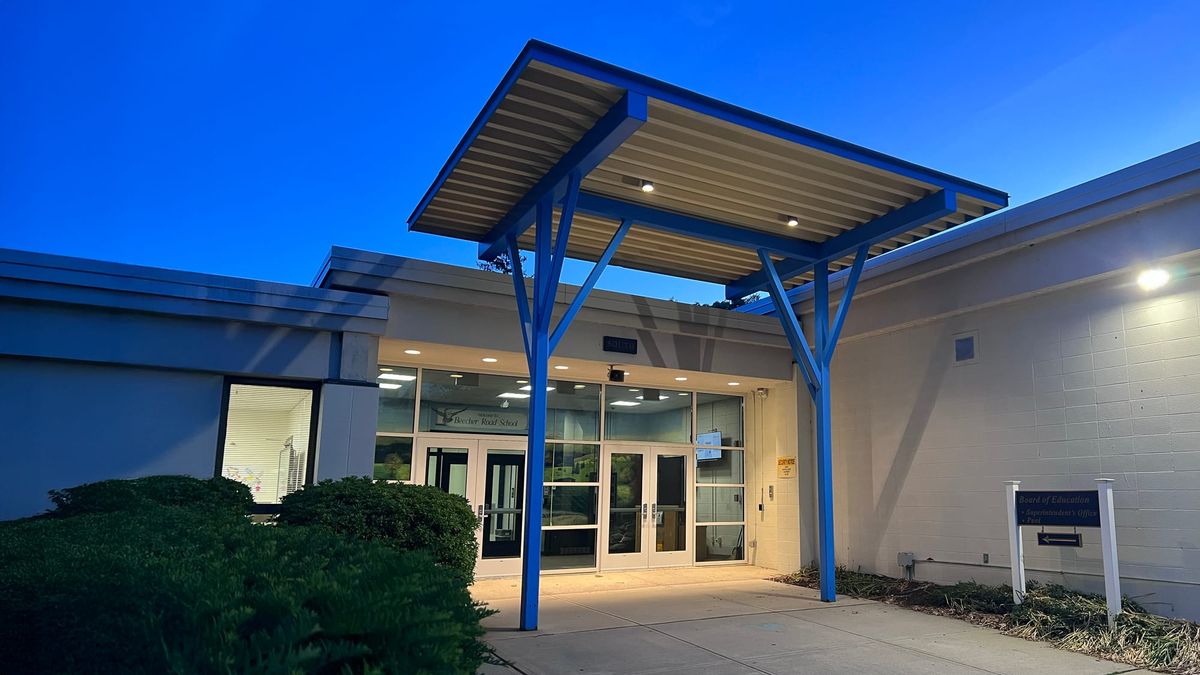
The Beecher Road School Building Committee received two major presentations at its June 16 meeting, beginning with the results of a community survey and followed by updated project cost estimates and state reimbursement projections from project consultants. Together, the presentations offered insight into both the questions residents are asking and the financial assumptions underlying the proposed school replacement project (see agenda).
Prior to the meeting, the committee also made Beecher Road School available for a public building tour. While attendance appeared light, the tour offered residents an opportunity to view existing conditions before hearing updated project estimates and reimbursement projections later that evening.
Survey highlights concern over costs and affordability
Survey respondents identified taxes, affordability, and project cost as their primary concerns regarding the proposed Beecher project, with nearly three-quarters (72.7%) ranking cost and tax implications among their top priorities. Improving classroom learning environments (62.4%) and strengthening safety and security (54.4%) followed.
The survey, presented by Tall Timbers consultant Ira Yellen, was described as drawing 250 responses through a combination of online and paper submissions. A majority of respondents (51%) reported living in Woodbridge for more than 20 years, while nearly half (49.4%) indicated they did not currently have a child attending Beecher Road School. The presentation also reported a 10.76% response rate among current Beecher families.
Town communications channels, particularly the Town Newsletter, were identified as both the primary source of project information and the preferred method for receiving future updates. The survey grouped information sources into institution-controlled channels — such as town and school newsletters, websites, meetings, and staff communications — and informal channels including social media and word of mouth. No category was provided for independent news coverage or local journalism.
Tall Timbers' summary of written comments identified recurring concerns regarding property taxes, project funding, affordability, debt management, transparency, and whether renovation alternatives had been fully explored, while also noting support for modernized facilities and long-term investment in the school.
The consultant's summary concluded that many responses reflected a desire to balance educational goals with fiscal responsibility and to receive clearer information about project plans and costs.
Consultants update project costs and reimbursement projections
Lisa Yates of Antinozzi & Associates presented updated design concepts, project cost estimates, and state reimbursement projections for the proposed Beecher Road School project. The presentation estimated the preferred D3 new-construction option, including expanded pre-kindergarten programming and central office space, at approximately $118.5 million up from the previous estimate of $108 million (see WTC article April 13, 2026). Consultants estimated the alternative A1 renovation option at approximately $122.9 million.
Using current assumptions, consultants projected approximately $63 million in state reimbursement and a local share of approximately $55.5 million. The presentation also highlighted recently enacted state legislation affecting the project, including an extended grant application deadline and reimbursement provisions specific to Beecher Road School (see WTC article May 4, 2026).
Reimbursement projections rely on multiple assumptions
The reimbursement projections presented to the committee rely on a series of assumptions, including qualification for multiple reimbursement incentives, expanded pre-kindergarten programming, implementation of recently enacted legislation, and the determination that new construction would cost less than a comprehensive renovation of the existing facility.
Consultants explained that these assumptions increase the reimbursement rate from a base level of 24 percent to more than 53 percent, producing the following range of potential local costs:
Scenario | Reimbursement Rate | Local Share |
Base rate | 24.0% | $90.0M |
New construction less costly than renovation | 32.14% | $80.4M |
Plus Pre-K incentive | 47.14% | $62.6M |
Plus special education adjustment | ~48% | $61.6M |
Plus housing incentive | ~53% | $55.7M |
Plus Open Choice estimate | ~54% | $54.5M |
Editor's note: The table's local share figures are based on consultant estimates presented June 16 and are intended to illustrate how different reimbursement assumptions affect the projected local cost.
The scenarios discussed by consultants imply a potential local share ranging from approximately $54.5 million to $90 million depending on which reimbursement incentives and assumptions ultimately apply.
Renovation comparison remains central
A key component of the reimbursement analysis is the determination that new construction would cost less than renovation. Consultants continue to conclude that constructing a new school would be less expensive than renovating the existing facility, estimating the renovation alternative at approximately $122.9 million compared with $118.5 million for new construction.
Because qualification for several reimbursement incentives depends on that conclusion, the assumptions underlying the renovation comparison remain central to the project's projected local cost. On a project of this size, each percentage point of reimbursement represents more than $1 million in potential state aid.
State funding context: How reimbursement rates vary from town to town
The reimbursement assumptions discussed by the Committee also come against the backdrop of Connecticut's 2026 school construction funding cycle. State lawmakers recently approved approximately $150.6 million in grant commitments for six projects on the state's 2026 priority list, representing more than $300 million in combined construction costs. The Town of Woodbridge received special legislation this year allowing Beecher Road School to submit a late application by October 1, 2026, effectively seeking entry into the same funding cycle. The six projects approved for funding this year provide a useful illustration of how dramatically state reimbursement rates can vary from one community to another (see Hartford Courant/CT Insider article June 19, 2026).
Milford's Jonathan Law High School renovation, for example, is expected to receive approximately $4.9 million toward a $12.6 million project, a reimbursement rate of about 39 percent. Seymour's new Bungay Elementary School is expected to receive approximately $38.7 million toward a $60 million project, a reimbursement rate of roughly 65 percent. At the other end of the spectrum is Westport's Long Lots Elementary School, a project involving demolition of the existing school and construction of a new elementary school on the same site. That project carries an estimated cost of $110 million and an estimated state grant of $12.2 million, a reimbursement rate of approximately 11 percent.
The differences largely reflect each community's wealth ranking under the state's Adjusted Equalized Net Grand List per Capita (AENGLC) system, a measure of municipal wealth used in determining school construction reimbursement rates. Woodbridge currently ranks 30th among Connecticut's 169 municipalities, compared with Westport (17), Milford (48), and Seymour (131).
As the Beecher project moves toward a potential October 1 state application, questions remain regarding what reimbursement rate should reasonably be assumed and how much additional reimbursement may ultimately be available through incentive programs. With consultants presenting reimbursement scenarios ranging from approximately 24 percent to 54 percent, future debt-service and tax-impact analyses may depend as much on reimbursement assumptions as on the project's final construction cost.
Communications and outreach
As the meeting concluded, the Committee discussed future outreach efforts, including development of a second project newsletter and expanded community engagement activities. Chair Marty Halprin also referenced a draft roles-and-responsibilities document. However, no copy of the document, draft newsletter, or other communications materials was presented for review during the meeting.
BRS Building Committee meetings are open to the public and recordings, when made, are available on the Town’s YouTube channel, WGATV79. Click below to watch the full recording of the June 16, 2026 meeting.