Board Watch: ZBA rules on two variance requests while BOF prepares for future borrowing and possible tax changes
Zoning Board of Appeals approves farm parcel, denies garage setback; Finance reviews debt policy as future borrowing looms

Board Watch is a recurring feature designed to provide a concise walk-through of activity as we keep track of the week's civic work. Longer-form articles will appear when issues warrant deeper coverage.
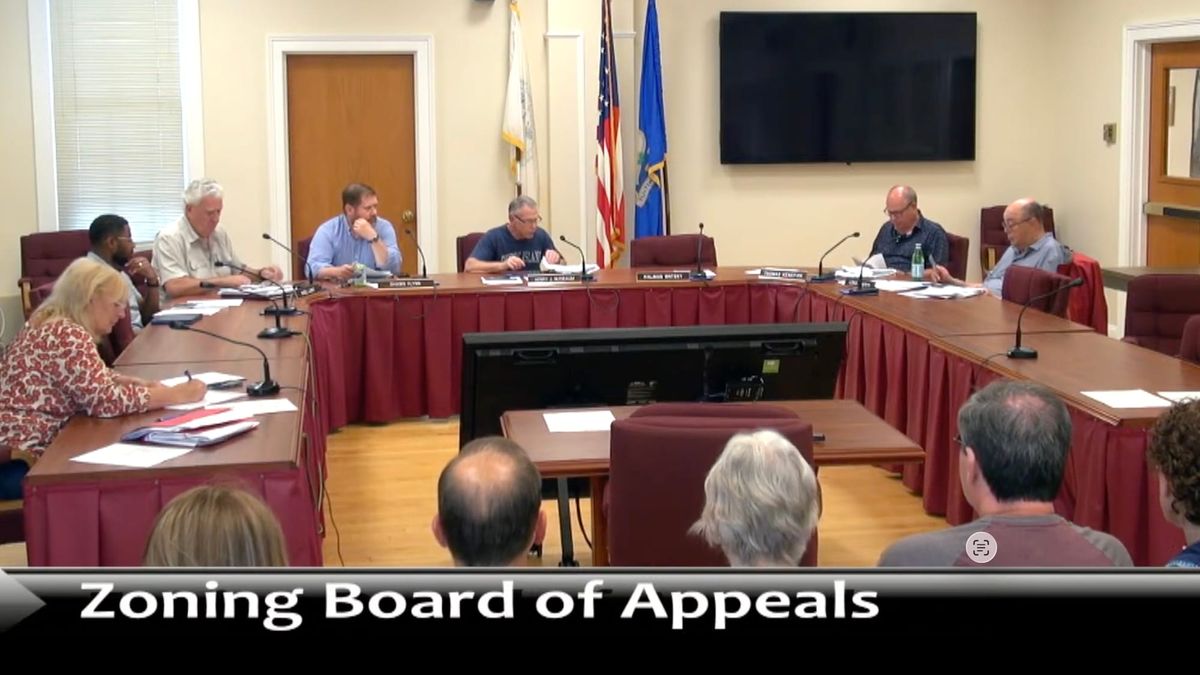
Zoning Board of Appeals — July 13, 2026
The Woodbridge Zoning Board of Appeals held two Public Hearings at its regular meeting (see agenda). Board members voted to approve a variance for the division of an historic Litchfield Turnpike property intended to preserve farmland. Later in the meeting they voted to deny a request involving a partially constructed detached garage on Newton Road.
Both applications sought relief from the town’s General Bulk Regulations. The first involved requirements governing buildable acreage and steep slopes, while the second requested a 41-foot variance from the required 75-foot front-yard setback for an accessory building.
Historic farm property divided
The board approved variances allowing Sarah Shepherd to divide the approximately 20.8-acre property at 1990 Litchfield Turnpike into two parcels.
Land surveyor Jesse Judson, representing Shepherd, said the property contains the remaining portion of the Shepherd Farm and a farmhouse that may be more than 200 years old. The proposed division would create a 12-acre parcel containing the farmhouse, which Shepherd would retain, and an approximately 8.8-acre parcel that would be sold to John Kirkham and preserved for agricultural use.
Judson said a longstanding fence line has separated the residential portion of the property from the farmland for decades. Although the proposed farmhouse parcel would contain approximately 12 acres, only about half an acre surrounding the house consists of land with slopes of less than 25 percent. Town regulations ordinarily require two acres of buildable land and a 150-foot lot square that excludes slopes greater than 25 percent.
According to the presentation, the property had previously consisted of separate parcels before they were merged during the settlement of a family estate in 2002. The proposed division would not precisely recreate the former lots but would provide the farmhouse with more land than it had previously. Judson said the variance would allow the property to be divided along the existing fence line while keeping the agricultural acreage intact rather than opening it to broader development.
The board approved the request after finding that the property’s longstanding configuration, topography and historic use supported the variance.
Newton Road setback request denied
The board denied a variance sought by Tiffany LaBella for a 30-by-50-foot accessory building under construction at 141 Newton Road. Town regulations require an accessory building to be set back 75 feet from the property’s legal frontage on Prospect Court. The building had been placed approximately 34 feet from that property line, requiring a 41-foot variance.
Attorney Brian McCann, representing LaBella, said the property functions as though its front yard and entrance are on Newton Road. He said the house faces Newton Road, its longstanding driveway connects to Newton Road and the area bordering Prospect Court had historically been treated as the backyard. LaBella said she mistakenly believed the setback applied from Newton Road. She said the building permit’s reference to the Prospect Court setback had been overlooked and that the placement was unintentional. She described the building as a garage and workshop that would provide vehicle storage, space for household projects and a loft area with a television.
The structure’s concrete foundation and steel frame had already been erected before town officials ordered work to stop. LaBella offered to install evergreen screening and a stone wall and said she would consider closing the construction driveway from Prospect Court.
Several Prospect Court residents opposed the variance. They questioned why construction had proceeded despite the permit’s express requirement that the building remain at least 75 feet from Prospect Court. Speakers also raised concerns about the building’s size, elevation, appearance, potential use and effect on the visual character of the cul-de-sac. Some residents suggested that the hardship was self-created because the structure had been erected without first confirming its location through a property survey. Others said the building appeared to be located in a front yard, where accessory buildings are generally prohibited.
During its deliberations, ZBA members focused primarily on whether the property presented a legally sufficient hardship and whether the requested variance minimized the degree of nonconformity. Members questioned whether a smaller building or another location on the property could reduce or eliminate the need for a variance.
The board voted not to grant the variance for the structure in its current size and location. Members noted that the owner could potentially submit a substantially different proposal.
Town staff later clarified that the board’s authority in the case was limited to the setback variance. The building’s size, design and proposed use had already been reviewed through other permitting processes and were not themselves before the board.
Click below to watch WGATV's full recording of the July 13, 2026 Zoning Board of Appeals meeting.
Board of Finance — July 16, 2026
The Board of Finance devoted much of its regular July meeting to an initial review of a proposed update to the Town's debt policy, a discussion Finance Director Anthony Genovese said was prompted by anticipated borrowing needs associated with future capital projects. The board also handled several routine matters, including preliminary year-end financial results, budget transfers, an audit update, recognition of the Town's Government Finance Officers Association award, and an introduction of newly appointed Administrative Officer Scott Roberts (see agenda).
Debt policy discussed
Genovese told board members he prepared the draft after reviewing debt policies from several other municipalities and consulting with the Town's financial advisor. He said the existing policy, last revised in 2016, provided a solid foundation but could benefit from modernization as the Town prepares for significant future borrowing.
The draft debt policy discussed at the meeting — obtained by the Woodbridge Town Chronicle and posted online for reference — retains many of the existing policy's core principles, including prohibitions on borrowing for operating expenses, use of the Six-Year Capital Improvement Program to identify projects suitable for financing, and a goal of repaying at least half of outstanding debt within ten years.
The draft also expands the policy by adding objectives related to maintaining the Town's credit rating and financial disclosure practices; more detailed descriptions of available financing tools; guidance on the use of variable-rate debt; a proposed target of keeping total debt service costs at or below eight percent of the operating budget; and a benchmark for refunding debt only when minimum savings thresholds are achieved.
Before discussing those substantive provisions, Board of Finance member Scott Prud'homme suggested that the document more clearly explain its purpose and the Board's role in the Town's debt approval process. He observed that several sections labeled as 'objectives' read more like guiding principles. Members also discussed adding introductory language clarifying that the Board of Finance develops recommendations and policies, while decisions to authorize borrowing remain subject to the Town Charter, including Town Meeting and referendum requirements where applicable. During the discussion, members agreed that references to borrowing authority should defer to the Town Charter to avoid conflicts with future charter amendments.
Board members then reviewed individual sections of the proposed policy. Discussion focused in part on a proposed provision stating that the Town would attempt to keep total debt-service costs at or below eight percent of the operating budget. Members discussed whether the benchmark should be increased above eight percent, framed as a planning target, or strengthened with additional guidance regarding how the Board should respond if the threshold were exceeded.
One financing mechanism appearing in the draft debt policy for the first time is Tax Increment Financing (TIF), a tool authorized under Connecticut law that municipalities can use to dedicate future increases in property tax revenue from designated redevelopment areas toward infrastructure improvements or other eligible project costs, rather than immediately directing those revenues to the general fund.
The Board of Finance did not discuss any potential TIF districts or projects in Woodbridge, and the draft policy does not identify where such a financing mechanism might be used. Its inclusion simply adds TIF to the list of financing tools available under the proposed update to policy.
No action was taken on the debt policy. Genovese emphasized that the document remained a working draft and encouraged board members to submit additional comments and suggested revisions. He said he would prepare a revised version incorporating the Board's feedback for further discussion and possible action at a future meeting.
Homestead Exemption timing discussed
The discussion of the proposed Homestead Exemption focused primarily on process because the requested tax modeling needed to evaluate specific exemption scenarios had not yet been completed. Genovese reported that Equality, the software company that provides the Town's assessment and tax systems, was preparing calculations showing how different exemption options would affect the mill rate and tax burden, but that the work had been delayed during the busy July tax billing season. As a result, the exemption subcommittee had been unable to meet before the Board's July meeting.
Board members discussed the timeline for developing their recommendation, noting that any proposal would first require review by the subcommittee and the full BOF before being forwarded to the Board of Selectmen. Should the Selectmen decide to proceed, it is anticipated that they would hold a public hearing before considering adoption of an enabling ordinance establishing the exemption.
Members indicated that additional subcommittee meetings — followed by a likely special August meeting of the Board of Finance — would be needed to advance the initiative. Before concluding the discussion, subcommittee members said they would aim to hold a working meeting on July 23 to review the data if it was available by that time. Genovese said he would distribute the modeling information to members as soon as it was received so the Board could begin its consideration of different exemption scenarios.
Click below to watch WGATV's full recording of the July 16, 2026 Board of Finance meeting.