Selectmen confront a growing list of Town infrastructure needs
Beecher referendum questions, Police Station renovation planning, failing plow-truck hydraulics, Town-wide roofs, and closed bridge among needs discussed

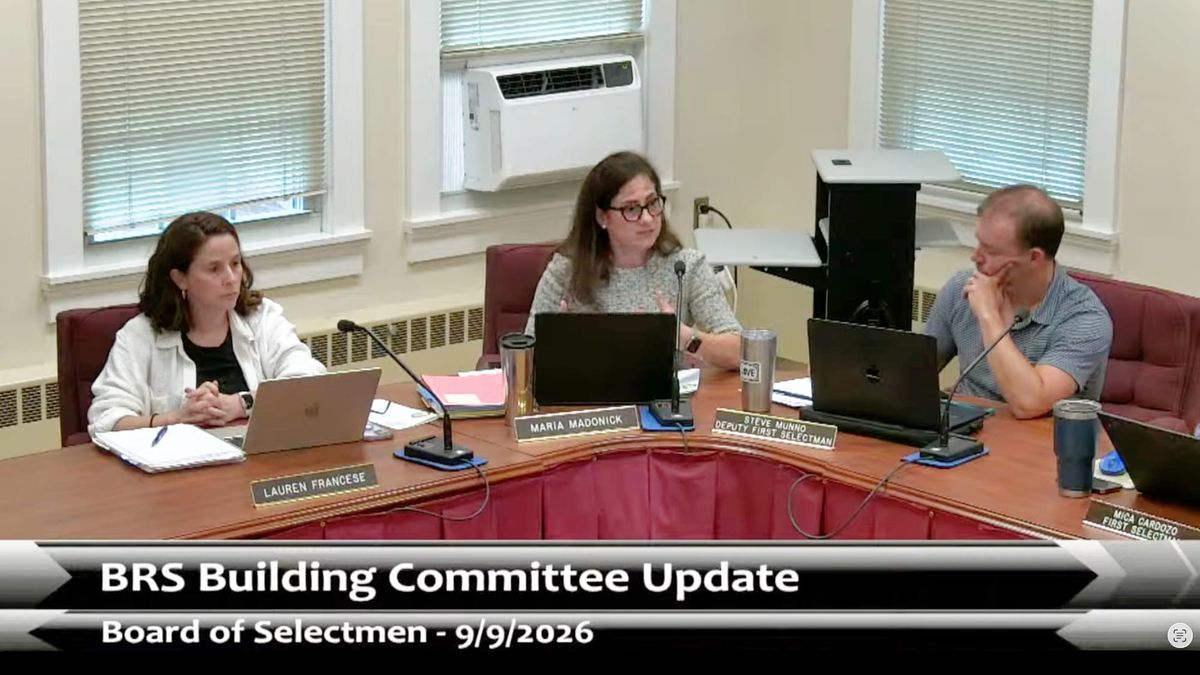
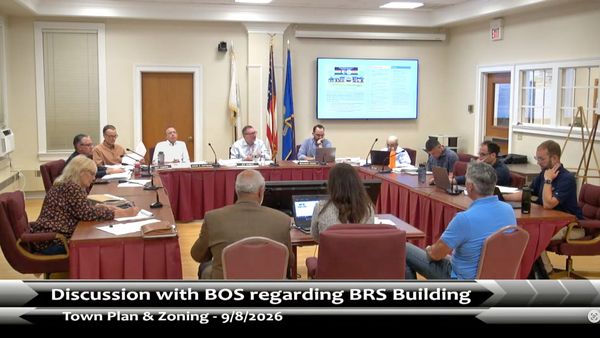
A four-and-a-half-hour Board of Selectmen meeting Sept. 9 offered a widening view of the capital and infrastructure demands facing Woodbridge as the Town moves toward an October referendum on the $118.5 million proposal to demolish and rebuild Beecher Road School.
The Selectmen revisited unresolved questions about the Beecher referendum and anticipated state reimbursement, heard an update on planning for a major Police Station renovation, authorized repairs to two aging plow trucks, moved ahead with architectural work for Town-wide roof projects, and discussed the closed Bethmour Road bridge, Transfer Station costs, Acorn Hill ball field lighting and next steps for the former Country Club of Woodbridge property (see agenda).
Some of those needs are long-range planning questions. Others are considerably more immediate. New Public Works Director Mike Siciliano, appearing before the Board less than a month after starting the job, described failed hydraulic systems on two plow trucks that need to be repaired before winter and also pointed to other needs he is finding as he reviews the Town fleet.
Beecher questions continue as referendum approaches
First Selectman Mica Cardozo opened the meeting by noting that the Board of Finance is scheduled to meet Sept. 17 and will review the Beecher Road School funding request. The Selectmen have also scheduled a Sept. 23 special meeting, a key date as the Town moves toward a proposed Oct. 6 Special Town Meeting and Oct. 13 referendum.
Superintendent Christopher Montini reported that Beecher Road School opened the school year with 853 students, five fewer than projected and three fewer than the 856 students enrolled at the start of last year. Last school year ended with 875 students after a net increase of 19 students during the year.
He noted the WBOE added an unbudgeted first-grade teacher shortly before school opened as first-grade enrollment approached, but had not exceeded, the upper end of Beecher's class-size guidelines, which suggest between 17 and 19 students for first grade. Montini said savings elsewhere in staffing, including from newly hired teachers and use of an existing staff member for an additional half-day Pre-K class, effectively offset the cost.
But the longer Beecher discussion centered on the proposed construction referendum and exactly what voters will be asked to authorize as the Selectmen turned to their next agenda item for a building committee update.
Selectman Amey Marrella said she was hearing a “disconnect” between the Board’s Aug. 26 discussion, subsequent public statements, and information presented at a Beecher forum at the Senior Center earlier that day. The referendum question, she noted, is expected to seek authority for the full $118.5 million project cost even though the Town anticipates substantial state reimbursement.
Marrella pressed for bond counsel to appear before the Board to explain how the legal referendum question, accompanying explanatory text and the concept of “permissive authority” fit together. “Right now I’m hearing different things on different occasions” she said, adding that she wanted the legal questions answered by bond counsel directly before the Board acts.
Selectman Maria Madonick, the Board’s liaison to the Beecher Road School Building Committee, said the referendum question must state the full $118.5 million project amount. She said explanatory material accompanying the referendum can state conditions under which the Town would proceed and indicated the Town will therefore be able to assure voters that it would not move forward without the anticipated school-construction grant funding.
Questions also surfaced about how reimbursement is ultimately calculated, including questions raised by Marrella about previous state grants and whether a newly enacted maximum reimbursable cost per square foot could negatively affect the final grant.
Marrella noted that the Board had previously sought written confirmation about whether a provision included in Public Act 26-68, which makes Beecher’s recently replaced roofs eligible for reimbursement despite being less than 20 years old, would also resolve potential repayment obligations associated with other previously state-funded improvements (see WTC article 5/4/2026). She also raised a separate question: even if the roof work can be included in the new reimbursable project, could the Town still be required to repay a prorated portion of earlier state grants for other improvements demolished before the end of their expected useful life?
Cardozo said Town officials understood the special legislation to waive the previous-grant penalty and said there had been no indication that Woodbridge would owe the state anything additional. “There’s been no indication. There’s been nothing that’s even arisen at all as relates to paying anything additional … back to the state,” he said.
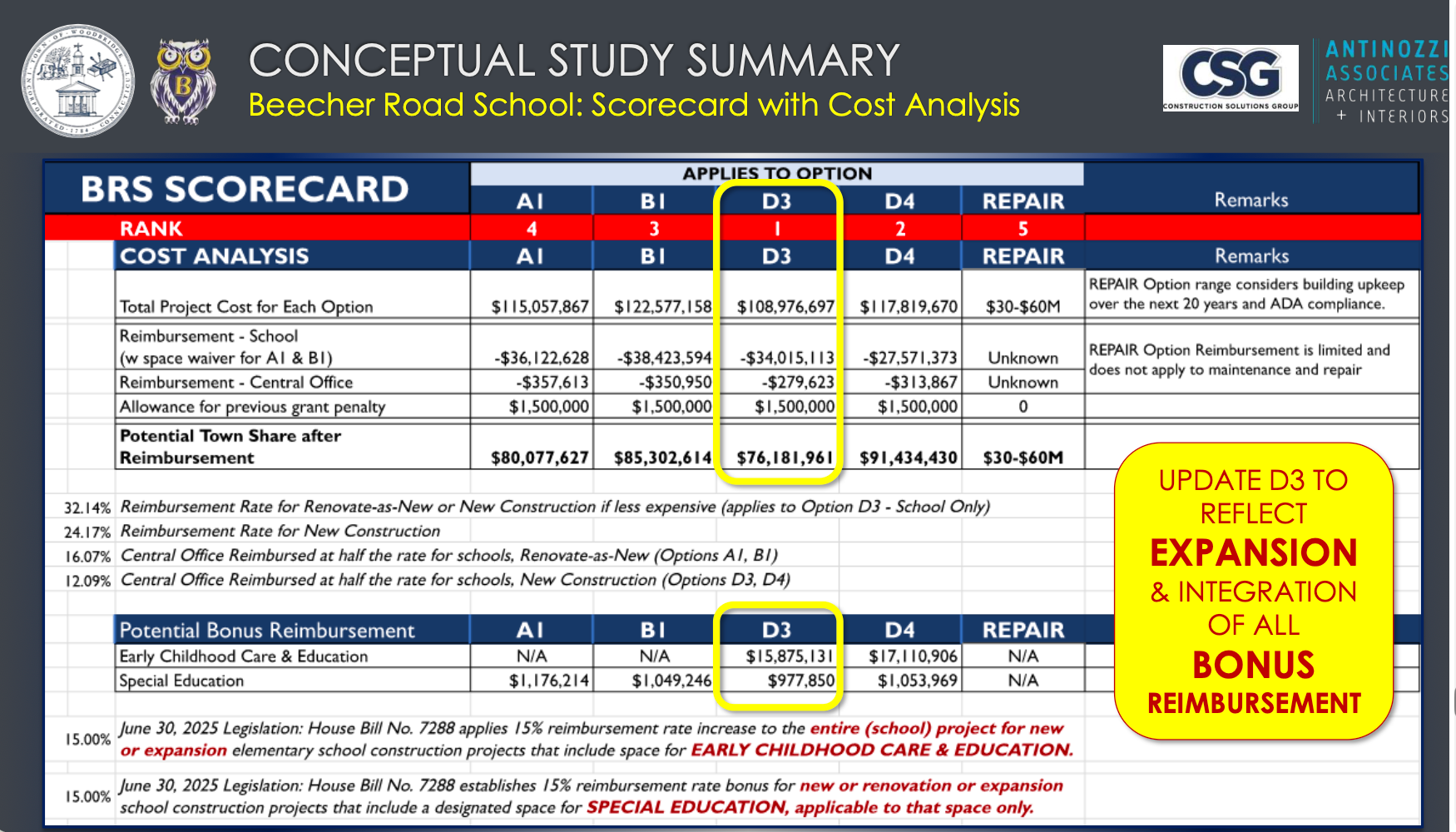
The possibility of a previous-grant penalty, however, had appeared earlier in the project review (see WTC article 3/2/2026). A Feb. 26 presentation by the project architects included a $1.5 million “allowance for previous grant penalty” in its comparative cost analysis for each construction option, but not the repair option. The presentation does not appear among the materials currently posted on either the Beecher project website or the Town website, but a copy previously obtained by WTC is available online and excerpted below.
The exchange left several legal and financial questions to be resolved as the Sept. 17 Board of Finance meeting and Sept. 23 Selectmen meeting approach. Marrella said the lack of clarity illustrated why the Board of Finance, Finance Director Anthony Genovese and the project’s contracted professionals need to discuss the questions directly, rather than relying on information passed through intermediaries.
First Public Comment opportunity since July 8 meeting
Residents spoke for about an hour during the Board’s first Public Comment period in two months, raising issues that included Beecher Road School and the upcoming referendum, Town finances and debt, Acorn Hill field lighting and a new environmental concern discovered by neighbors at that location, the Bethmour Road bridge closure, and the taxpayer cost of operating and maintaining Town facilities, including the new Community and Cultural Center.
Police renovation: “Something has to be done”
The Board then received its first substantial update from the Police Department Building Renovation Project committee. Police Commissioner and committee chairman Kris Wuestefeld said the Police Department has occupied its current building — the former Center School — since shortly after school operations there closed in the 1970s. He said the building now has numerous deficiencies and noted that the Police Commission considered whether to pursue a new building but concluded that a new facility could be beyond the Town’s financial reach. For this reason, they instead chose to pursue renovating the existing structure.
The committee worked with Town officials to solicit architectural firms to help determine what can realistically be accomplished within the existing building. Six firms responded; the committee narrowed the field, conducted interviews and selected a recommended firm. Wuestefeld said Jacunski Humes Architects has been retained and has begun to provide the necessary preliminary work, and the committee is scheduled to present at the Selectmen's Oct. 14 meeting. “The important thing is something has to be done,” he told the Selectmen.
Wuestefeld introduced Police Chief Ronald Smith who described the facility deficiencies and the needs, encouraging the Selectmen to tour the Police Department to see the existing conditions firsthand.
The project is particularly significant in the broader Town capital picture because the cost and scope have not yet been established. The architectural work is intended to help determine what renovation is feasible before the Town moves further into design and financing.
New Public Works director finds urgent plow-truck repairs
A more immediate infrastructure problem was described by Siciliano, who was appointed Public Works Director this summer and began work in August.
Siciliano told the Board that the hydraulic systems have failed on two Town plow trucks, approximately 10 and 11 years old. He said the trucks themselves remain in good condition, but the existing hydraulic systems are difficult to service and replacement parts are hard to obtain. The hydraulics operate not only the plows but the truck bodies, sanders and spreader controls — making the trucks unusable for normal winter operations without the repair.
Siciliano estimated the replacement hydraulic systems at about $27,000 per truck, including installation, and said the new systems should outlast the trucks themselves. The Selectmen unanimously authorized purchase of the components needed to repair the two trucks using a state contract.
The discussion quickly broadened beyond those two vehicles. Asked whether he had begun assessing the Town fleet, Siciliano said he had and pointed to another relatively new truck that has been sitting without a plow installed. Fitting that truck for service represents another substantial expense. Siciliano is preparing additional information on the Town’s fleet as he continues his review.
The exchange added a practical example to the Town’s larger capital discussion: while Woodbridge weighs major building projects extending decades into the future, maintaining basic municipal services also requires continued investment in the vehicles and equipment already owned by the Town.
Town-wide roofs and Community Cultural Center repairs
The Selectmen also moved forward with architectural work for a Town-wide roofing project. The Board approved two funding transfers — $30,000 and $36,550 — for architectural services and unanimously awarded the work to Fryer Architecture of Farmington, the firm recommended by the staff and volunteers assigned to the project planning team.
The roof work is another component of the Town’s developing facilities picture, which officials have acknowledged extends beyond the projects currently included in long-term debt projections.
The Board also approved funding for repair work at the not-yet-opened Community and Cultural Center. Two related transfers for $17,725 and $11,500 were authorized to cover cost of work at the building involving replacement of an exit door, plumbing and electrical repairs. The Selectmen anticipate a presentation at their October meeting to further discuss programming, a vendor contract, and operating budget needs.
Bethmour Road bridge remains closed
The closed Bethmour Road bridge — shared by Woodbridge and Bethany as it spans the Bladens river that marks the town's northern border — is another infrastructure issue now moving into design and grant planning. The bridge was damaged during recent heavy rainfall and associated flooding earlier this summer.
Cardozo said the two municipalities are reviewing engineering proposals together and will need to agree on the same design consultant. The selected engineer would help with design, permitting and preparation of a grant application. Officials said the State’s LOTCIP program could potentially fund construction, but not the design work, leaving the municipalities responsible for those upfront costs.
The closure has had a particularly significant effect on Bethany residents and school buses because the road is an important east-west connection. In Woodbridge, diverted traffic has increased pressure on other roads. The Town has asked the state Department of Transportation to resynchronize the traffic signal in that area because of increased traffic and rush-hour backups. A temporary bridge span is also under consideration, although Cardozo indicated that any proposal would return to the Board and public before a decision is made.
Acorn Hill ball field lighting heads toward broader review
The long-running question of whether lights should be installed at the Acorn Hill ballfields returned both during public comment and later as a formal agenda item. Residents opposed to the lights again urged the Town to honor a 1995 understanding concerning use of the site and to preserve the area’s dark-sky and neighborhood character. Supporters have argued that lighting would expand playing time for youth sports.
The Selectmen appeared to agree that the issue should move into a more formal process, including consideration by the Town’s ordinance process, but several members also called for a broader examination of athletic-field needs rather than deciding the question solely around the Acorn Hill facility.
That could include looking at field availability in both Woodbridge and Bethany, determining who would use lighted fields, whether other locations could serve more sports and residents, and whether Woodbridge should add lighted athletic fields at all. The discussion did not produce a final decision on the Acorn Hill proposal and instead the Selectmen agreed to schedule the topic for a future meeting to be determined.
Transfer Station costs and hours under review
The Board also continued its review of Transfer Station operations, including user fees and operating hours. Staff members are comparing Woodbridge fees with those charged by other municipalities, particularly neighboring towns.
The discussion included the possibility of increasing tipping or other fees, but Selectmen also considered whether operating savings could be achieved by extending the seasonal Wednesday closure during months when Public Works employees are needed for other work.
The summer schedule was described as a useful test. No final fee or schedule changes were adopted, with additional information expected to return to the Board.
CCW master plan implementation discussed
The former Country Club of Woodbridge property also returned to the agenda as the Board discussed a revised Request for Expressions of Interest (RFEOI) intended to identify potential partners for portions of the property.
The draft seeks interest in possible residential development while requiring that proposed housing include a deed-restricted affordable component. Board members discussed how much specificity to include at this early stage and agreed not to prescribe a fixed affordability percentage in the request.
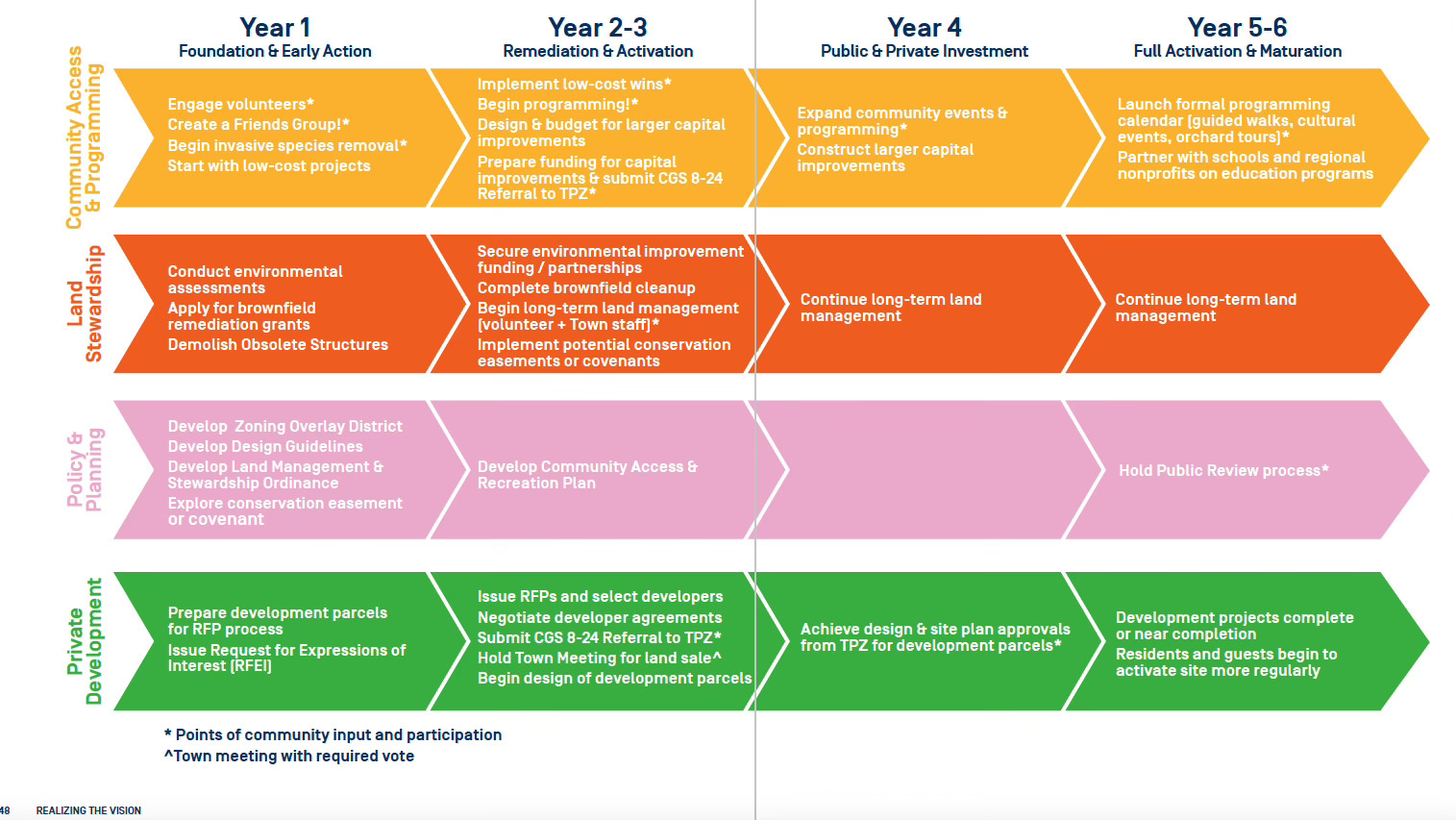
The Selectmen noted the multi-year Implementation Roadmap (see graphic, above) from the CCW Master Plan document and Urbano again raised the need to advance conservation goals at the same time as development opportunities are explored, including natural-resource management, invasive-species control and possible conservation easements.
Cardozo said those efforts can proceed in parallel and reported that the Town has also received a recommendation for a licensed environmental professional to conduct Phase II environmental assessment work using grant funding. The assessment would help identify environmental conditions and potential remediation needs, including around areas of the former clubhouse and maintenance facilities.
Cardozo concluded discussion by noting that the revised RFEOI document would also be sent to the Town Planner for input before moving forward.
Building committees get two additional ex officio members
Near the end of the meeting, the Selectmen unanimously voted to add the Town’s administrative officer, Scott Roberts, and building maintenance foreman, Brad Parsons, as ex officio members of existing building committees created by the Board of Selectmen — with an explicit exception for the maintenance foreman role on building committees covering Beecher Road School. They noted that the Woodbridge School District's own staff for the facility management, Vito Esparo, will continue to fulfill the Beecher committee role.
The change is intended to bring additional Town administrative and facilities knowledge directly into building-committee work.
After unanimous approval of the previous meeting minutes, the Board adjourned its meeting shortly after 9:30 p.m., noting preparations expected prior to its Special Meeting scheduled for Sept. 23. That meeting is expected to include action as appropriate to set dates for a Special Town Meeting and referendum vote on the Beecher Road School $118.5 million proposal. It is not yet known if public comment will also be included on the Sept. 23 agenda.
Board of Selectmen meetings are open to the public and usually streamed live on the town's YouTube channel, WGATV79. Click below to watch the full recording of the Sept 9, 2026 meeting.