Board Watch: Housing proposals, charter changes and conservation priorities occupy three commissions
Proposed zoning changes to allow shared residential housing considered, charter revision details emerge, and expert presentations address light pollution and invasive plant management

Board Watch is a recurring feature designed to provide a concise walk-through of activity as we keep track of the week's civic work. Longer-form articles will appear when issues warrant deeper coverage.
Town Plan and Zoning considered a proposal to convert a vacant office building into shared housing, the Charter Revision Commission examined residents’ petition rights and longer agricultural leases, and the Conservation Commission celebrated a $150,000 forestry grant. Here are highlights from three municipal meetings held November 2–5, presented in chronological order.
Town Plan and Zoning Commission — November 2, 2026
At the regular November TPZ meeting (see agenda), commissioners heard a proposal from property owner Winter Cartwright to permit shared community residential housing in Development District 2. Cartwright hopes to convert the existing building at 100 Bradley Road into approximately 12 to 15 private bedrooms with shared kitchens and bathrooms. She described independent, affordable accommodations that could serve people seeking transitional, recovery, veterans or other supportive housing, rather than a treatment facility.
Commissioners questioned how the proposed use would be regulated throughout the district, including occupancy, safety and parking. Chairman Jeff Kennedy asked town staff to develop standards and obtain legal review. The commission did not approve the zoning change at this meeting.
The commission also reviewed proposed zoning amendments intended to bring Woodbridge into compliance with state requirements for family and group childcare homes. Under Connecticut law, qualifying licensed childcare operations must be permitted in residential settings without additional zoning restrictions that would otherwise prevent their operation. Town Planner Mike D’Matto explained that Woodbridge had previously committed to updating its regulations by the end of 2026.
During discussion, commissioners questioned inconsistencies between the terminology used in the proposed amendments and state law, particularly references to “daycare homes” rather than “child care homes.” They agreed that the definitions should match state licensing categories to avoid confusion and voted to reopen the public hearing and postpone action until its December 7 meeting to allow the language to be corrected.
Separately, the commission received an application from Deanna Birdsong for a special exception permit to install a freestanding sign at 264 Amity Road. A public hearing was scheduled for December 7.
During a work-session discussion, commissioners reviewed the town’s request for expressions of interest concerning possible development on portions of the former Country Club of Woodbridge (see WTC article 11/2/2026). Kennedy described site visits by prospective respondents and emphasized that the solicitation is exploratory, not an approved development proposal. Responses are due December 4.
The commission also discussed forthcoming state housing-growth planning requirements and regional coordination, noting that the South Central Regional Council of Governments (SCRCOG) is planning a January 7 public forum in Woodbridge. The forum, described as the first in a three-part series, will address housing issues broadly, including affordable housing, accessory dwelling units, multifamily housing and the state's new housing-growth planning requirements. No event details are available on the Town website at publication time.
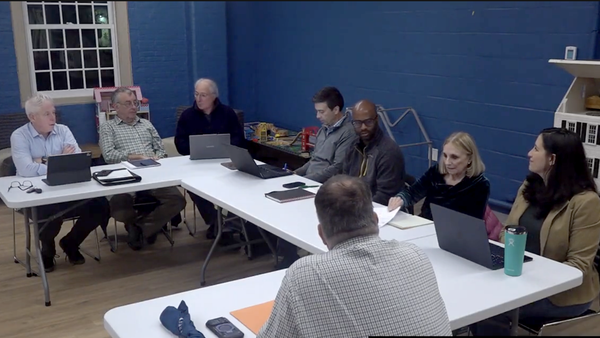
Click below to watch the full recording of the TPZ's November 2, 2026 meeting.
Charter Revision Commission —November 4, 2026
The Charter Revision Commission opened its November meeting (see agenda) with public comments on several proposed changes to the town charter. Residents advocated strengthening petition rights for special town meetings, requiring voter approval of the annual town budget and potentially municipal borrowing. Speakers also urged commissioners to revisit the full range of recommendations presented at the commission’s March public hearing, including proposals to expand the Board of Selectmen’s role in appointing town officials.
A report from representatives of the Agriculture Commission urged the Commission to address the town charter’s treatment of leases on municipal land. Chairman Chris Sorensen and Vice Chair Krystina Holland said one-year agricultural leases can prevent farmers from qualifying for grants and discourage investment in improvements. Commissioners discussed an approach that would allow five-year agricultural leases without automatically treating them as property sales requiring Town Meeting approval. They expressed general support for addressing the problem, but did not settle final language, instead asking Town Attorney Nick Bamonte to prepare draft language for consideration at a future meeting.
The commission also examined whether to clarify the charter provision governing residents’ petitions for special town meetings. After discussing the interaction between charter language, state law and the authority of municipal bodies, commissioners voted unanimously to retain the existing provision without amendment, concluding that its language was adequate and consistent with state law.
Members also discussed increasing the monetary threshold for town real estate transactions requiring Town Meeting approval. They voted to recommend updating Section 4-8, replacing the existing $50,000 threshold with $90,000 while retaining the provision based on 0.15% of the annual municipal budget, whichever is greater. Commissioners also identified related thresholds governing supplemental appropriations in Section 6-3 and agreed to consult Finance Director Tony Genovese before deciding whether to recommend corresponding changes to those provisions.
Finally, the commission revisited its previous 4–3 vote to recommend requiring a referendum on the annual town budget, focusing on how the process would work if voters rejected the proposed budget. Bamonte reviewed questions surrounding subsequent votes, the preparation of a revised budget and the respective responsibilities of the Board of Finance and Board of Selectmen. He described Wilton’s system, under which a budget is rejected only if at least 15% of voters participate and a majority votes against it. In that case, the Board of Finance must reconsider the budget, consulting with town and school officials, and present a revised proposal at another Town Meeting within 25 days. Wilton’s process allows no more than two votes and must conclude before July 1.
Commissioners asked Bamonte to provide Wilton’s procedures in writing for further consideration and requested examples of procedures used in other Connecticut towns before determining what additional charter language might be necessary. The commission’s next meeting is scheduled for December 2.
Click below to watch the full recording of the Charter Revision Commisson's November 4, 2026 meeting.
Conservation Commission — November 5, 2026
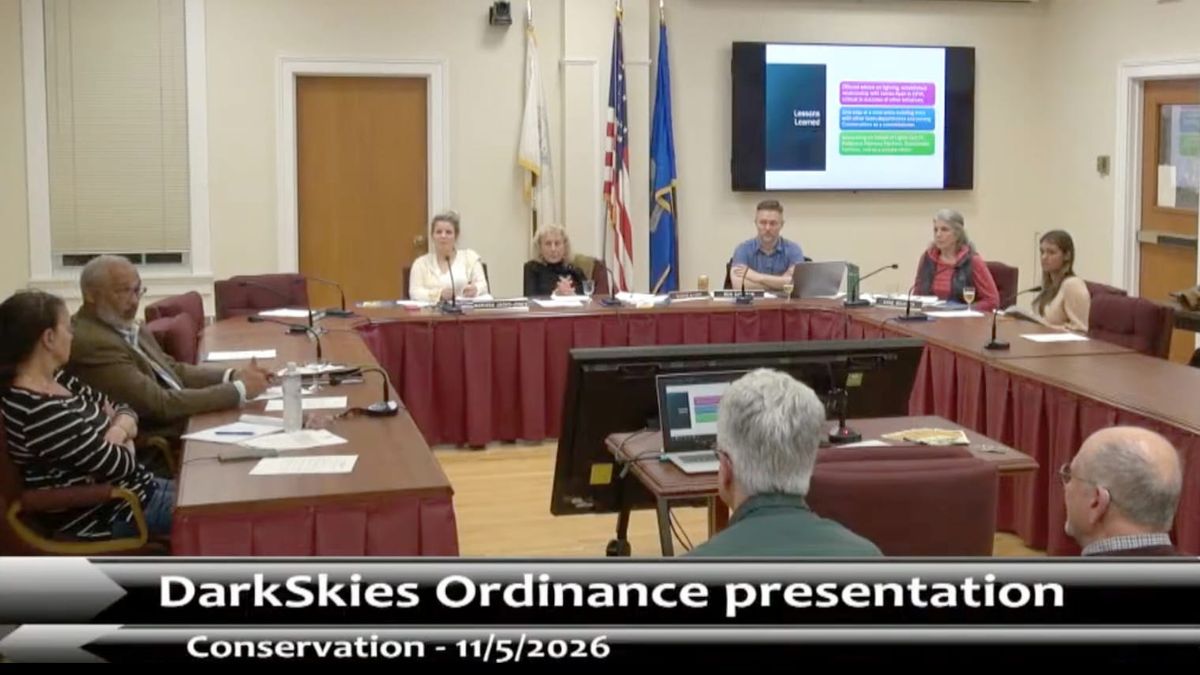
The Conservation Commission's meeting (see agenda) featured a series of presentations on environmental issues, including light pollution, invasive plant management and forest conservation. First Selectman Mica Cardoza attended and participated in discussions about the town's conservation priorities.
During public comment, Acorn Hill Road residents Anoka Faruqee and David Driscoll described their efforts to investigate contamination in neighborhood private wells. Their findings and concerns are detailed in an open letter calling for action to protect safe drinking water. Faruqee said testing found multiple PFAS compounds, some above drinking-water limits, and reported other contaminants in nearby wells. The residents urged attention to possible sources, including sites beyond the immediate neighborhood, and offered to share their research with town officials. Their comments did not establish the source of contamination.
Turning to the agenda, commissioners began by celebrating the award of a $150,000 forest resiliency grant from the Connecticut Department of Energy and Environmental Protection (DEEP). Members credited a team effort led by Ben Carlson, with significant contributions from fellow commissioners and forester Eric Hansen. Commissioners also emphasized the importance of explaining the project and its environmental benefits to residents as implementation proceeds.
Representatives of Lights Out Connecticut presented information about the ecological effects of artificial nighttime lighting, particularly on birds and pollinators, and described approaches such as shielding fixtures, using warmer lighting and turning off unnecessary lights. They also shared a model outdoor lighting ordinance that municipalities can adopt or adapt, citing Simsbury’s dark-sky lighting regulations as an example. The presenters suggested that Woodbridge could strengthen its existing regulations by establishing more specific standards for light intensity and color temperature.
During the discussion that followed, Cardoza mentioned the Town's ongoing business district improvements, where lighting decisions are being made as part of a state-funded project. He expressed interest in working with commissioners and the presenters to explore options that would meet project requirements while reducing unnecessary lighting.
A separate presentation by representatives of the Guilford Land Conservation Trust examined the threat invasive plants pose to native ecosystems and described Guilford's approach to identifying, mapping and managing invasive species with volunteer assistance. Commissioners also heard a report from a recent Connecticut Invasive Plant Working Group conference. Discussion turned to how Woodbridge might develop similar efforts, including coordination with Public Works and local conservation organizations.
The commission also discussed open-space information, its website and future work priorities. Members reported no substantive update on a possible conservation easement at the former Country Club of Woodbridge.
Click below to watch the full recording of the Conservation Commission's November 5, 2026 meeting.