Beecher Road School survey: What do Yes and No voters agree on?
Chronicle reader survey results identify shared reporting priorities on building conditions, costs and oversight, despite sharp differences over the rejected construction proposal


Following Woodbridge voters' rejection of a $118.5 million proposal to replace Beecher Road School by more than a 2-to-1 margin in October, the Woodbridge Town Chronicle invited residents to share their views on what should happen next.
The reader survey, conducted November 2–15, drew 161 responses. Participants were asked how they voted in the October 13 referendum, their opinions about the defeated proposal, and which issues they believe deserve the most attention as school and town officials reconsider the future of the building.
The results reveal a distinction between what respondents believe should happen to the school and what they want to know about its condition, costs and future.
Although those who supported the construction proposal and those who opposed it remain sharply divided over whether a new school is necessary, both groups identified the condition of the existing building, needed repairs and its remaining useful life as their leading reporting priority.
Questions about future construction costs, financing, the accuracy of information presented to voters, and oversight of the building planning process also ranked prominently.
Understanding the survey and its limitations
Of the 161 respondents, 100 reported voting No in the referendum and 44 reported voting Yes. Eleven preferred not to disclose their vote, two said they did not vote, and four did not record a voting choice.
Among the 144 respondents who reported voting Yes or No, 30.6% supported the proposal and 69.4% opposed it. That closely resembles the actual referendum result of 33.2% Yes and 66.8% No, a difference of 2.6 percentage points. The similarity is noteworthy, but it does not mean the survey is representative of Woodbridge voters.
Unlike professionally sampled and weighted surveys, including many election exit polls, the Chronicle's survey was voluntary, with participants choosing whether to respond. This creates the possibility of selection bias, particularly among residents with strong opinions about the school project. Because it was not a probability-based survey, a reliable statistical margin of error cannot be calculated.
To broaden participation beyond its regular readership, the Chronicle also distributed survey invitations to an email list obtained from the Town through a Freedom of Information request. That outreach generated at least 164 reported clicks on the survey link, although the survey did not track which participants arrived through those emails.
The analysis that follows compares respondents according to their reported referendum votes, using a technique known as cross-tabulation to identify where the two groups' views overlap and where they differ.
What residents want investigated
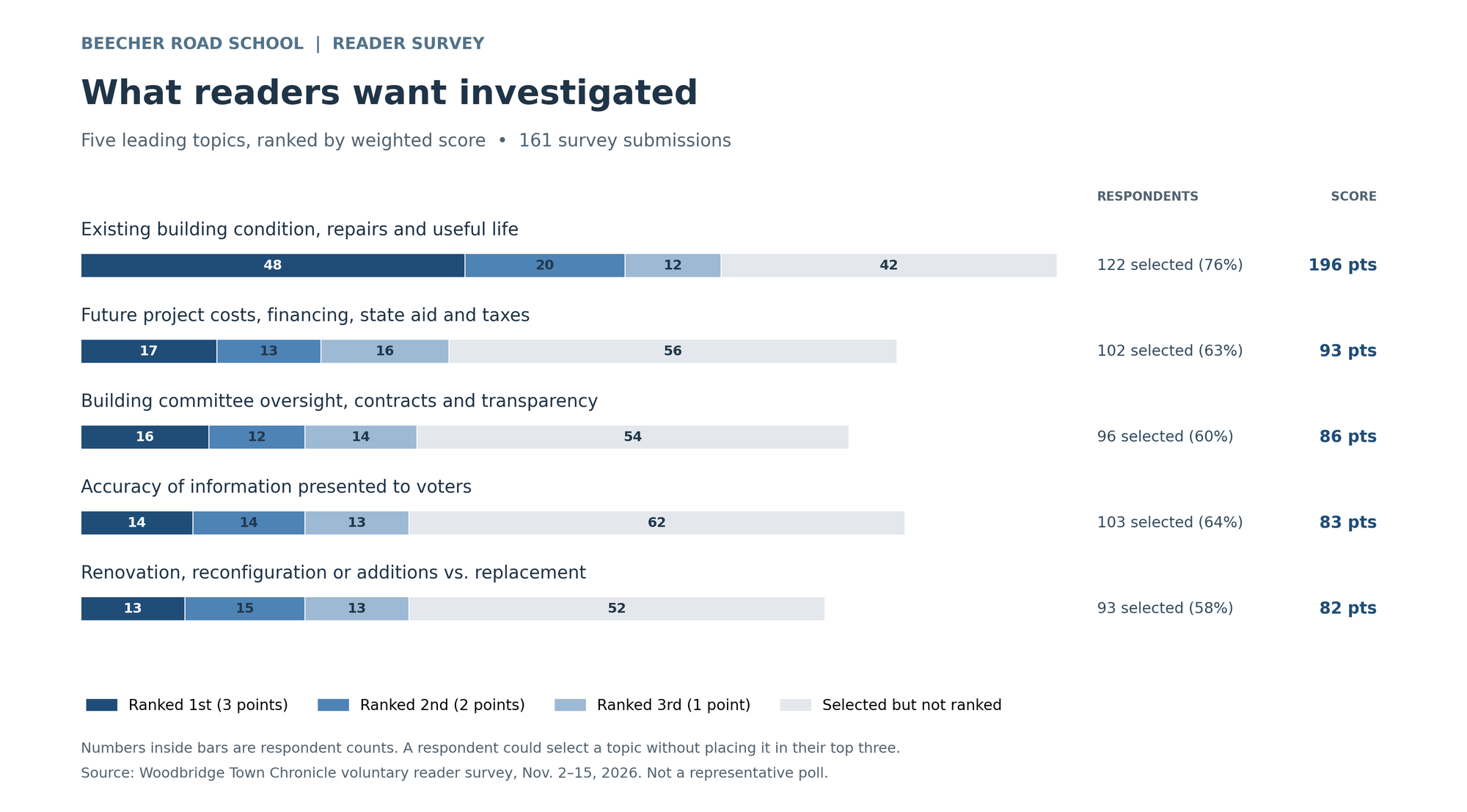
The survey asked respondents to select the topics they considered most important for future Chronicle reporting, then rank up to three of their selections in order of priority.
First-place rankings received three points, second-place rankings two points and third-place rankings one point. The resulting weighted scores reflect the number of times each topic was ranked among respondents' top three priorities and the importance assigned to those rankings.
The condition of the existing school, including needed repairs and remaining useful life, was the clear leader. It received 196 weighted points, more than twice the score of the next-highest topic, and was selected by 122 respondents.
Future project costs, financing, state aid and property-tax impacts ranked second with 93 points, followed by building committee oversight, consultant contracts, decision-making authority and transparency with 86 points.
The accuracy of information presented to voters ranked fourth with 83 points, followed closely by renovation, reconfiguration or additions compared with complete replacement, at 82 points.
Other frequently selected subjects included enrollment projections and school capacity, maintenance and deferred work, and opportunities to make better use of existing classrooms and other spaces.
Taken together, the rankings suggest that respondents want more detailed information about the existing building and a clearer accounting of the costs, assumptions and decisions that could shape its future.
Where Yes and No respondents share priorities
The comparison between respondents who reported voting Yes and No reveals an important area of common interest.
Among Yes respondents, 66% selected the condition of the existing building, needed repairs and remaining useful life as a reporting priority. Among No respondents, the figure was 81%. It was the highest-ranked topic within both groups.
Future project costs, financing, state aid and property-tax impacts were selected by 50% of Yes respondents and 69% of No respondents.
Building committee oversight, consultant contracts, decision-making authority and transparency were selected by 43% of Yes respondents and 68% of No respondents.
The accuracy of information presented to voters was selected by 43% of Yes respondents and 73% of No respondents, while renovation, reconfiguration or additions compared with complete replacement drew interest from 41% of Yes respondents and 66% of No respondents.
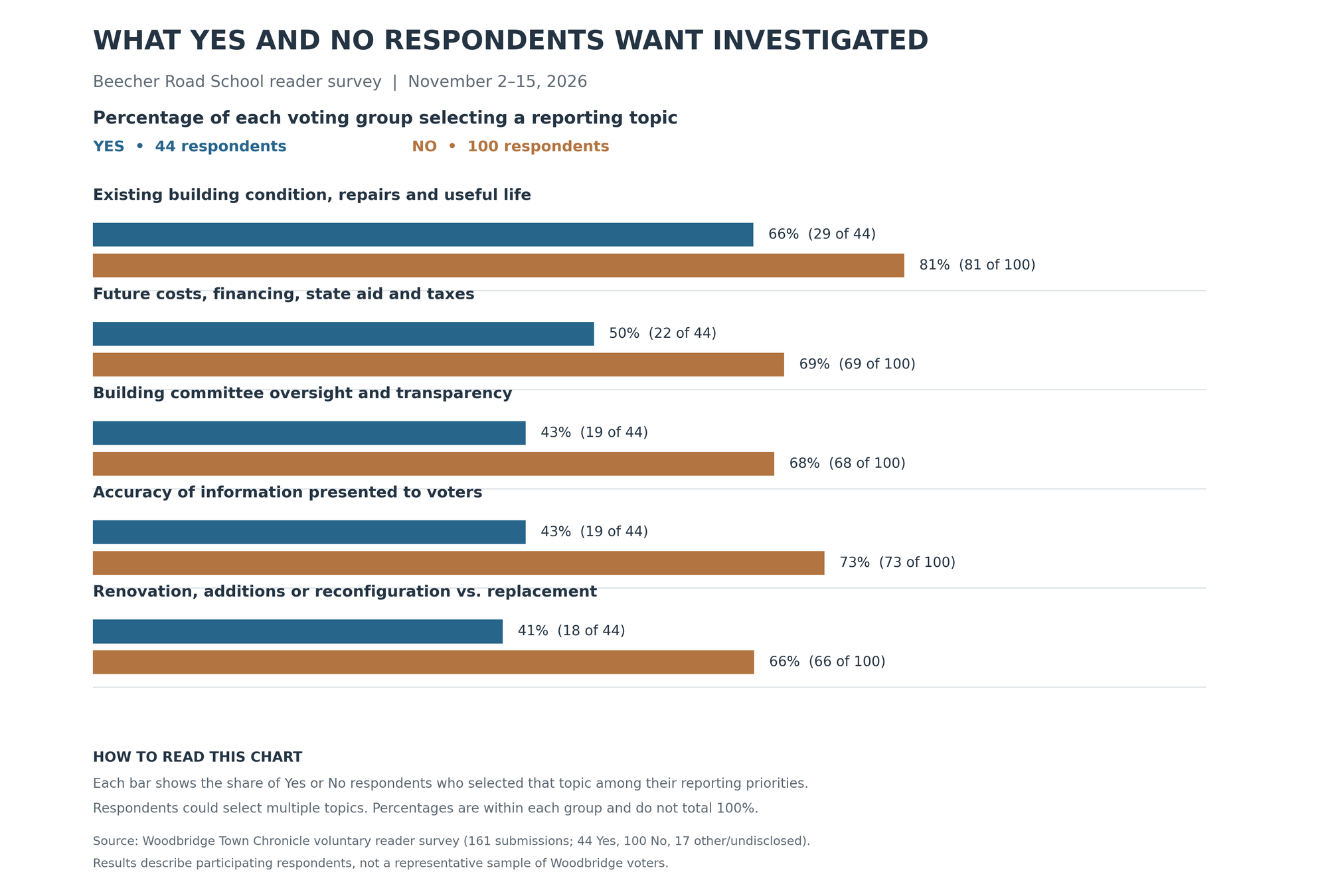
These comparisons do not establish agreement about the merits of the defeated project. Rather, they show that respondents on both sides identified many of the same subjects as worthy of further examination, even when the level of interest differed.
That distinction is especially important when considering the existing school's condition. Supporters of the construction proposal may view further investigation as an opportunity to document deficiencies that justify replacement. Opponents may see it as a way to determine whether repairs, renovations or a more limited project could address those deficiencies at a lower cost.
The survey did not ask respondents to explain why they selected each reporting topic, so those possible motivations cannot be established from the rankings alone.
Where opinions remain sharply divided
The survey also asked participants whether they agreed, disagreed or were neutral about a series of statements concerning the rejected proposal. Those responses reveal much greater differences between Yes and No respondents.
Among respondents who reported voting Yes, 84% agreed that the proposed project was a worthwhile investment despite its cost. Only 2% of No respondents agreed.
Conversely, 98% of No respondents agreed that the project was too expensive and would increase property taxes too much, compared with 16% of Yes respondents.
The groups also differed markedly over the condition of the existing building and whether replacement was necessary. Among Yes respondents, 63% agreed that the existing school was in such poor condition that replacing it was necessary. None of the No respondents who answered that statement agreed.
Meanwhile, 92% of No respondents agreed that the existing school could continue serving students with repairs, maintenance or more limited improvements, compared with 16% of Yes respondents.
On educational needs, 80% of Yes respondents agreed that building a new school was necessary, compared with none of the No respondents who answered that question.
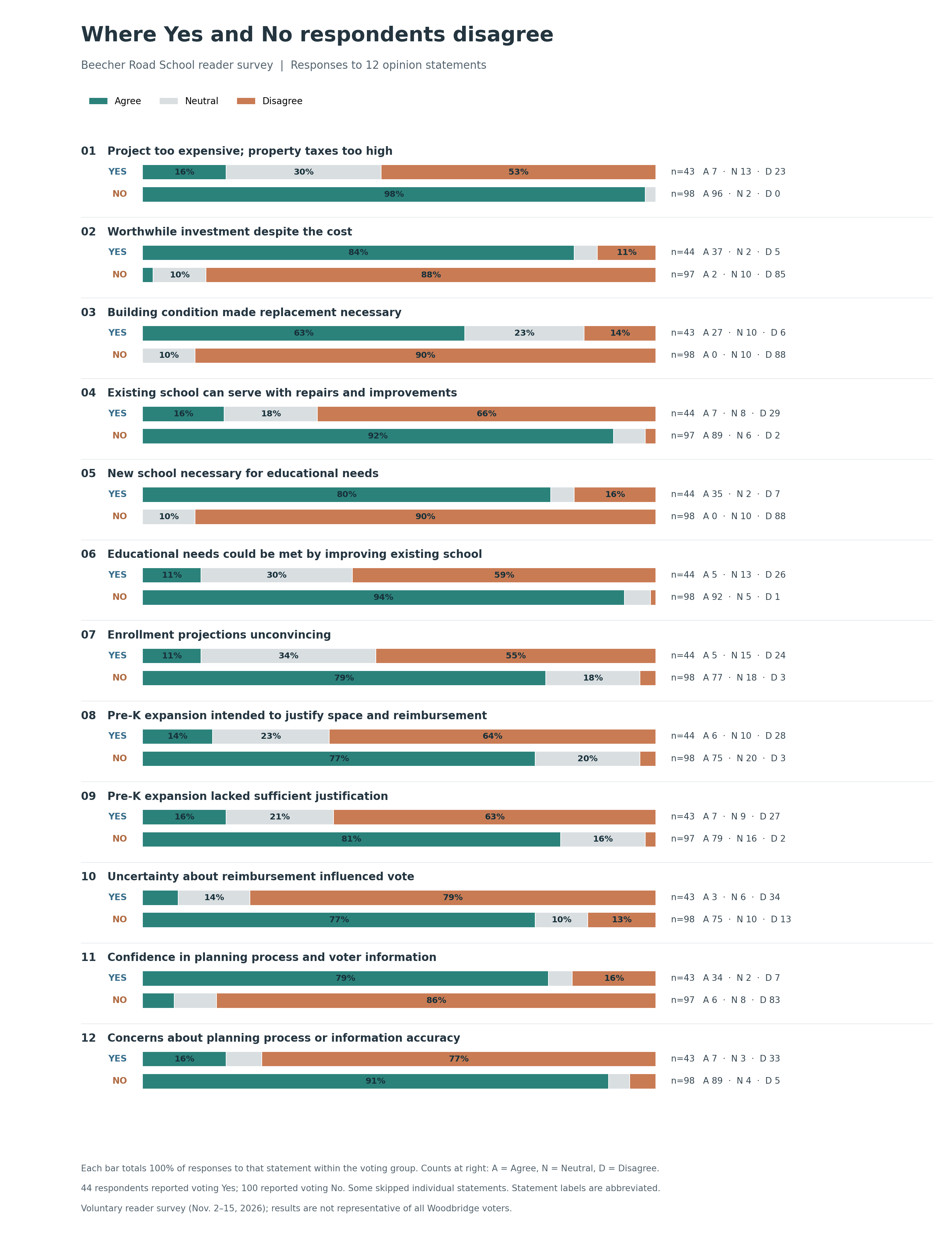
The findings illustrate why a shared interest in investigating building conditions should not be mistaken for consensus about the appropriate solution.
What residents said in their own words
The survey also invited participants to submit written comments identifying additional questions or subjects for investigation. Sixty-eight respondents did so.
Their comments raised questions about the condition and use of existing school facilities, the availability and cost of alternatives to complete replacement, enrollment projections, special education space, Pre-K expansion, and the financial implications of future projects.
Some respondents questioned whether repairs and reconfiguration had received sufficient consideration. Others emphasized the educational and physical needs of students and the potential costs of continuing to operate the existing building.
Several comments also raised questions about the building committee's responsibilities, the role of consultants, the information provided to voters and the transparency of decisions leading to the October referendum.
These comments represent individual perspectives rather than findings independently verified by the Chronicle. They will help identify questions for additional reporting.
What the Chronicle will investigate next
The survey's findings will help guide the Chronicle's continuing coverage as town and school officials consider their next steps following the October referendum.
One area of particular interest is the condition of the existing school, including the repairs and improvements needed to extend its useful life. The Chronicle will continue examining previous investments in the building, maintenance needs, and the assumptions underlying estimates for renovation and replacement.
See recent Chronicle reporting:
After Beecher referendum defeat, building committee considers revising proposal and trying again (October 26);
WBOE Facilities Committee reviews maintenance and capital needs of Beecher Road School (November 9); and
Board Watch: Financial pressures, Beecher planning and environmental concerns surface (November 16).
The survey also identified considerable interest in project costs, building committee oversight, and the transparency of the planning process. As part of its ongoing reporting, the Chronicle is undertaking a detailed accounting of public expenditures associated with developing the rejected $118.5 million construction proposal. That review will examine consultant contracts and payments, including work by Antinozzi & Associates and Construction Solutions Group, as well as legal, financing, and referendum-related expenses.
The investigation will also examine how expenditures were authorized, which municipal or school budgets funded them, and whether additional costs remain outstanding following the referendum's defeat. The objective is to establish a documented accounting of what taxpayers have already spent on the proposal, separate from the projected costs of construction and financing, while providing greater clarity about the decisions and responsibilities involved in the planning process.
This review comes as officials prepare for a joint meeting of the boards of Selectmen, Finance, and Education to consider revisions to the charge of the Beecher Road School Building Committee before the next phase of planning begins. No date has been announced for the tri-board meeting as of press time (check the Town website for updates).
As the Board of Education and town officials evaluate immediately needed repairs, near-term capital budget requests, and longer-term project alternatives for possible consideration during the annual budget-setting process in early 2027, the Chronicle will continue examining the public record and reporting on the costs, assumptions, and decisions that will inform the school's future.