Board Watch: TPZ adopts new ‘middle housing’ regulations, recommendations for Charter revision advance
New zoning rules take effect July 1 following sparsely attended public hearing, while review of Selectmen referrals for Charter revision continues

Board Watch is a recurring feature designed to provide a concise walk-through of activity as we keep track of the week's civic work. Longer-form articles will appear when issues warrant deeper coverage.
Town Plan and Zoning Commission — June 1, 2026
TPZ met June 1 at the Center Building for its regular meeting and to conduct a public hearing before considering adoption of amendments to the Town’s zoning regulations (see agenda).
The amendments to Section 3.2 Opportunity Housing regulations were developed in response to Public Act 25-1, a housing law adopted by the General Assembly during a 2025 special session in November. Among other provisions, the law requires municipalities to allow certain forms of ‘middle housing’ — generally residential developments containing between two and nine units — on commercially zoned or mixed-use properties through a process known as ‘summary review.’ Municipalities were required to adopt any necessary zoning changes by July 1, 2026.
Unlike a special permit or other discretionary land-use review, summary review does not include a public hearing on an individual application. Instead, applications are reviewed by staff against objective standards established in the zoning regulations. As a result, many of the discussions that would traditionally occur during the review of a specific development proposal must instead be addressed in advance through the regulations themselves. As part of its review, the commission referenced guidance prepared by the Connecticut Association of Councils of Governments summarizing the new law and its implementation requirements.
The proposed regulations, drafted by Town Planner Mike D'Amato and Town Attorney Nick Bamonte, underwent several revisions following discussion at previous TPZ meetings before reaching the public hearing (see previous WTC articles February 8, 2026, March 9, 2026, March 30, 2026 and May 4, 2026). During the June 1 meeting, commissioners reviewed additional changes intended to clarify how the new middle-housing provisions would be incorporated into Woodbridge’s existing zoning regulations while maintaining compliance with state law. A copy of the draft regulations dated May 8, 2026 considered by the commission is available on the Town website.
Three individuals spoke during the public hearing. Housing Commission Chair Dominic Thomas noted that the commission had previously identified the downtown commercial area as one of the town's most promising locations for additional housing. He said housing above retail and commercial uses should be encouraged and expressed concern that several of the proposed dimensional standards could make redevelopment of existing commercial properties more difficult. Overall, he urged the commission to consider adjustments that would maximize flexibility and encourage housing development within the commercial district.
Conservation Commission Chair Sharon deKadt also spoke to encourage the commission to preserve landscaping, tree, and open-space requirements as the regulations are revised. Derek Iwaskiewicz, who currently has applications before several town land-use boards, also commented on the proposal. He questioned affordability requirements included in the regulations and said increasing housing supply is an important component of improving affordability. The commission also received written comments from Scott Hunter, whose email had been distributed to commissioners prior to the meeting and entered into the public hearing record, although the contents were not summarized or discussed during the meeting.
Separately, commissioners received an email from Jim Urbano that was referenced as correspondence but was not discussed during the meeting. The transcript does not indicate that it was entered into the public hearing record.
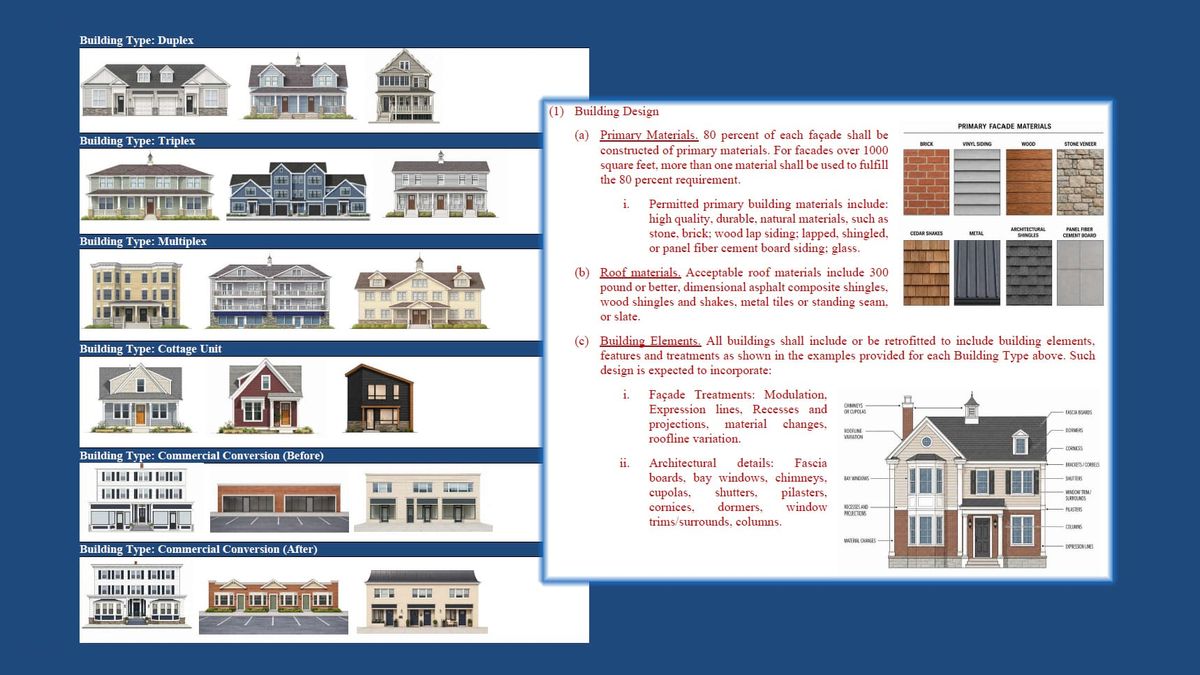
During the work session, commissioners made several revisions before voting on the regulations. One of the most substantive changes involved the proposed building-design standards. Commissioner Paul Schatz expressed concern that a draft provision requiring only 60 percent of each building façade to consist of specified primary materials set the bar too low. In response, TPZ Chair Jeff Kennedy noted that the regulations would likely be revisited as the Town gains experience with the new state requirements and as courts and other municipalities further interpret the law. Several commissioners expressed support for establishing a higher initial standard, noting that it would be easier to reduce the requirement in the future than to raise it after projects had already been approved. The commission ultimately increased the requirement from 60 percent to 80 percent.
Commissioners also made a clarifying edit to include language explicitly limiting the new middle-housing provisions to developments containing between two and nine residential units, consistent with the state law.
During discussion of the final motion, Commissioner Jim Horwitz expressed continued concerns about the regulations’ alternative compliance provisions, which would allow applicants to seek limited relief from certain design standards through a special permit process. Horwitz said he believed the provision was unnecessary and potentially counterproductive to the state’s requirements. Alternate Commissioner Robert Wiznia, who was seated for the vote, indicated his agreement.
The regulations, as amended, were approved on a 4–2 vote, with Horwitz and Wiznia opposed, and will take effect July 1, 2026.
During staff reports, Kristine Sullivan reported that the zoning office had received complaints regarding lawn signs displayed on private property. Sullivan noted that many such signs constitute protected First Amendment speech and therefore are permitted under the regulations and cannot be removed based on their content. She said the Town’s response focused instead on ensuring compliance with applicable setback requirements, advising property owners to use the Town’s GIS system to identify property boundaries and relocate signs farther from the roadway where necessary.
Sullivan also reported a complaint regarding weekend work activity associated with the approved 110 Luciani Street development (see WTC article May 4, 2026). She noted that the zoning issue depended on the nature of the work being performed, explaining that excavation activity would fall under the excavation permit while noise-related issues would be governed separately under the Town’s noise ordinance. First Selectman Mica Cardozo, who was seated in the audience during the meeting, was invited to provide additional context and said he had visited the site on Sunday and observed a truck being loaded while other activities were also occurring. Commissioners did not take any action on the issue.
It was also reported that commissioners had received correspondence concerning Kennedy’s attendance at a January 14 Board of Selectmen meeting (see WTC article January 19, 2026). Kennedy stated that the matter had been referred to the Town Attorney for review and, citing potential legal considerations, declined further discussion during the meeting. It was noted that the information was being shared for the record, and no action was taken by the commission.
Click below to watch the full recording of the June 1, 2026 TPZ meeting.
Charter Revision Commission — June 3, 2026
The Charter Revision Commission (CRC) met June 3 at Town Hall, continuing its review of fourteen issues referred to the commission by the Board of Selectmen and advancing several preliminary recommendations while deferring broader discussion of many of the more substantive proposals (see agenda).
Most of the meeting focused on process, identifying additional information needed from Town officials, and discussing how proposed changes in one section of the Charter could affect language elsewhere in the document.
One of the more notable exchanges occurred during a discussion of election-related Charter provisions. As commissioners considered possible changes to term commencement dates, members questioned how they would identify all of the related Charter sections that might require revision and ensure consistency throughout the document. When asked about the possibility of legal counsel assisting with that review, Town Attorney Nick Bamonte said he could help but cautioned that a comprehensive legal review would “eat into the budget” and was not something he would typically undertake as part of his role, although he indicated he would assist the commission as needed.
The commission ultimately reached a preliminary consensus recommendation to move the commencement of elected terms of office from January 1 to December 1 while also recommending that appointed boards and commissions begin terms on July 1.
The proposal would reverse part of the Town’s current structure, which was established by the Board of Selectmen following Woodbridge’s transition from May to November municipal elections and under which both elected officials and appointed boards and commissions begin their terms on January 1 (see WTC article May 11, 2026). Commissioners said the proposed change is intended to provide newly elected officials additional time to make appointments before the annual budget cycle begins.
Discussion of a proposal to extend agricultural leases on town-owned land for terms of up to five years without triggering referendum requirements was again deferred pending additional information. Commissioners agreed that a one-year lease term appears too short for many agricultural uses but said they would seek additional input before determining whether five years is the appropriate alternative.
The commission also reached preliminary agreement on a proposal to address gender-specific language through a general Charter provision stating that references throughout the document should be interpreted in a gender-neutral manner rather than revising individual references one by one.
In addition, commissioners discussed inviting representatives of the Board of Finance, Town Plan and Zoning Commission, Agricultural Commission, and First Selectman Mica Cardozo to future meetings as the review process continues.
The commission's next regular meeting is scheduled for July 1.
Click below to watch the full recording of the June 3, 2026 Charter Revision Commission meeting.