Revisiting the record of the 2014 Beecher Road School referendum
As Woodbridge prepares for another school referendum, the Chronicle reviewed contemporaneous public records to reconstruct the public planning, legal review and voter outreach that guided the Town's last school construction project

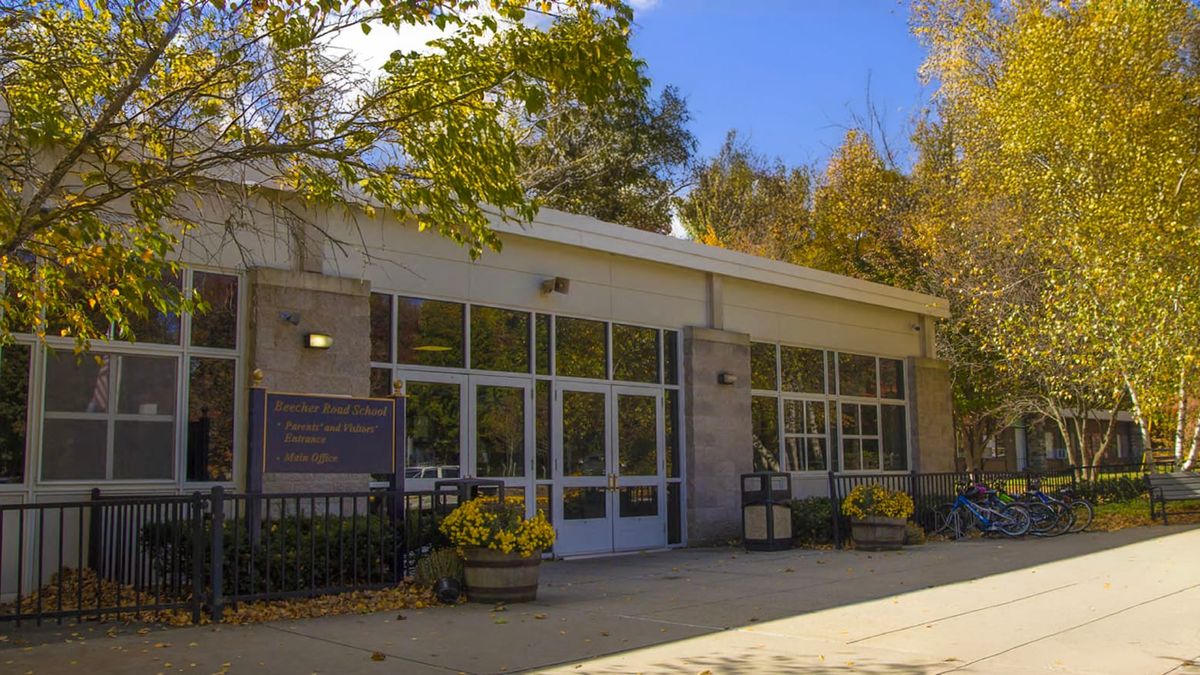
As Woodbridge officials prepare for a possible referendum this fall on a proposal to demolish and rebuild Beecher Road School, the Town's last school referendum has once again become part of the public conversation.
An unexpected discussion during the July 18 meeting of the Beecher Road School Building Committee (see WTC article July 20, 2026) about whether the 2014 school referendum satisfied the Town Charter's approval requirements prompted the Woodbridge Town Chronicle to revisit the public record surrounding the Beecher Road School renovation project.
To help readers understand the public process that led to that referendum, the Chronicle reviewed meeting agendas, approved minutes, public meeting transcripts, historical project materials, and other contemporaneous records documenting the proposal from its planning stages through final state reimbursement.
What emerges is a public record spanning nearly four years. The records document months of public outreach before the referendum, legal guidance from the Town's bond counsel, formal action by the Board of Selectmen and Board of Finance establishing both initial and contingency voting schedules under the Town Charter, a Special Town Meeting, a town-wide referendum, and ultimately the project's close-out through Connecticut's school construction grant program — providing a detailed reconstruction of the public process that guided the 2014 project.
Public outreach began months before the vote
By the fall of 2013, planning for the Beecher Road School renovation had already been underway for several years under the direction of a Town Building Committee established in 2011. (Additional background on the project itself — including the planning process, design decisions and completed construction — is available in a 2025 essay from the Chronicle's sister publication, TownHistory.org, titled “A School for the Future: Looking Back on the 2016 Beecher Road School Renovation Project.”) At a September 17, 2013 joint meeting, the Board of Selectmen and Board of Finance received a detailed project presentation and authorized the Town Building Committee to begin formal outreach and public information meetings.
That public outreach effort culminated in a Nov. 20, 2013 public information meeting at the Center Gym where residents received a detailed presentation, printed handout (see below), and financing information. A project video created by project consultant under the direction of the building committee was shown, and members of the public participated in a question and answer session.
The project was presented as a $13.345 million investment with an estimated average homeowner cost of approximately $195 per year (about $16 per month). As with the current Beecher Road School proposal, the availability of outside funding to help offset the taxpayer burden formed part of the project's public presentation. The informational handout stated that the Town would be “aggressively pursue” available state and federal grants as well as utility company rebates, but noted that the amounts were “to be determined.” Accordingly, the amount presented for voter approval reflected the full estimated project budget — including projected borrowing costs — while any grants or rebates would be pursued separately if they later became available.

Bond counsel explains the Charter
Following the public outreach efforts, on Jan. 16, 2014 the Board of Selectmen and Board of Finance convened a joint special meeting to consider the bonding resolution and determine how and when the proposal would be presented to voters. At this meeting, First Selectman Ellen Scalettar introduced Bond Counsel Joseph Fasi to explain Woodbridge's Charter requirements before the Board of Selectmen decided whether to hold the vote at a Special Town Meeting or adjourn it to a referendum.
Fasi explained that while Connecticut law permits a Town Meeting to be adjourned to a referendum, Woodbridge's Charter establishes a process unlike that used by other municipalities. “The word referendum does not appear in your Charter,” he told the boards. Instead, he said, the Charter “lays out a process that is a public meeting, a public discussion and a public decision in one place.” He described Woodbridge's process as “extraordinarily unique,” explaining that the Charter requires a two-thirds vote at an initial Town Meeting. If that threshold is not achieved, the Charter provides for a second Town Meeting where only a simple majority is required for approval. Fasi also emphasized that the same Charter process would continue to apply even if the vote were conducted by referendum. “...if you don't get two-third approval at the first referendum,” he explained, “a second Town Meeting is held and then adjourned to a referendum where a simple majority is required to approve a resolution.”
Following Fasi's presentation, members of both boards debated whether the project should remain a traditional Town Meeting vote or be referred to a town-wide referendum. Some argued that the proposal represented the largest bond authorization in town history and that a referendum would allow substantially greater voter participation. Others questioned whether routinely using referenda was consistent with the Charter's traditional Town Meeting process and noted that referenda were more expensive to conduct.
Ultimately, the Board of Selectmen unanimously adopted a resolution calling a Special Town Meeting for Feb. 3, 2014, with the vote adjourned to a referendum on Feb. 11, 2014. At the same time, the resolution established contingency dates for a second Special Town Meeting on Feb. 20 and a second referendum on Feb. 27 if a second vote became necessary under the Charter (see meeting minutes). Both dates were established before the first referendum was held, reflecting the Town's effort to provide a complete voting schedule under either outcome contemplated by the Charter and to allow adequate time between the chosen dates while also observing timing requirements of the Charter.
Special Town Meeting held on February 3, 2014
Before voters went to the polls, the Town held the required Special Town Meeting on February 3, 2014. Although the Board of Selectmen had already voted to adjourn the matter to a referendum, First Selectman Scalettar emphasized that the Special Town Meeting remained an important part of the Charter process. Despite a winter storm, she thanked residents for attending, explaining that “the schedules for the referendum and for going ahead with the project depends upon our having the Special Town Meeting this evening.” She also announced that the presentation would be posted on the Town website and that consulting engineer John Rice would be available at Town Hall later that week to answer additional questions from residents who were unable to attend because of the weather.
The meeting included another comprehensive presentation of the proposal by members of the Building Committee and the Town's consultants, followed by an extensive public question-and-answer session. Residents asked about financing, projected energy savings, state reimbursement, tax impacts, construction scheduling, and alternatives to renovating the existing school. During the discussion, Finance Director Tony Genovese explained that the proposed bond authorization represented the project's gross budget and “does not include possible grant and utility incentives that exist and that we hope to take advantage of,” which he estimated at the time could total between $300,000 and $400,000.
The referendum
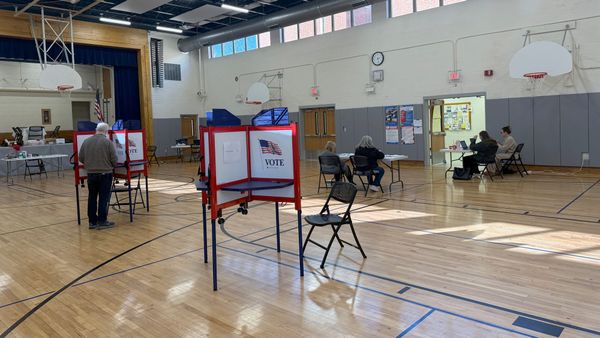
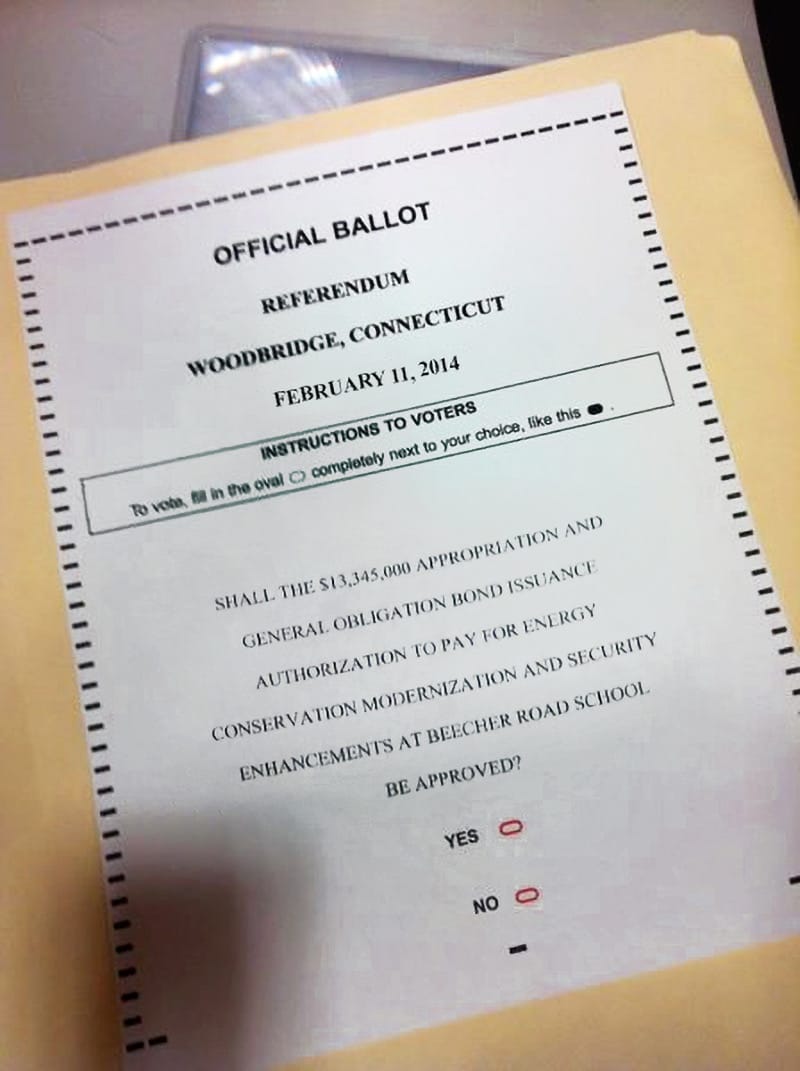
On February 11, 2014, Woodbridge voters were asked whether to approve a $13.345 million appropriation and general obligation bond authorization for energy conservation, modernization and security enhancements at Beecher Road School. A total of 687 ballots were cast.
The official results announced at the conclusion of voting that day were 511 votes in favor and 176 opposed. Construction subsequently moved forward, and the conclusion of the school renovation project was celebrated at a ribbon-cutting ceremony in May 2016.
Project closes out with the State
Following completion of construction, the project entered its final administrative phase through Connecticut's school construction grant program.
Documents obtained by the Woodbridge Town Chronicle through a Freedom of Information request to the Connecticut Office of School Construction Grants include both the Town's original ED049 Project Application and the subsequent ED049F Final Grant Application, which reconciled the project's estimated costs with its final construction costs and established the basis for final state reimbursement (see PDF of documents).
Those records show that the project ultimately closed out slightly below the amount authorized by voters. The Town's final grant application reported total project costs of $13,310,351, approximately $34,600 less than the $13.345 million approved at referendum.
The records also show that the project ultimately qualified for approximately $2.58 million in state school construction reimbursement — about 22 percent of the project's eligible costs. While the original project application projected a substantially smaller state grant based on preliminary estimates, the final reimbursement was determined only after construction was complete and the State reviewed the Town's final costs and eligible expenses.
Editor's Note: Following the Chronicle's initial reporting, responding members of the Beecher Road School Building Committee stated that they do not maintain records relating to the meeting described by Selectman Maria Madonick during the committee's July 18, 2026 meeting. Prior to publication of this article, the Chronicle submitted a follow-up request to First Selectman Mica Cardozo and Superintendent Christopher Montini seeking to identify which public agency, if any, maintains records concerning the July 17, 2026 discussion involving attorneys and bond counsel that Madonick referenced during the committee's July 18 meeting.