Beecher Road School Building Committee focuses on public outreach as referendum questions emerge
Special Saturday meeting sharpens communications strategy and considers possible voting timeline

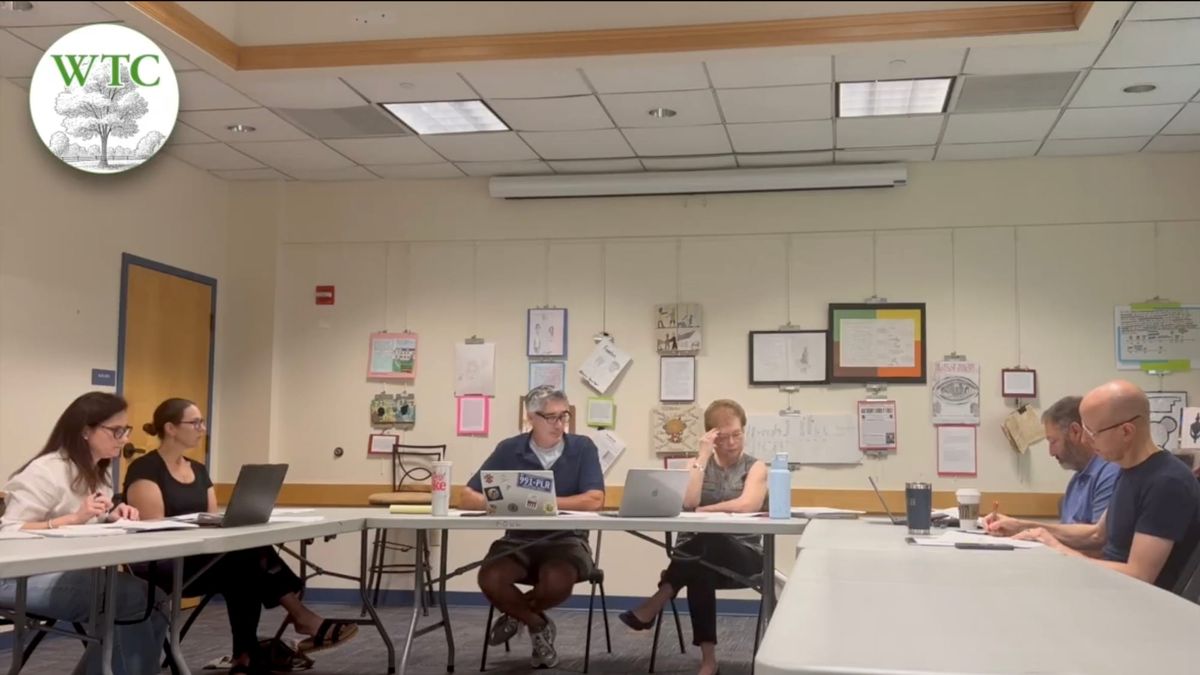
At the Beecher Road School Building Committee's July 18 special meeting, held on a Saturday morning in the Woodbridge Town Library with no members of the public in attendance, committee members refined their public communications strategy ahead of the proposed school building referendum. But the discussion shifted when Board of Selectmen liaison Maria Madonick told the committee that recent discussions with the town attorney and bond counsel had raised questions about how the Town Charter's referendum requirements should be explained to voters, including assertions about the Town's 2014 Beecher Road School referendum.
As a result, rather than discussing changes to the project itself, the meeting largely focused on how information about project costs, state reimbursement, taxes, and the Town Charter's referendum requirements will be communicated to voters during the months leading up to the anticipated fall referendum to demolish and rebuild Beecher Road School.
Consultant Ira Yellen participated remotely via Google Meet, although the published agenda listed only an in-person meeting location and did not include any remote access information (see agenda). Yellen walked the committee through a draft newsletter that would serve as the next major public communication. He described the publication as more factual than the committee's initial newsletter and said it was designed to answer common questions while directing residents to the project's website for additional detail.
Before the group proceeded further into the newsletter review, Madonick told the committee that discussions at a meeting she described as taking place July 17 had fundamentally changed how the committee would need to explain the upcoming referendum process to voters.
“One of the things that came up yesterday afternoon, after meeting with the attorneys and meeting with bond counsel, we are going to have to find a way to start explaining to people the referendum does not have to pass by 60% on the first try. It's 2/3 which is 66%,” she said. She suggested the committee should prepare residents for the possibility that two referendums could be required under the Town Charter.
Madonick then referenced the town's 2014 Beecher Road School referendum. “The last school building committee passed by 62% and they put it through because they thought it was 60. But according to our attorney, that should never have happened. It should have gone to a second referendum because the threshold in the charter is 2/3 which is 66% not 60,” she said.
The remarks prompted audible surprise from committee members. Madonick reiterated that, based on the legal advice she described, the 2014 vote “did not pass... it did not reach a two-third threshold” and that, because the attorneys concluded it did not satisfy the Town Charter's requirements for approval at an initial referendum, no town project has ever been approved on a first referendum.
The discussion that followed focused less on the legal advice itself than on how to explain the Town Charter's referendum requirements to voters before this fall's anticipated school construction referendum. Speaking from the audience, First Selectman Mica Cardozo suggested simplifying the terminology for public communications. “I was just going to suggest that the term super majority be used for the first vote and simple majority for the second vote,” he said. Committee members agreed that clearer language would help residents understand why two referendums may be required under the Charter.
The exchange also suggested that at least some committee members had not previously understood the Town Charter's referendum requirements before Saturday's meeting.
Madonick said town officials had already begun consulting with the Registrars of Voters while bond counsel worked with the Connecticut Secretary of the State to better understand how a potential second referendum would interact with the state's election calendar. The discussion included questions about voting equipment, statutory deadlines, and the possibility that early voting for the November general election could overlap with the referendum schedule. Committee members agreed that the timing would require extensive public education so residents would understand when and how they would be expected to vote.
Committee members also began discussing how the referendum schedule itself could unfold to accommodate the potential need for two votes. Committee member and Woodbridge Board of Education Chairman Steven Lawrence said he was informally looking at Tuesday, October 13, as a possible date for an initial referendum, allowing a second referendum to be held during the final week of October if necessary. Lawrence emphasized that the dates were tentative and intended only for discussion purposes while officials continued working through the election calendar.
Chronicle review of the 2014 record
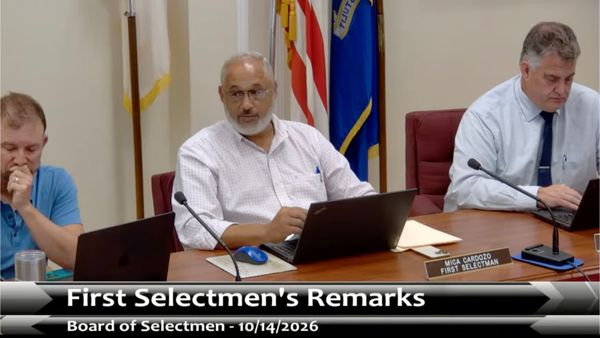
Following Saturday's meeting, the Woodbridge Town Chronicle reviewed the contemporaneous public records related to the 2014 Beecher Road School renovation referendum, including the recording of a January 16, 2014 joint meeting of the Board of Selectmen and Board of Finance at which the referendum procedure was explained in detail before two dates were selected. During that meeting, bond counsel stated that the Charter requires a two-thirds majority for approval at the first referendum and that, if the proposal receives more than 50 percent but less than two-thirds support, it proceeds to a second referendum requiring only a simple majority.
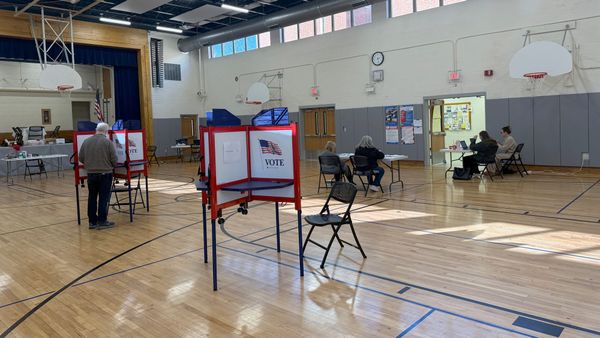
The initial referendum was subsequently conducted on February 11, 2014 and according to the announcement of the vote result by Moderator MaryLee Barker, a total of 687 ballots were cast. Speaking to a small crowd gathered in the Center Gym that evening, Barker stated that approval according to the Town Charter would require 458 affirmative votes — a two-thirds majority — before announcing that the proposal received 511 “yes” votes.
Nothing in the contemporaneous public record reviewed by the Chronicle indicates that the Charter's two-thirds requirement was misunderstood during the 2014 referendum process. The official results as announced show the referendum passed with 74.4 percent support, exceeding the Charter's required two-thirds threshold by 53 votes. Click the links below the images to watch the full recordings on WGATV's YouTube channel.
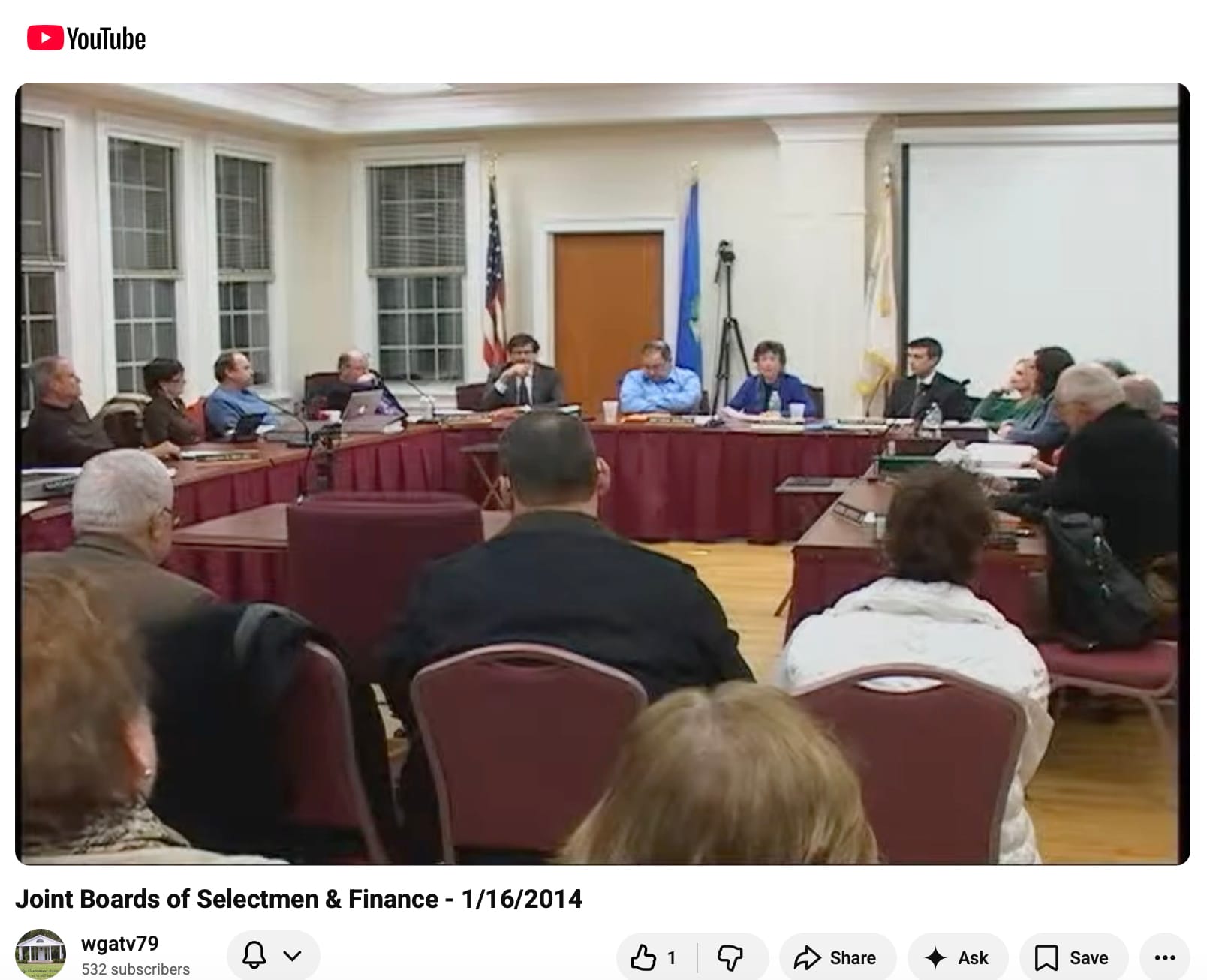
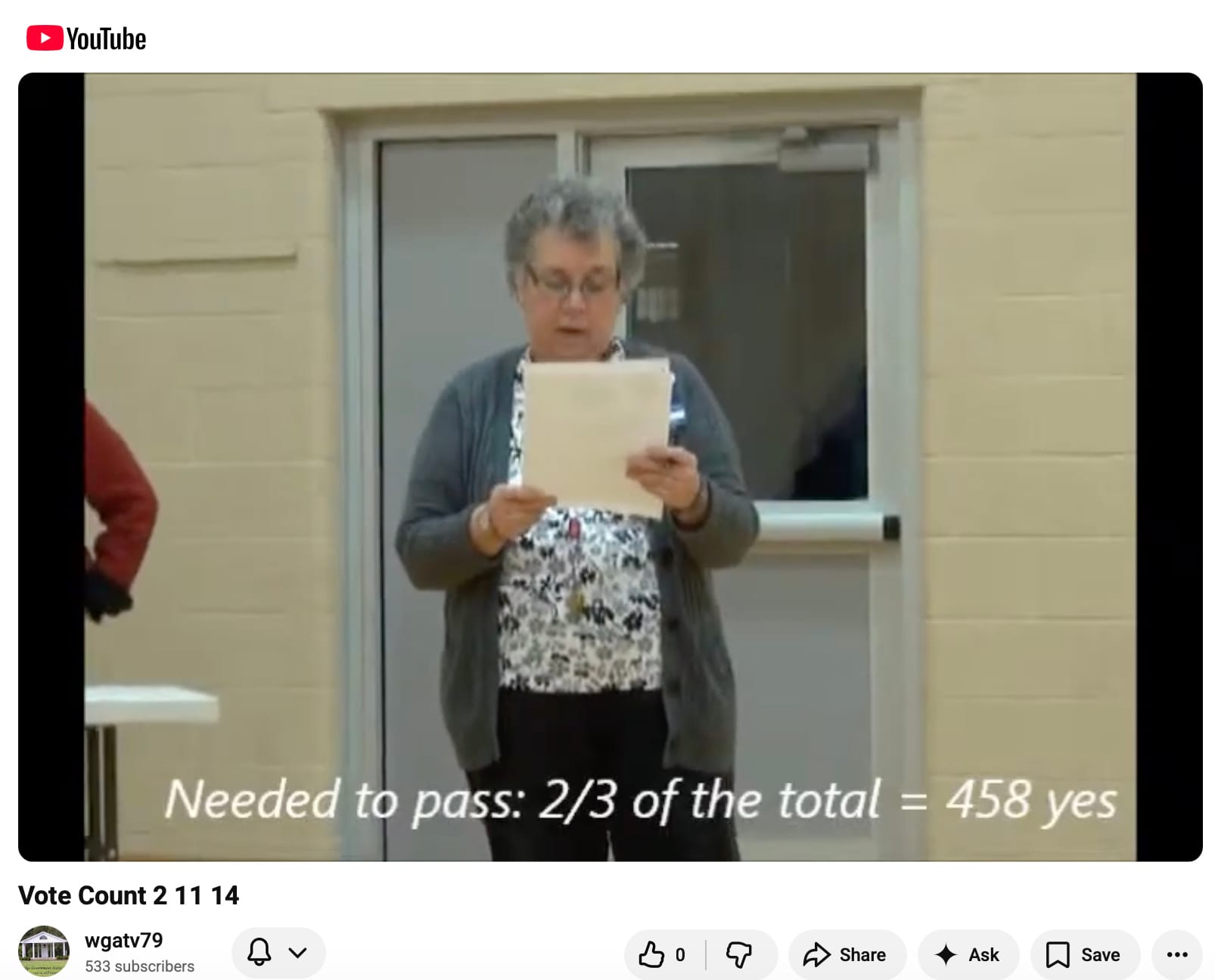
2014 records — Joint BOS & BOF meeting in January and vote results announced in February (click the links to view video recordings on YouTube).
Continued review of planned communications
With the discussion of referendum requirements concluded, the committee returned to the draft newsletter, focusing on how best to present the project's financial information to residents. Yellen recommended emphasizing the division between the town's share of the project and anticipated state reimbursement, suggesting that the material clearly illustrate what taxpayers would fund while highlighting what he described as an unusually favorable level of state participation. Committee members also stressed that every financial figure should be carefully verified before publication because residents are expected to scrutinize the numbers closely.
The committee also reviewed proposed examples showing the estimated tax impact on a median assessed home. Members discussed the importance of using consistent terminology throughout the newsletter and future online tax calculator so residents would understand exactly which property values were being used.
Members also agreed that future public presentations should devote greater attention to explaining the consequences of not moving forward with the project. Rather than focusing exclusively on the cost of constructing a new school, committee members said residents should understand the continuing expense of maintaining the existing building, the additional capital improvements that would still be required, and the long-term financial implications of delaying major work.
Beyond written communications, the committee reviewed an expanding public outreach schedule. Members reported positive engagement at the concerts on the Green series after attendance improved during the second week. The committee plans to continue to offer an informational table through the remainder of the July concerts while also exploring additional weekend forums, visits to the Senior Center, presentations to town boards and commissions, and a possible tri-board meeting to broaden public discussion.
The committee also discussed sending a courtesy letter to residents living near the school construction area. The goal would be to inform neighbors about the project, encourage questions, and provide an opportunity to discuss issues such as construction activity and traffic before work begins.
This special meeting was not recorded for the town's WGATV YouTube channel. To provide a public record of the proceedings, the Woodbridge Town Chronicle independently recorded the meeting as part of its ongoing hyper-local journalism coverage. Click below to watch the Chronicle's complete recording of the July 18, 2026 special meeting of the Beecher Road School Building Committee.
Editor's Note: Following the July 18 meeting, the Woodbridge Town Chronicle filed a request seeking any legal opinions, memoranda, correspondence, election certifications, or other records reflecting the legal interpretation described to the committee regarding the Town Charter's referendum requirements. The request was prompted by an apparent discrepancy between statements made during the July 18 meeting and the contemporaneous public record reviewed by the Chronicle.