Woodbridge turnout tops 67% as statewide ballot votes offer lessons for local issues
Woodbridge outpaces statewide turnout and gives Democrats stronger support, while school construction and charter revision votes elsewhere offer timely comparisons

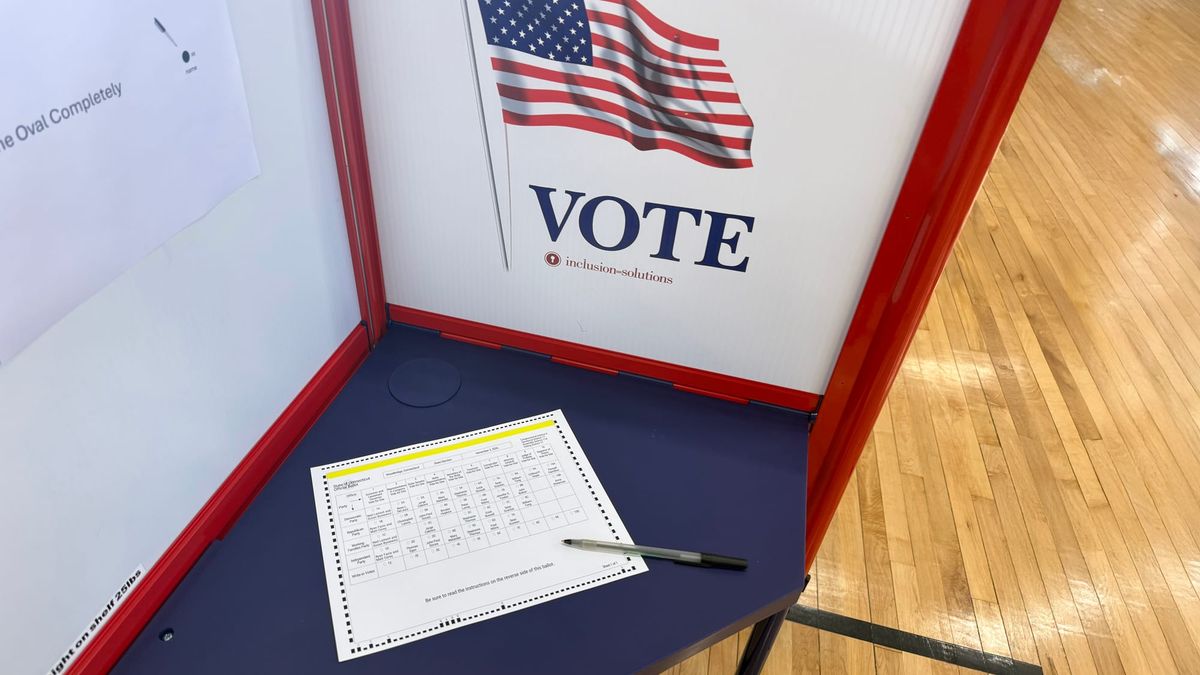
Woodbridge voter turnout reached 67.57% in the November 3 general election, with 4,280 of the town’s 6,334 registered voters participating — more than 10 percentage points above Connecticut’s statewide turnout of 57.29% and higher than the 60.94% turnout recorded in last year’s municipal election.
Woodbridge by the numbers
Democrats swept every contested race on the Woodbridge ballot, while more than half of all votes were cast before Election Day through early in-person or absentee voting. In the governor’s race, Ned Lamont and Susan Bysiewicz received 2,841 votes across their ballot lines, compared with 1,467 for Ryan Fazio and Matt Corey. Democratic candidates also carried the town’s congressional, legislative and statewide constitutional-office contests. Clifford Hoyle, the sole candidate for probate judge, received 3,059 votes. The CT Secretary of the State's Election Center website reports all the details.
More than half of Woodbridge voters cast their ballots before Election Day, continuing a shift in voting patterns since Connecticut introduced early in-person voting in 2024. Of the 4,280 votes cast, 1,877 (43.86%) were submitted during early in-person voting and another 265 (6.19%) by absentee ballot. Together, those 2,142 ballots accounted for 50.05% of the total, narrowly exceeding the 2,138 ballots (49.95%) cast on Election Day.
The following table breaks down Woodbridge's 2026 voter turnout by party affiliation, showing how many registered voters in each group participated in the election.
Affiliation | Registered | Ballots cast | Turnout |
Democrat | 2,477 | 1,881 | 75.94% |
Republican | 1,083 | 758 | 69.99% |
Unaffiliated | 2,693 | 1,590 | 59.04% |
Minor parties | 81 | 51 | 62.96% |
Total | 6,334 | 4,280 | 67.57% |
Unaffiliated voters gain ground as major-party enrollment declines
Looking back to November 2022, the last gubernatorial election, voter registration trends show a gradual shift away from both major parties and toward unaffiliated status.
Unaffiliated voters continue to make up the largest share of Woodbridge’s electorate, accounting for 42.5% of registered voters in November 2026, up from 40.4% in November 2022. Democrats account for 39.1%, down from 40.5% four years ago, while Republicans represent 17.1%, down from 17.8%. Since the 2022 gubernatorial election, Democratic enrollment has declined by 156 voters (5.9%) and Republican enrollment by 77 (6.6%), while unaffiliated registration has increased by 62 (2.4%). More recently, Democratic enrollment has rebounded slightly, rising by 31 since November 2025 and 51 since the August 2026 primary. Overall, Woodbridge has 6,334 registered voters, down 175 from November 2022 but up 79 from last November.
The following table tracks Woodbridge voter registration by party affiliation for each November election since 2022, illustrating changes in the size and composition of the town’s electorate over the past four years.
| Election | Total | Democrat | Republican | Unaffiliated | Minor parties |
|---|---|---|---|---|---|
| Nov. 2022 (Governor) | 6,509 | 2,633 (40.5%) | 1,160 (17.8%) | 2,631 (40.4%) | 85 (1.3%) |
| Nov. 2023 (Municipal) | 6,157 | 2,513 (40.8%) | 1,091 (17.7%) | 2,474 (40.2%) | 79 (1.3%) |
| Nov. 2024 (President) | 6,423 | 2,588 (40.3%) | 1,119 (17.4%) | 2,634 (41.0%) | 82 (1.3%) |
| Nov. 2025 (Municipal) | 6,255 | 2,446 (39.1%) | 1,093 (17.5%) | 2,639 (42.2%) | 77 (1.2%) |
| Nov. 2026 (Governor) | 6,334 | 2,477 (39.1%) | 1,083 (17.1%) | 2,693 (42.5%) | 81 (1.3%) |
Sources: Woodbridge Registrars of Voters historical enrollment records. The 2025 minor-party figure is calculated by subtracting the three listed affiliations from the total.
Lessons from around the state
While Woodbridge voters had no local ballot questions to decide on November 3, residents elsewhere in Connecticut faced decisions with direct relevance to issues under consideration here. Across the state, voters weighed competing school construction priorities, approved or rejected major capital investments, and considered changes to municipal charters governing everything from budget authority to political representation.
Those results offer useful comparisons as Woodbridge considers its next steps following the defeat of the Beecher Road School proposal, Amity Regional School District 5 prepares a possible capital referendum, and the town’s Charter Revision Commission develops recommendations that could reach voters in November 2027.
School construction: Voters distinguish infrastructure from athletic improvements
In Southington, voters rejected an $86.675 million school facilities measure, 10,531 to 9,432. Enfield voters narrowly approved a $511 million school construction and conversion program, while Middletown voters approved a $30.4 million school infrastructure project. The mixed outcomes follow Woodbridge’s October 13 rejection of the proposed $118.5 million Beecher Road School project by approximately two to one.
In Regional School District 10, serving Burlington and Harwinton, voters overwhelmingly approved $5 million for HVAC improvements (77.7% in favor) and $14.935 million for roof replacements (77.2% in favor), while rejecting both alternatives for a new athletic field at Lewis S. Mills High School. Voters were offered a choice between a $3.9 million synthetic turf field and a less expensive $3.1 million engineered natural grass field, but neither proposal won approval.
The results offer a timely comparison for Amity Regional School District 5, where officials are considering approximately $35 million in capital projects involving roofs, HVAC systems, library improvements and athletic fields. As previously reported by the Chronicle, Amity officials have discussed whether to present those projects as separate ballot questions. Region 10 official referendum results document the contrasting outcomes.
Charter revisions: Voters weigh budget authority and political representation
In Weston, voters rejected a proposal to eliminate the annual town budget meeting’s authority to reduce or eliminate individual budget line items before the budget proceeds to referendum, 1,766 to 926. Coventry voters rejected a proposal to replace fixed-dollar appropriation authorization limits with limits calculated as a percentage of the current tax levy, 3,023 to 2,661. Both towns also rejected separate questions encompassing remaining charter revisions.
In Weston, voters also rejected a proposal to change political party representation limits on town boards and commissions. Connecticut law limits how many seats members of the same political party may hold, ensuring representation for minority parties or unaffiliated voters. On a seven-member board, for example, state law allows no more than five members from one party, leaving at least two seats for others. Woodbridge follows that statutory limit. However, state law expressly permits municipalities to adopt charter provisions that provide greater minority representation than the statutory minimum, and Weston’s charter does exactly that. Its existing charter allows no more than a bare majority of seats to be held by one party — four on a seven-member board. A proposed revision would have relaxed that restriction to permit the statutory maximum of five, but voters rejected the change, 1,745 to 947, preserving the town’s stronger minority-representation requirement.
Meanwhile, Durham voters rejected making the elected town clerk and tax collector appointed positions, 2,464 to 750, and also voted down a broader charter revision question, 1,859 to 1,131. New Canaan, by contrast, submitted six separate charter questions, five of which passed. Voters rejected eliminating the requirement that Board of Finance members own taxable real estate, 6,058 to 1,845. Guilford approved a comprehensive charter revision, while West Haven voters approved four-year terms for the mayor and town clerk.
Woodbridge will decide how to present its own charter revisions
These results offer comparisons for Woodbridge, where charter revision recommendations could reach voters in November 2027. The Board of Selectmen will decide whether to submit changes together or as separate questions, allowing voters to accept some and reject others. New Canaan’s six-question ballot illustrates the individual-question approach; Weston, Coventry and Durham each separated specific proposals from a question covering other revisions.
Proposed Charter Revision questions may be put to voters at a regular November election or a standalone referendum, with different approval thresholds (see WTC article 10/6/2025 “What is Charter Revision?”). At a regular election, a majority of those voting on the question is sufficient. At a special referendum, the proposal must receive a majority of votes cast on the question and affirmative votes equal to at least 15% of registered voters. At the November 2026 registration level of 6,334, that would be at least 951 yes votes.
The Selectmen's decisions about ballot format and timing will determine whether Woodbridge voters can consider individual revisions separately and which approval standard applies.