Beecher’s new $45–$60 million question: What needs fixing now — and what is regular lifecycle replacement?
Town says maintaining the existing school will cost $45–$60 million over 20 years, but its latest newsletter does not distinguish current needs from future lifecycle replacement of systems installed during the last renovation

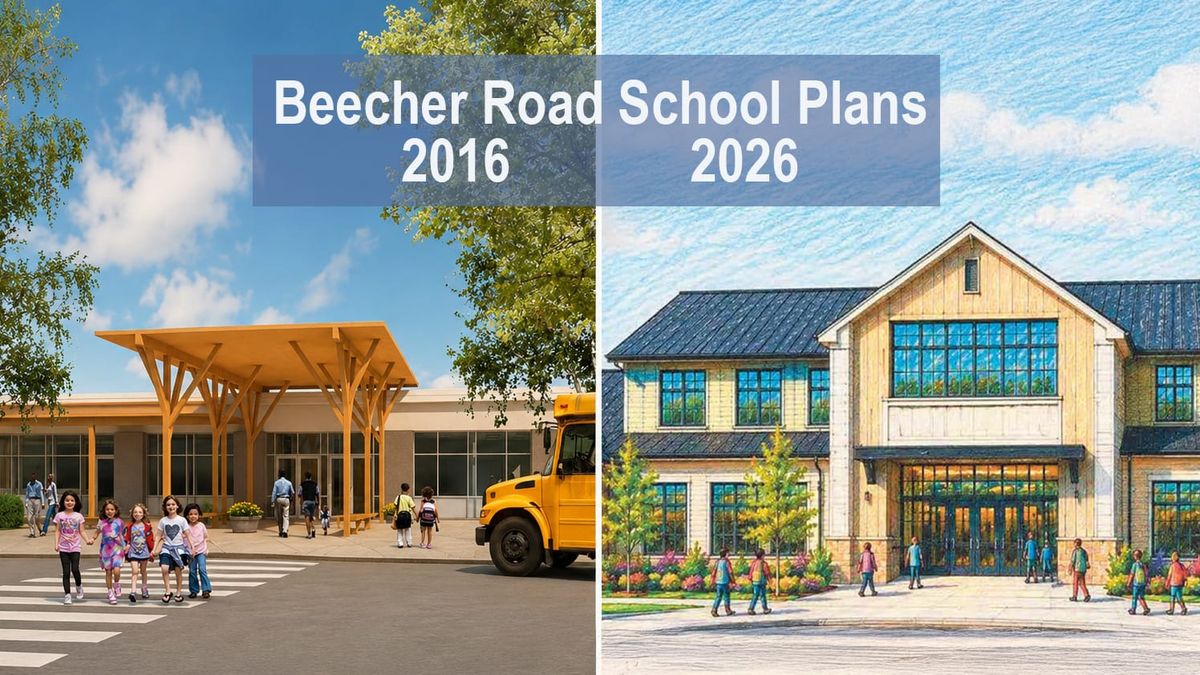
Woodbridge residents considering the proposed $118.5 million Beecher Road School project are being presented with an increasingly stark financial choice. The Beecher Road School Building Committee’s August newsletter says a new school is the option that “is the most cost effective.” By contrast, it says Woodbridge will need to spend an estimated $45 million to $60 million over the next 20 years “just to keep [the existing school] operational,” without addressing its educational and space needs.
But there is an important question embedded in that comparison: How much of the $45–$60 million represents work Beecher actually needs in the near future — and how much represents regular replacement of building systems years from now as they reach the ends of their useful lives?
The newsletter does not provide that breakdown.
A cost to “keep the doors open” message takes shape
The distinction has become increasingly important as Building Committee members and other officials have begun presenting the project to Town boards and commissions.
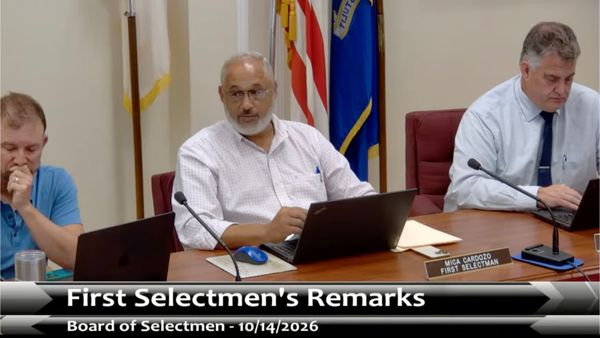
At the Aug. 17 Housing Commission meeting, Selectman Maria Madonick said Woodbridge would have to spend “between 45 and $60 million in the next 20 years to upkeep the Beecher Road School campus. Just the campus as it is right now.”
Later in this meeting, she put the range at $47 million to $60 million “just to maintain the current building over the next 20 years.” Madonick explained that approximately $47 million represented the estimated cost if all of the identified work were done immediately, while the higher figure included escalation because the work would actually occur over 20 years.
The following evening, the Building Committee discussed making that comparison a central feature of its final communication before the referendum. At that meeting, Woodbridge Board of Education Chairman Steven Lawrence, who also serves asa member of the Building Committee, said the community would spend tens of millions of dollars “just to keep the doors open on the existing facility” or could instead construct a new school.
At the BRSBC meeting Lawrence also said, “We really want to make the point [to] help the community understand it's not a question of whether we're going to spend the funds. It's how are we going to spend these and what do we as a community think will be the wisest investment.” Committee members went on to discuss using a large postcard rather than another newsletter to emphasize that choice.
The same framing also appeared during the August Woodbridge Board of Education meeting. WBOE vice-chair Lynn Piaszyk, who also serves on the Building Committee, described an estimated $30 million to $60 million as necessary to “keep the doors of the current facility open and running properly.”
Later in the discussion with WBOE members, Lawrence described spending $30 million to $60 million, potentially more with escalation, “just to keep the doors open on the existing facility” without addressing Beecher’s other identified challenges.
WBOE members then discussed translating the estimate into an approximate monthly taxpayer cost and potentially using that comparison in the Building Committee’s final mailing.
The language varies — “upkeep,” “maintain,” “keep it operational,” “keep the doors open” — as does the lower end of the range. But the message increasingly being presented to residents is straightforward: Woodbridge will spend tens of millions of dollars on Beecher either way; the question is what taxpayers will receive for that money.
Understanding that comparison, however, requires understanding when the projected spending would occur and what it would pay for.
Many major systems were replaced only a decade ago
The Beecher being evaluated today is not the same building Woodbridge confronted before its last major renovation (see WTC article 7/27/2026).
Beginning in 2013, Town officials made the case for a substantial modernization of the school. One stated goal was to “upgrade the Building Systems to serve the facility reliably for the next 25 years.” The November 2013 presentation described the anticipated result as a “School for the future,” “Top 20% energy” and “20-25 year life.”
The project ultimately included major building-envelope and mechanical work: high-efficiency gas boilers, a central chilled-water plant and chiller, mechanical equipment and controls, air-handling and ventilation work, substantial roofing work and 24 new thermal window-wall assemblies serving all classrooms in the A, B, and C wings originally built in the 1960s.
The work was completed in 2016, with Woodbridge borrowing approximately $13.3 million to finance the project.
That history matters because some of those systems are now roughly 10 to 13 years old — and the consultants evaluating Beecher for the current project acknowledge that many still have years of expected useful life.
The March 2026 Existing Facility Condition Assessment report by Antinozzi Associates says the school’s boilers, installed in 2013, have an “estimated useful life of approximately 25–30 years.” The chiller, pumps and heat exchangers, primarily installed in 2015, are assigned estimated useful lives of approximately 20–25 years. Numerous air-handling, rooftop and energy-recovery units also date to 2015 and are assigned similar useful-life expectations, while windows replaced during the previous renovation are described as being “in good condition.”
None of that means those components will last forever. In fact, that is precisely the point. A 20-year cost projection beginning in 2026 extends to approximately 2046. By then, a chiller installed in 2015 would be more than 30 years old. Boilers installed in 2013 would be more than 30 years old. Other equipment installed during the previous renovation would likewise be at or beyond its anticipated service life.
If replacing those components years from now is included in the $45–$60 million estimate, that is important information for voters to understand. Replacing a component that reaches the end of its lifecycle in 2027 is a current building need. Replacing a mechanical system installed in 2015 after it reaches the end of a normal service life in 2035 is instead regular lifecycle replacement.
Both require money. Both appropriately belong in long-range capital planning. But they tell residents different things about Beecher’s condition today.
Building new resets the clock
Public buildings require continuing investment throughout their lives. Roofs wear out. Mechanical equipment ages. Controls become obsolete. Flooring, pavement and finishes eventually need replacement.
The goal of responsible capital planning is generally to obtain as much useful life as possible from major building investments while planning ahead for their eventual replacement.
A system reaching the end of its expected service life after 20 or 25 years does not necessarily mean an earlier investment failed. It means another capital-replacement cycle has arrived.
A new Beecher would eventually face the same cycle. If the D3 option's proposed new school opens around 2030, its new roofs, HVAC equipment, pumps, controls, flooring, windows and other components will begin aging from that point. Twenty or 25 years later, some will themselves begin approaching replacement age. Building new would simply push many of those replacement needs further into the future, rather than eliminate them.
The Town’s six-year plan offers a different window
The Town’s existing capital plan provides another reason the timing behind the $45–$60 million estimate matters. Woodbridge’s preliminary FY2027 six-year capital plan identifies approximately $724,000 in specific Beecher building and facility work over the 6-year planning period, excluding the proposed new-school project.
Projects include $160,000 to plan for replacement of the Beecher elevator; $159,250 to repaint the exterior; $120,000 for art-room asbestos abatement, casework and flooring; $80,000 to replace 11 unit ventilators; $80,000 for classroom and hallway flooring; $62,680 for HVAC recommissioning; and $62,500 to replace various 1970s classroom casework.
The six-year plan is preliminary and is not presented as a comprehensive facility-condition forecast, so a six-year capital plan cannot be directly compared with a 20-year estimate. Additional needs could emerge, projects could change and the longer period necessarily captures far more of the building’s aging cycle. But that is exactly why the missing timeline behind the $45–$60 million estimate matters.
What happens after those first six years? If substantial portions of the $45–$60 million expenditures occur in years 10 through 20 because equipment installed during the 2016 renovation eventually reaches normal replacement age, that is materially different from presenting the entire 20-year figure as the cost of “just” keeping Beecher operational.
The numbers being cited have also varied
The lower end of the estimate has not been consistent. Earlier project discussions described a “repair only” scenario of approximately $30 million to $60 million over 20 years. At the Aug. 17 Board of Education meeting, officials continued to use a $30–$60 million range.
At the Housing Commission meeting that same day, Madonick used $45–$60 million and later $47–$60 million.
The new Building Committee newsletter settles on $45–$60 million and says the Town “will need to spend” that amount over 20 years.
Madonick’s Housing Commission explanation provides some additional context for the upper end: she said the cost would be about $47 million if all the identified work were performed immediately, with escalation pushing the projection toward $60 million when the work is spread over 20 years.
But residents have not yet been provided a year-by-year schedule showing what projects make up the estimate, when each is expected to occur and how much of the total reflects escalation. Without that schedule, it remains difficult to distinguish current deficiencies from future lifecycle replacements.
A question for the next stage of financial review
None of this establishes that Woodbridge should maintain Beecher rather than build a new school. A new building could offer educational, accessibility, security, environmental, operational or other advantages that residents ultimately conclude justify its cost.
The question here is narrower. If the financial case for rebuilding includes telling residents that Woodbridge will otherwise spend $45–$60 million “just to keep it operational” or “just to keep the doors open,” residents — and the Town boards being asked to evaluate the project’s finances — need enough information to understand what that figure represents.
The Building Committee’s pre-referendum calendar anticipates a joint financial presentation to the Board of Selectmen, Board of Finance and Board of Education, although it remained unclear as of publication whether a session tentatively identified for Wednesday, Aug. 26 would take place as scheduled.
As that financial review proceeds, the underlying schedule behind the $45–$60 million estimate would provide an important piece of the comparison: what would be repaired or replaced, why, how much each item is expected to cost and when the expenditure is expected to occur.
That would allow Town officials and residents to separate three things now compressed into one number: What Beecher needs now. What it is expected to need later. And what represents regular lifecycle replacement over the next 20 years.
Voters need that context to make a meaningful comparison between the cost of maintaining the existing school and the cost of replacing it. Building new doesn't make lifecycle costs disappear. It starts the clock again.