Housing Growth Plan requirements dominate TPZ discussion
Commissioners question how future state housing targets will be determined as town prepares for new planning mandate

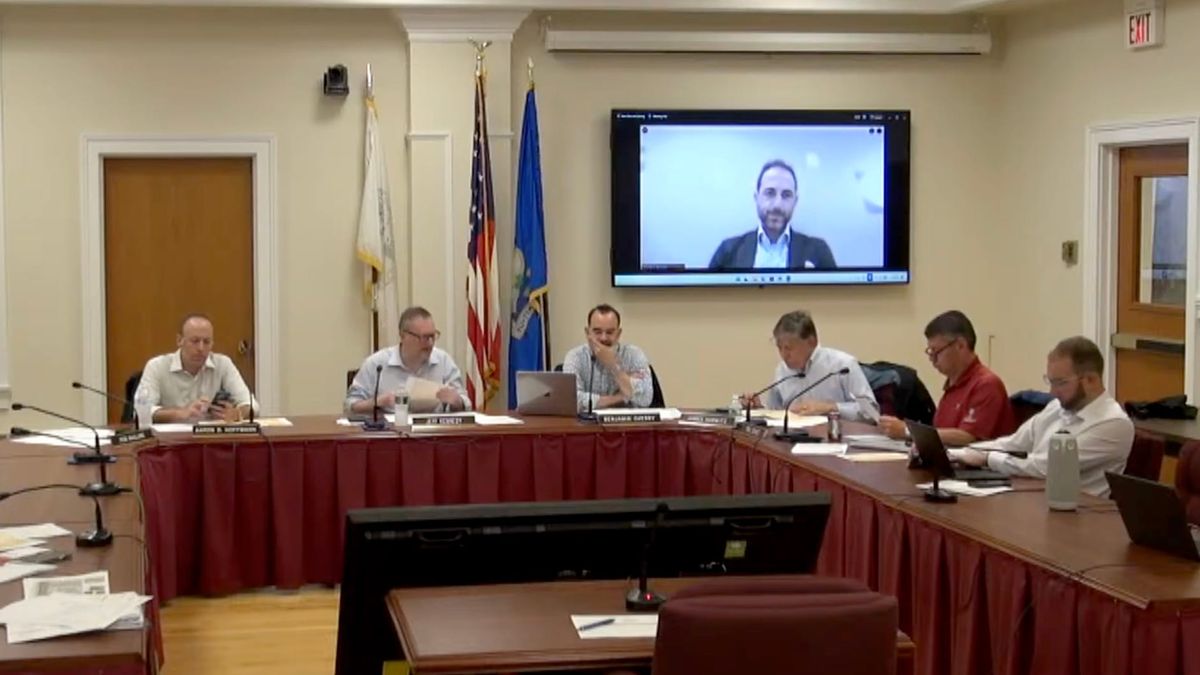
The Town Plan and Zoning (TPZ) Commission spent much of its July 6 meeting discussing Connecticut's new Housing Growth Plan requirements, a state-mandated planning process that will require municipalities to evaluate future housing needs and identify opportunities for residential development (see agenda)
Town Planner Mike D'Amato and Town Attorney Nick Bamonte provided commissioners with an overview of Public Act 25-1, adopted earlier this year, which establishes a framework for housing growth planning across Connecticut. Although the state has not yet finalized how individual municipal housing targets will be calculated, the law will eventually require each municipality to either prepare its own Housing Growth Plan or participate in a regional planning effort.
During the discussion, commissioners and staff frequently referenced a one-page Housing Growth Plan flowchart developed by the Capitol Region Council of Governments (CRCOG) that summarizes the planning process established under Connecticut's 2025 housing legislation. The document condenses the statutory requirements into a visual guide outlining municipal planning, public hearing, adoption, and state review milestones.
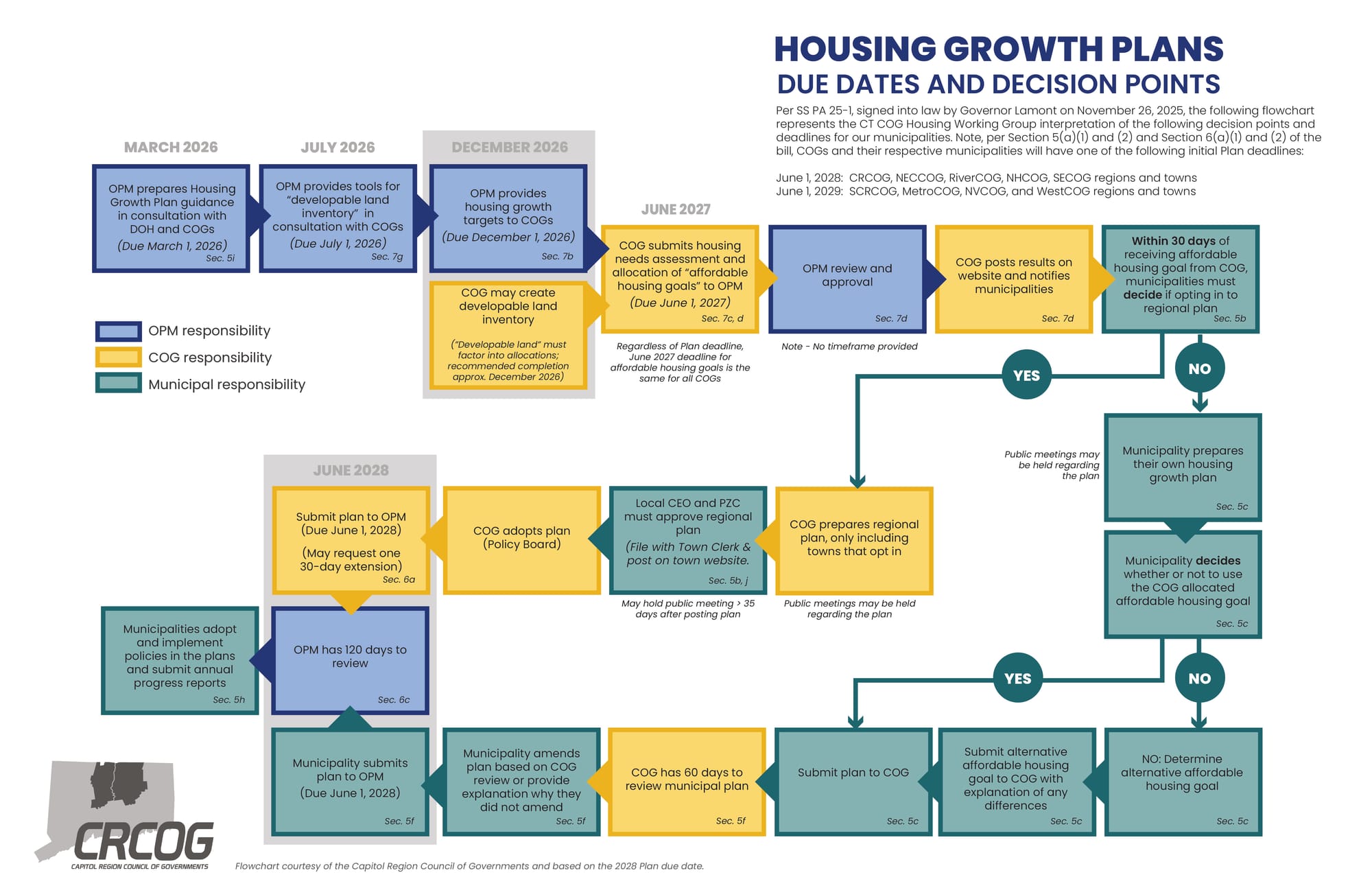
Commissioners noted that the chart identifies the South Central Regional Council of Governments (SCRCOG), of which Woodbridge is a member, as part of a second group of regional planning organizations with a June 1, 2029 deadline for completion of Housing Growth Plans, compared with a June 1, 2028 deadline for the first group. During the meeting, however, it remained unclear whether the intermediate milestones shown on the chart are similarly delayed for SCRCOG municipalities or whether only the final plan submission date differs.
The discussion reflected both the complexity of the new law and the uncertainty surrounding its implementation. Commissioners repeatedly questioned how future housing allocations would be determined and what tools municipalities actually possess to achieve housing goals when most development occurs on privately owned land.
TPZ members also raised concerns about how municipalities would be able to evaluate or challenge future housing targets generated through the state's allocation process. D'Amato noted that local officials across Connecticut have been asking how towns can be confident that state calculations will adequately account for site-specific constraints such as infrastructure limitations, environmental conditions, contamination, development costs, or other factors that may affect the realistic development potential of particular properties. He suggested that one of the town's near-term tasks will be to identify the factors Woodbridge believes should be considered so that officials can effectively evaluate any future housing allocation proposed by the state or the regional Council of Governments.
Several members sought clarification regarding the relationship between Housing Growth Plans, affordable housing requirements, and Connecticut's affordable housing appeals statute, commonly known as 8-30g. Questions also focused on whether rezoning land alone could satisfy state expectations and what role town-owned properties might play in meeting future housing objectives.
The discussion also explored what practical tools municipalities have to encourage housing development when they do not control the underlying land. Commissioners noted that simply allowing additional housing through zoning changes does not guarantee that developers will build new units. In response, Bamonte referenced a previously discussed list of potential zoning approaches assembled during the commission's earlier Opportunity Housing deliberations, which TPZ chairman Jeff Kennedy referred to as “a menu“ that was compiled at the request of commissioner Ben Cherry. This includes regulatory options that could make housing development more attractive, such as allowing greater density, increased building heights, modified lot coverage requirements, and other zoning incentives in selected areas. Commissioners indicated they may revisit those concepts in the coming months as they consider how existing Opportunity Housing regulations could align with future Housing Growth Plan requirements.
During the discussion, Cherry also suggested that Woodbridge's state legislators be invited to a future meeting to explain the intent of the legislation and how it is expected to help municipalities address housing needs. Kennedy responded that he would be willing to extend such an invitation, noting that public discussion and education would be an important part of the commission's ongoing review of the state's housing policies.
Commissioners also discussed the potential role of town-owned property in meeting future housing goals. Bamonte noted that municipalities have limited ability to influence development on privately owned land but can negotiate affordability requirements when town-owned property is leased or conveyed for housing development (see WTC article on the recent approval of The Warner lease). The discussion included references to long-term ground leases, deed restrictions, and requests for proposals that could be used to encourage affordable housing on municipal land. Several commissioners expressed unease with the prospect that state housing policies could increasingly place pressure on communities to consider development of publicly owned properties as one of the few tools directly within local control.
Commissioner Jim Horwitz questioned how municipalities can translate planning goals into actual housing production when development decisions ultimately remain in private hands. While acknowledging that zoning regulations can be modified to permit greater density or other incentives, Horwitz observed that “you zone it, they don't necessarily come,” noting that simply creating opportunities for housing development does not guarantee that developers will pursue them. The challenge, he suggested, is identifying what additional actions municipalities can take to encourage responsible housing development beyond making it legally permissible.
D'Amato explained that many details regarding the Housing Growth Plans remain unresolved pending additional guidance from the state. He noted that municipalities will have opportunities to comment on proposed methodologies before housing allocations are finalized.
The discussion follows several recent housing-related initiatives in Woodbridge, including the adoption of Opportunity Housing regulations that took effect July 1 (see WTC article June 8, 2026) and ongoing conversations regarding the town's affordable housing goals (see WTC article June 22, 2026).
No formal action was taken, although commissioners indicated they would continue reviewing the evolving state requirements as additional information becomes available.
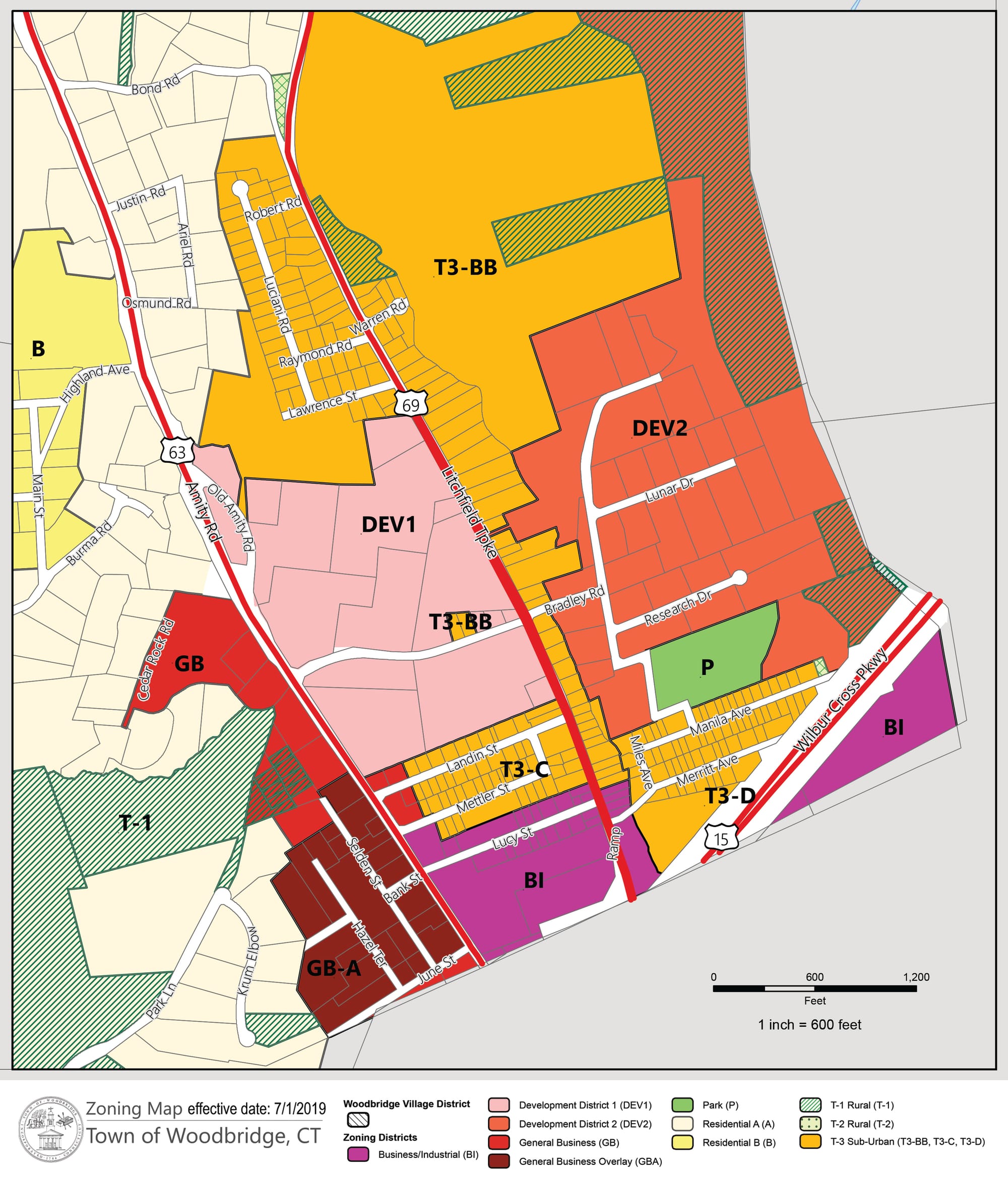
Krum Elbow rezoning application accepted
In other business, the commission accepted an application submitted by Gail and Christopher O'Connor seeking to rezone properties at 15 and 21 Krum Elbow Road from General Business (GB) to Residence A (for location, see lower left corner of map, above).
After determining that a public hearing would be required, commissioners scheduled the hearing for September 8 (see Public Hearing Notice).
Business district improvement project
Commissioners also discussed correspondence received from resident Jim Urbano, a commercial property owner in the Commercial Business District regarding the proposed LOTCIP-funded transportation improvements intended for the district (see map above showing this area of Woodbridge). Urbano questioned whether aspects of the project are consistent with existing zoning and village district regulations.
Members discussed what role, if any, the commission has in reviewing the project. Chairman Jeff Kennedy noted that the commission had not previously been involved in developing the grant-funded proposal. No formal action was taken, and commissioners agreed to seek additional guidance from town counsel regarding the commission's potential role in reviewing elements of the project.
Other business
The commission also approved minutes from its June 1 regular meeting and unanimously granted a one-year extension of a special exception permit for excavation and fill activities at 20 and 23 Lunar Drive. The extension was requested by the property's new owners, who recently acquired the site and indicated that no work has yet been undertaken under the existing permit. Commissioners also received updates on several administrative matters, including ongoing zoning enforcement activity and progress on implementation of the recently adopted Opportunity Housing regulations.
Next steps
July's meeting was the commission's final regular meeting before its traditional August recess. Looking ahead, Kennedy said the commission plans to continue its review of the state's evolving Housing Growth Plan requirements when it reconvenes on September 8. Proposed agenda items include a discussion with representatives of the Housing Commission, a review of town-owned properties that could potentially support future housing initiatives, and further consideration of the Opportunity Housing concepts previously developed by the commission and informally referred to during the meeting as a menu of potential housing incentives. Kennedy also indicated he would invite state legislators to discuss the intent of the new housing legislation and its implications for Woodbridge. In addition to the Krum Elbow rezoning public hearing already scheduled for September 8, commissioners expect to continue discussions regarding housing growth targets, local housing strategies, and the town's options under the new state framework.
TPZ meetings are open to the public and usually streamed live on the Town’s YouTube channel, WGATV79. Click below to watch the full recording of the July 6, 2026 meeting.