As Beecher vote approaches, questions remain about project cost, enrollment, and scope
Tuesday’s Special Town Meeting offers a final opportunity for public discussion before Oct. 13 referendum on the $118.5 million project as proposed

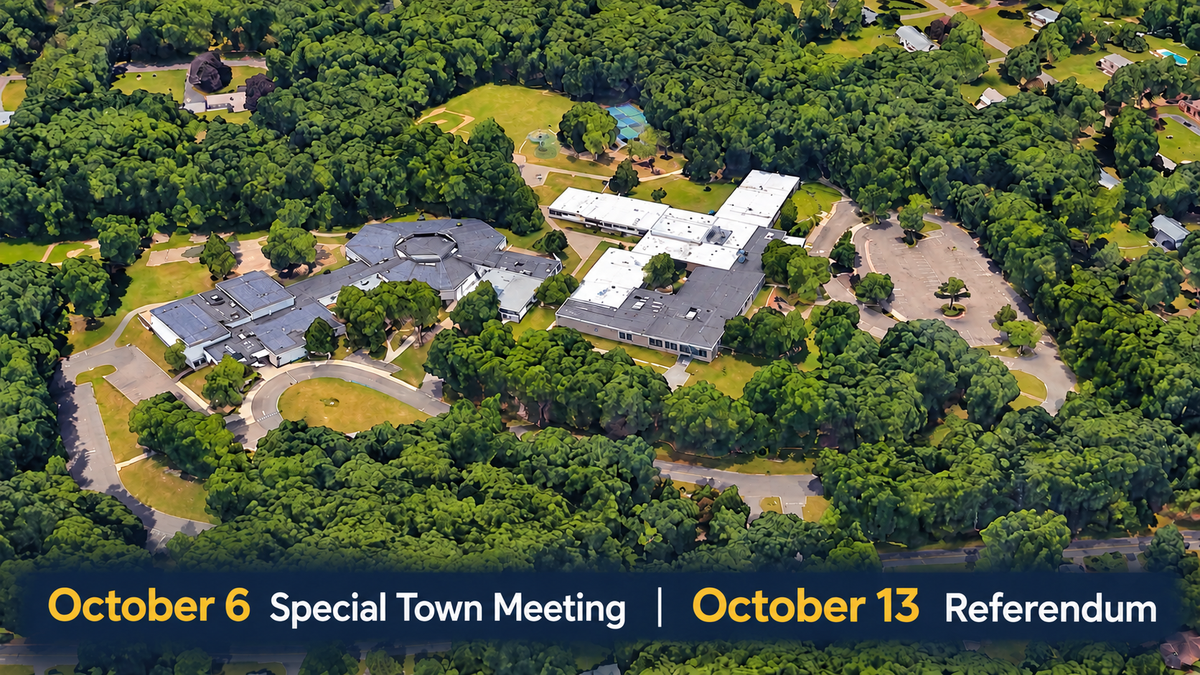
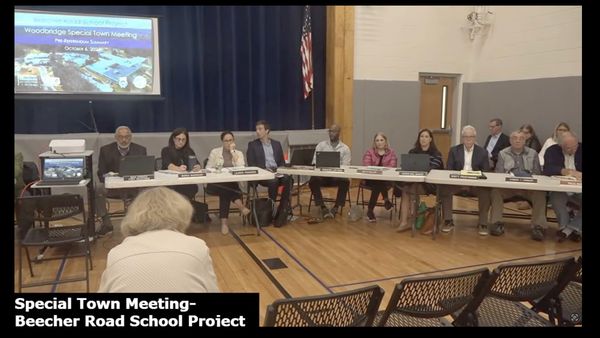
Woodbridge residents and property owners qualified to vote from the Grand List will gather Tuesday, Oct. 6, for a Special Town Meeting on the proposed $118.5 million Beecher Road School project, the final public meeting before the question goes to voters in an Oct. 13 referendum (see Special Town Meeting notice).
The Town has also published the official Explanatory Text for the referendum, authorized by the Board of Selectmen as part of the process of sending the project to voters at its Sept. 23 meeting (see WTC article 9/28/2026). The document provides additional detail — and important qualifications — about projected state reimbursement, how much Woodbridge could ultimately have to borrow and the estimated tax impact.
As the vote approaches, the Chronicle is taking a closer look at what the Explanatory Text says and at several questions that remain about the project itself:
- How much state reimbursement is actually assured, and what could Woodbridge ultimately have to borrow?
- How much enrollment growth is anticipated, and how much comes from the planned expansion of Pre-K? Does Woodbridge appear to meet a newly enacted enrollment-growth threshold that could substantially increase state reimbursement?
- Was a lower-cost alternative proposed by local architect David Barkin fully evaluated? And after the Town decided to retain Beecher’s South building, is a new Board of Education Central Office still necessary?
The Explanatory Text provides some answers. Enrollment studies, project documents and recent public discussions leave other questions unresolved.
What the Town’s Explanatory Text says
The Town’s official Explanatory Text for the referendum puts several important qualifications around the financial projections being presented to voters (see the full official Beecher Referendum Explanatory Text as posted to the Town website).
The document says the Finance Department’s projections assume a state grant of approximately 53% of the project cost, which would leave approximately $55.5 million to be financed by the Town. But it also states that “the rate and amount of any grant will not be known until the State acts on the Town’s application.”
Under the state’s school-construction grant process, the next major step in that process comes by Dec. 15, when the state Department of Administrative Services (DAS) submits its annual school-construction Priority List to the Governor and legislative reviewers. State law requires the list to include the estimated grant amount for each eligible project. If Beecher is included, that would provide a state estimate of the grant, but not yet a final grant commitment.
The Priority List then undergoes legislative review. A legislative committee acts on the list by Feb. 1, after which approved projects proceed through the General Assembly. Once the resulting legislation is approved by lawmakers and signed by the Governor, DAS issues grant commitment letters to approved districts. DAS describes that final stage as occurring in the spring or summer.
The Explanatory Text also identifies some of what remains uncertain today. It says the projected reimbursement rate includes “about six percentage points of potential bonuses” associated with housing and Open Choice participation that the Town has not yet secured.
And the reimbursement percentage does not necessarily apply to every dollar of the $118.5 million project. The document states that, for the school portion, costs the State ultimately treats as ineligible for reimbursement “have not been identified and are not deducted” from the figures presented to voters.
The Explanatory Text also makes clear that the referendum authorization is not limited to the approximately $55.5 million currently projected to be financed by Woodbridge. It says the Town could borrow more, “up to the full $118,500,000,” if necessary.
Tax-impact estimates also depend on assumptions
The Town projects that Beecher-related debt would add approximately $1,324 annually to the tax bill of the average homeowner at the projected peak. The Explanatory Text cautions, however, that those figures are projections for this project alone and do not include debt Woodbridge may issue for other projects.
The calculations also assume interest rates of 3.5% for borrowing in 2027 and 2028 and 3.75% in 2029 and 2030. The Town expressly cautions that “a smaller grant, higher interest rates or slower Grand List growth would increase the tax impact.”
Taken together, the Explanatory Text lays out the assumptions behind the $118.5 million project and its projected tax impact, while identifying several financial factors that will remain uncertain until after the referendum.
What do the enrollment projections show?
Enrollment has been one of the principal arguments for the size of the proposed Beecher project, but the most recent enrollment study draws an important distinction between projected growth in the elementary grades and growth resulting from the planned expansion of Pre-K.
An April 2026 enrollment study by M&P Planning Group, obtained by the Chronicle, provides the more recent projection generated for the project. The study’s medium model projects total PK–6 enrollment reaching a peak of 981 students in 2032 and concludes that “a majority of the enrollment growth is due to the expansion of Pre-K” (see PDF of M&P Planning Group April 2026 document).
However, the $118.5 million project’s May 15, 2026 revised Educational Specifications cite a separate enrollment projection prepared by demographer Peter Prowda and updated Nov. 24, 2024. Prowda projected enrollment of 882 students in 2025 and 908 in 2026, rising to a peak of 960 students in 2032 (see PDF of Prowda Nov. 24, 2024 enrollment report). The Educational Specifications then add 76 students for the planned expansion of Pre-K to arrive at a project enrollment figure of 1,036 students.
Actual enrollment subsequently came in below Prowda’s projection. His report bases its projections on Oct. 1 enrollment; Beecher’s Oct. 1, 2025 enrollment was 860 students, 22 fewer than the 882 he had projected less than a year earlier.
By the opening of the 2026–27 school year, Superintendent Christopher Montini reported to the Board of Selectmen in September that enrollment stood at 853 students, compared with the 908 Prowda had projected for 2026. If enrollment remained at 853 when the district reported its official Oct. 1 enrollment, that would be 55 students, or about 6%, below Prowda’s projection.
In a phone interview with the Chronicle, Prowda said the state’s change in the kindergarten entry age made enrollment projections more difficult across Connecticut, including his 2024 projection for Woodbridge, because it was not yet clear how families would respond to the change. After the Chronicle provided him with the newer enrollment figures during the interview, Prowda said the largest discrepancy in his projection had been kindergarten. “I was projecting 882 in ’25 and the enrollment was 860 and the biggest place that … we had a problem, not surprisingly, was kindergarten. My whole [analysis] was off in kindergarten,” Prowda said.
He explained that the smaller kindergarten cohort would then move through each successive grade, temporarily depressing enrollment across the school for several years — an effect he described as an “indent in the snake.”
Prowda’s projection also does not include the additional enrollment associated with the planned expansion of Pre-K. His updated projection, incorporated into the May Ed Specs, reaches a peak of 960 students in 2032. The revision to the Ed Specs approved by the WBOE then adds 76 students for the planned Pre-K expansion to arrive at the project enrollment figure of 1,036 students.
Prowda told the Chronicle that he had not been asked to determine how many students a larger Pre-K program would attract and did not conduct that analysis as part of his enrollment projection. Asked how he would approach such an analysis, he said he would examine births as well as the number of Woodbridge preschool-age students already attending private and other Pre-K programs. He said, “I’d want to look at births and say, is it reasonable to attract the number 75 or whatever the number is? Is it reasonable? Will the births support that right now?”
During the interview, Prowda located state data showing 17 Woodbridge residents enrolled in nonpublic Pre-K programs in 2024, while noting that other preschool and daycare programs would also have to be considered. He also questioned an assumption that all eligible students would participate, noting that some families choose to keep their children home.
Will new apartment buildings result in enrollment increases?
The newer M&P study uses updated enrollment and demographic information and also accounts for anticipated housing development. Its projections include the approved — but not yet built — 96-unit development at 804 Fountain Street, which M&P estimates will generate nine K–6 public-school students once fully occupied. The study phases those students into its projections beginning in 2028–29.
Even with the approved Fountain Street development included, M&P’s medium model projects K–6 enrollment increasing from 838 students in 2025–26 to 867 in 2035–36, an increase of approximately 4%. The larger increase in total school enrollment comes from the planned expansion of Pre-K, which the study projects will amount to an increase of 71 Pre-K students assuming the new school is approved and opens, accounting for about 60% of the projected overall enrollment growth. If the six additional Pre-K classrooms were not built and the program remained at its current size, applying M&P’s K–6 projections would produce a peak Beecher enrollment of approximately 910 students — 47 students, or about 5.4%, above 2025–26 enrollment.
M&P also considered the proposed 100-unit development at 27 Beecher Road, estimating that it could generate 19 K–6 public-school students. Those students were not included in the forecast because the application pending when the study was prepared had been withdrawn, although the report said the property “still bears watching in case it is resubmitted with modifications.” A new application for a 100-unit development at 27 Beecher Road was subsequently filed. That proposal proceeded through the Inland Wetlands process before the agency denied the application as incomplete in July. Its ultimate disposition remains unclear, however, because the proposal was also the subject of a filing with the state Department of Energy and Environmental Protection.
If M&P’s estimate of 19 additional K–6 students from 27 Beecher Road were simply added to its medium projection, the projected peak would increase from 981 to approximately 1,000 students. That is not a separate projection modeled by M&P, but a simple calculation using the student-generation estimate contained in its report.
If those 19 students were added but the planned Pre-K expansion did not occur and Pre-K instead remained at its current size, the same calculation would produce a peak enrollment of approximately 929 students — 66 students, or about 7.6%, above 2025–26 enrollment.
Could Woodbridge qualify for an additional 20 points of reimbursement?
Those enrollment figures also bear on a newly enacted state reimbursement provision. Effective July 1, state law provides an additional 20 percentage points of reimbursement, if a school district’s enrollment has increased by at least 20% during the 10-year period immediately preceding its school-construction grant application.
In a Sept. 29 Milford-Orange Times column, state Rep. Mary Welander wrote that Woodbridge “should qualify” for the new provision. The Chronicle sent a press inquiry to Welander asking what enrollment figures or study she relied upon. Welander acknowledged the inquiry but said she was unable to provide a response within the Chronicle’s publication deadline this week. We will report any additional information received as part of a planned follow-up article next week.
The enrollment records reviewed by the Chronicle do not appear to show growth approaching the 20% threshold. Under the special legislation governing the Beecher project, the Town was required to submit its school-construction grant application by Sept. 30, 2026. A ten-year lookback from that deadline would therefore encompass the state’s annual Oct. 1 enrollment counts from 2016 through 2025. The state’s October enrollment figures for that period show an increase of 88 students from 2016 to 2025, or 11.37%. M&P Planning’s April 2026 report similarly states that Woodbridge school enrollment had increased by approximately 11% over the previous decade.
Precisely how DAS will determine the enrollment figures used to apply the new provision remains to be confirmed. Because the statute looks backward at the 10 years immediately preceding the grant application, however, projected future growth — including enrollment associated with the planned Pre-K expansion — would not appear to satisfy the historical-growth requirement.
Was a lower-cost alternative fully studied?
Another question, raised publicly by local architect and former Board of Education Vice Chairman David Barkin, is whether a more selective renovation-and-replacement approach to Beecher could meet the project’s Educational Specifications at a lower cost.
In a follow-up letter to the Chronicle, Barkin clarified details of his suggestions to retain and repair portions of the existing school that remain serviceable, removing portions presenting the greatest problems, and constructing only the additional space needed to meet the Educational Specifications. This concept is not the same as the project’s previously studied B1 option.
B1 called for substantial demolition while retaining the Rotunda area and the ramped hallway leading to it, as well as other portions of the North school that were substantially renovated in 2016. Under B1, however, the retained portions were to be “renovated as new” — essentially stripped back to their underlying structure and rebuilt with new building systems and equipment intended to provide a new 20-year useful life. That approach would replace substantial portions of the work completed during the 2016 renovation, which was undertaken with an anticipated 20-year useful life, rather than simply repair or selectively upgrade the existing building.
The approach suggested by Barkin has not been developed into a complete architectural plan or cost estimate, so there is no dollar-for-dollar comparison with the $118.5 million project now before voters. Nor has it been established whether such an approach would qualify for the same or a similar level of state reimbursement. State law does, however, allow qualifying expansion projects to receive the same 15-percentage-point early-childhood reimbursement incentive available to new elementary-school buildings. The law also makes the 15-percentage-point special-education incentive available to qualifying new construction, renovation or expansion projects.
A separate reimbursement question also remains. State law provides a higher base reimbursement scale for renovations, extensions and major alterations, and allows a new or replacement school to receive that scale when a municipality demonstrates that new construction is less expensive than renovating, extending or substantially altering the existing building. It is not yet clear whether DAS would make that comparison using the previously studied B1 “renovate-as-new” option or whether a more selective approach such as Barkin’s would have to be evaluated as part of that determination.
Is a new Central Office still necessary?
Another question, raised in a recent letter to the Chronicle, concerns the approximately $2.3 million included for a new Board of Education Central Office. The existing Central Office is located in Beecher’s South building, which the Board of Selectmen subsequently decided to retain along with the pool, locker rooms, gym, and South Assembly.
That decision raises a straightforward question: if the existing Central Office will remain, does the project still need to construct a new one? The new administrative space also receives a lower state reimbursement rate than qualifying instructional portions of the project; as a result, only about $280,000 of the Central Office cost would likely be reimbursed by the state, leaving approximately $2 million to be borne locally.
Ultimately, the referendum is on the project as proposed
As the Oct. 13 vote approaches, some questions examined here may remain unresolved. Tuesday evening’s Special Town Meeting provides an opportunity for those and other questions about the project to be raised and addressed. But the meeting notice provides for the question to be adjourned to referendum, not for changes to the project — and absentee ballots on the referendum question have already been cast (see the Town Clerk page at the Town website for details on this process — for any questions, call the Town Clerk's office at 203-389-3432).
Regardless of Tuesday’s discussion, the proposal headed to the Oct. 13 referendum will remain the specific $118.5 million project authorized for the ballot. Voters are not being asked to choose among alternative designs or modifications to it, but to vote yes or no on the project as proposed.