Finance Board begins to dig into unanswered questions behind $118.5 million Beecher proposal
Following clarification of Charter role, BOF scrutinizes borrowing, reimbursement assumptions, school conditions and alternatives

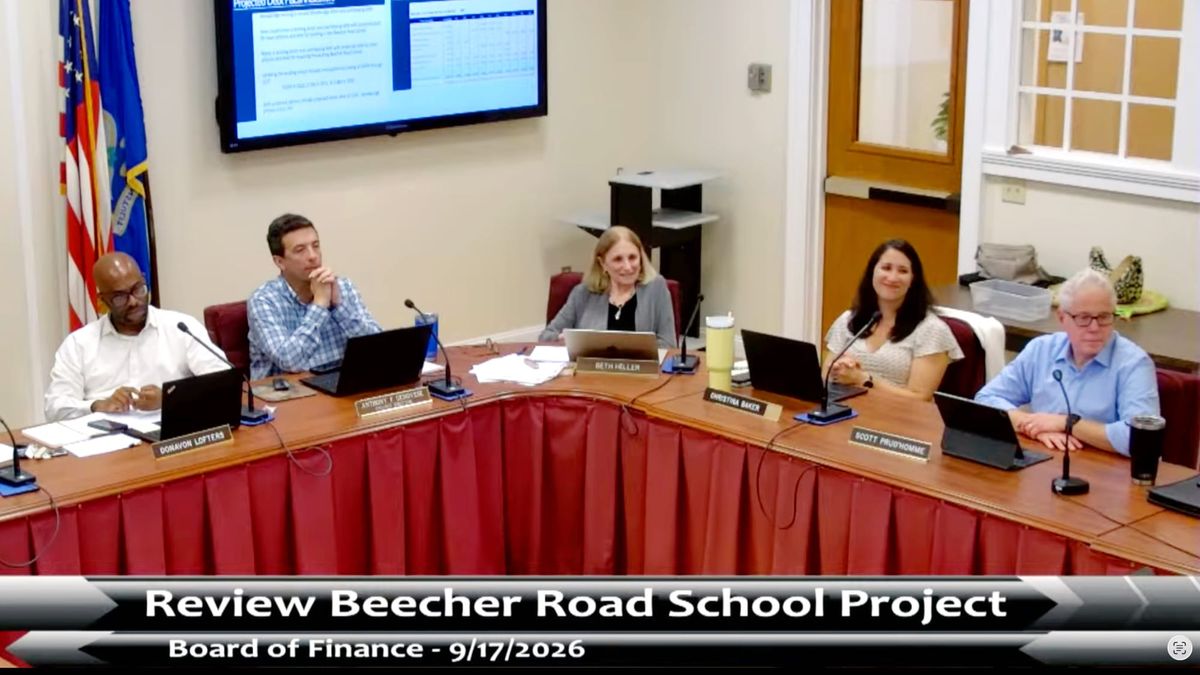
Less than a week before the Board of Selectmen is expected to act on sending the proposed Beecher Road School project to voters, the Board of Finance spent nearly four hours examining the $118.5 million proposal — its first sustained review following clarification that the Town Charter requires the board to act on the appropriation (see agenda).
The Sept. 17 discussion did not produce a simple up-or-down verdict. Instead, members pressed on what voters would actually authorize, how much state reimbursement can safely be assumed, what happens if the grant is smaller than projected, how the Town’s debt load would change and what alternatives to the proposed replacement were actually studied.
The discussion returned repeatedly to a central distinction: which numbers are established, which remain projections or interpretations, and which still require confirmation from the state agency that will administer the school-construction grant.
Several of those questions had already surfaced during the meeting’s approximately 45-minute public comment period. Selectman Amy Marrella, speaking as both a resident and member of the Board of Selectmen, said that board also had unanswered questions and that she had submitted written questions to bond counsel about the referendum language and the possible gap between projected and actual taxpayer cost.
Other speakers urged the Finance Board to distinguish projections from commitments, consider the project’s impact on taxpayers and weigh Beecher alongside the Town’s broader capital needs.
What exactly would voters authorize?
One of the clearest answers of the evening concerned what the referendum would actually authorize. Bond counsel explained that voters would be asked to authorize the full $118.5 million project cost, because the amount the State will ultimately reimburse is not yet known.
The Town currently estimates that state reimbursement will cover a substantial portion of the project. Considerably more certainty would typically come only after the upcoming legislative session, when the Legislature acts on the State’s school-construction grant commitments and the Governor signs the legislation, generally in late spring or early summer. DAS would then issue the Town a grant commitment letter.
Even that would not establish the final reimbursement amount. State reimbursement remains subject to adjustment, with the final amount determined after the project is completed and audited.
As state grant payments and other available funds are received, they would reduce the amount the Town ultimately needs to finance locally. If the project ultimately costs less than $118.5 million, the Town would not have to spend or borrow the unused authorization.
But the distinction becomes important if state reimbursement is lower than currently projected. The referendum would still have authorized a project costing up to $118.5 million.
Town officials have repeatedly said they do not intend to proceed unless the expected state funding is received. During the Finance Board discussion, however, bond counsel distinguished that stated intention from a legal condition written into the authorization.
That leaves a practical question if the state grant comes in materially below the amount now assumed: Who decides how much additional local cost is acceptable before the project proceeds?
The discussion pointed to several decision points — including acceptance of the state grant, Board of Selectmen authority over contracts and project scope, and Finance Board authorization of borrowing — but did not identify an automatic mechanism that would extinguish the referendum authorization if reimbursement falls short of the current projection.
Asking the state to put it in writing
Finance Board member Scott Prudhomme repeatedly pressed project representatives on another distinction: what the project team believes state law will allow and what the Department of Administrative Services (DAS), which administers Connecticut’s school-construction grant program, has actually confirmed.
One question involved newly enacted limits on reimbursable school-construction costs. Project representatives said Beecher’s special legislation places the project into an earlier grant cycle and, in their interpretation, protects it from a newer per-square-foot cost limitation.
Prudhomme asked whether DAS had confirmed that interpretation in writing. When the discussion returned to the project team’s reading of the law, Prudhomme responded: “So, that’s your opinion.”
The distinction could be financially significant. Prudhomme said application of the newer limitation could change projected reimbursement by roughly $8 million.
The special legislation enacted for Beecher expressly addresses several issues, including an extended application deadline, a maximum project cost of $118.5 million, eligibility for an enhanced reimbursement rate connected to housing, and eligibility of the school’s newer roof for reimbursement (see WTC article 5/4/2026). But the discussion did not establish that DAS has issued a written determination resolving every reimbursement assumption now built into the Town’s financial model.
“I think I would like to see it in writing,” Prudhomme said. He also said he had contacted state Rep. Mary Welander seeking clarification and a DAS contact who could answer the questions directly.
Prudhomme also questioned which year’s base reimbursement percentage applies. The current financial model uses a 32.14% base rate associated with the earlier grant cycle, while he said the following year’s rate is 31.43%. The difference could amount to roughly another $1 million.
None of those questions establishes that the project team's projected reimbursement is wrong. But they underscore that the estimated local share used in public presentations remains dependent on several assumptions about eligibility and reimbursement that will ultimately be determined through the state process.
Another question left from the last Beecher project
The discussion also returned to a separate reimbursement question involving earlier state-assisted work at Beecher, including the major project completed in 2016 (see WTC article 7/27/2026). Two issues have sometimes been compressed into discussion of a state “clawback.”
While the 2026 special legislation expressly allows the Beecher roof to qualify for reimbursement under the new project by deeming it more than 20 years old, that provision addresses eligibility for the proposed project. It does not on its face answer whether demolition or abandonment could trigger a repayment obligation associated with state reimbursement previously received for work that has not reached the end of its required useful life.
That issue potentially extends to both the 2016 project — which included windows, mechanical systems, controls and building-envelope improvements, among other work — and the more recent 2024 roof and grounds project. It remains unresolved whether demolition or abandonment of any previously reimbursed improvements before the end of their applicable useful lives could create a repayment obligation to the State.
The Finance Board discussion did not establish that DAS has provided written confirmation resolving the treatment of those other improvements.
Any potential state-grant repayment obligation would also be separate from the Town’s outstanding municipal debt on the 2014–16 project, which would continue to be paid according to its existing debt schedule through 2036.
A repair option — but not yet a repair plan
The Finance Board also spent substantial time trying to understand the alternative to replacing Beecher. Finance Director Anthony Genovese’s long-range debt presentation modeled roughly $45 million for repairing and updating the existing school over time. During the discussion, one iteration of the “Repair Option” estimate was described at approximately $49 million.
But participants repeatedly cautioned that the figure is a high-level financial scenario, not a construction plan developed and priced to the same level as the proposed replacement. The underlying repair estimate included roughly $18 million to $19 million in direct construction costs, plus approximately $12 million in escalation calculated to the midpoint of the 20-year period. The balance consisted of contingencies, insurance, professional and other soft costs, repeated mobilizations and related expenses.
The estimate also includes work that could potentially qualify for state reimbursement, but no estimated state reimbursement was deducted from the $45 million to $49 million repair figure. By contrast, the financial model for the proposed new school assumes substantial state reimbursement in calculating the Town’s projected local cost.
That means the two figures are not directly comparable as estimates of the ultimate cost to Woodbridge taxpayers: the repair figure is presented before any potential state reimbursement, while the replacement scenario incorporates an estimated state grant.
Developing a real repair program would require the Board of Education to establish priorities and timing and would require additional engineering and design work. That distinction is important because the repair scenario is also not the same thing as the renovation-and-addition alternatives studied during the project’s feasibility phase.
What was — and was not — studied as an alternative
When a Finance Board member asked about preserving existing wings while adding new construction, project representatives corrected the record: “That’s not the repair option.”
One of the earlier alternatives, B1, did retain substantial portions of Beecher — including the 1970s-era Rotunda — while demolishing other areas and constructing an addition. But for cost-estimating purposes, the retained space was not simply repaired and selectively modernized. It was scoped as “Renovate as New” — essentially a gut renovation — and priced accordingly.
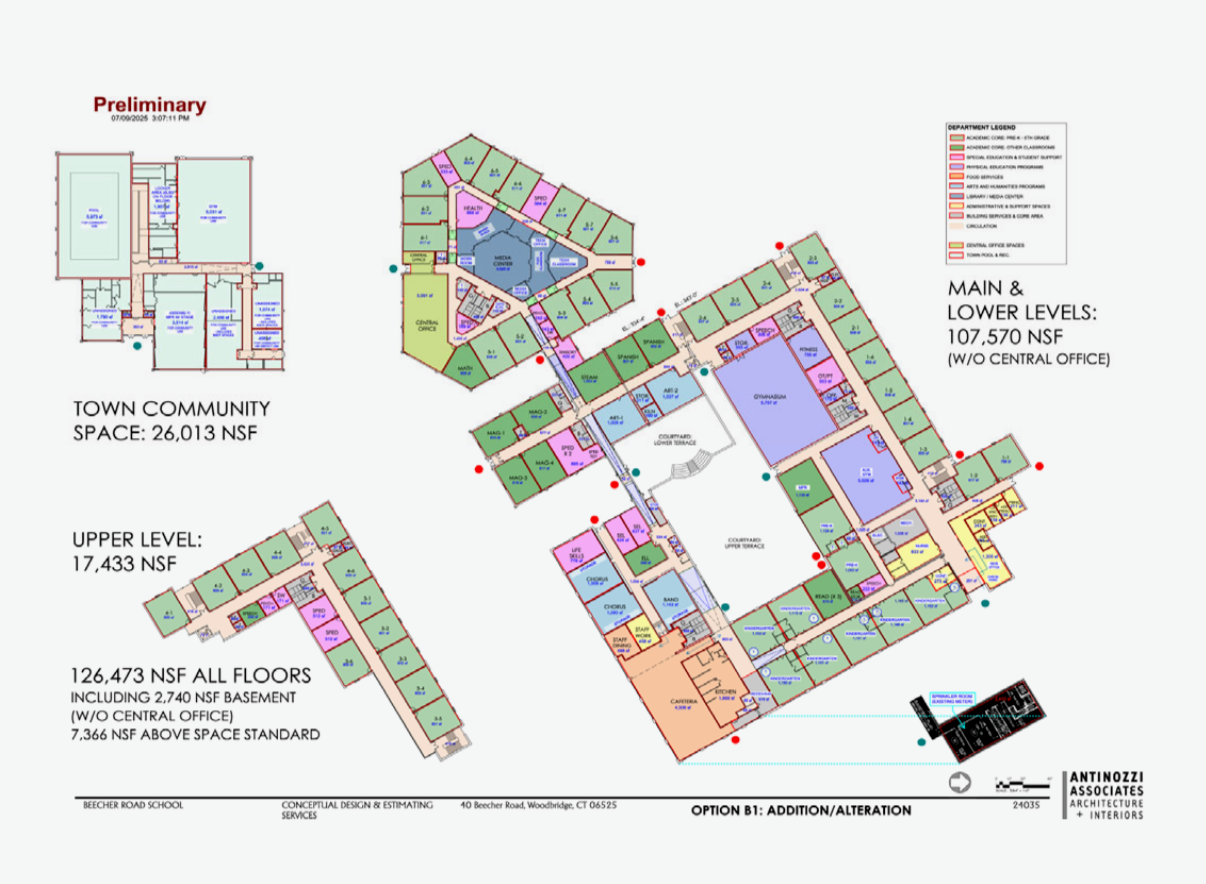
According to the detailed August 2025 conceptual specifications and cost estimate prepared by PACS Ltd, B1 called for partial demolition of the South building, construction of a new classroom wing and extensive renovation of the remaining South building and the entire North building. The scope called for mechanical, plumbing and electrical systems to be removed and replaced in retained areas, along with roofing and other building components — including some installed or refurbished during the 2014–16 project.
Some components slated for replacement were themselves described in the project documents as having substantial remaining useful life. Metal-panel and window/door assemblies in the 1960 and 1964 wings, for example, were described as “recently refurbished,” yet the Renovate as New concept still called for their replacement to accommodate the proposed new HVAC design.
Renovate as New therefore addresses a materially different question from the one Finance Board members were beginning to ask: What would it cost to retain serviceable portions and systems, repair or selectively replace what is deficient, and add the space the school actually needs?
Requests to examine that kind of alternative had also begun to emerge outside the Finance Board. Architect David H. Barkin, a longtime Woodbridge resident and former Board of Education member who previously chaired a Beecher building committee, previewed one such approach during the Sept. 15 Building Committee public forum. He subsequently submitted a letter to officials, and submitted a guest opinion piece to the Chronicle (see Community Voice article 9/21/2026), proposing that the Town preserve serviceable portions of the existing school, remove problematic construction, make targeted improvements elsewhere and add new space where the educational program requires it.
Such an alternative was not before the Finance Board at its Sept. 17 meeting and appears not to have been developed or priced by the Town. But it illustrates the type of alternative now being requested: not another Renovate as New estimate, but an analysis of what it would cost to preserve existing investments that remain serviceable, address identified deficiencies and add only the new construction required.
What happened to Beecher’s building-envelope work completed in 2016?
One exchange at the Finance Board meeting raises a larger question about how the condition of the existing school is being evaluated — and whether officials evaluating Beecher today have a complete understanding of the work taxpayers already funded.
Superintendent Chris Montini told the Board that “the building envelope is not in great shape.” Among the examples he cited were soffits that lack insulation and exterior brick needing resurfacing.
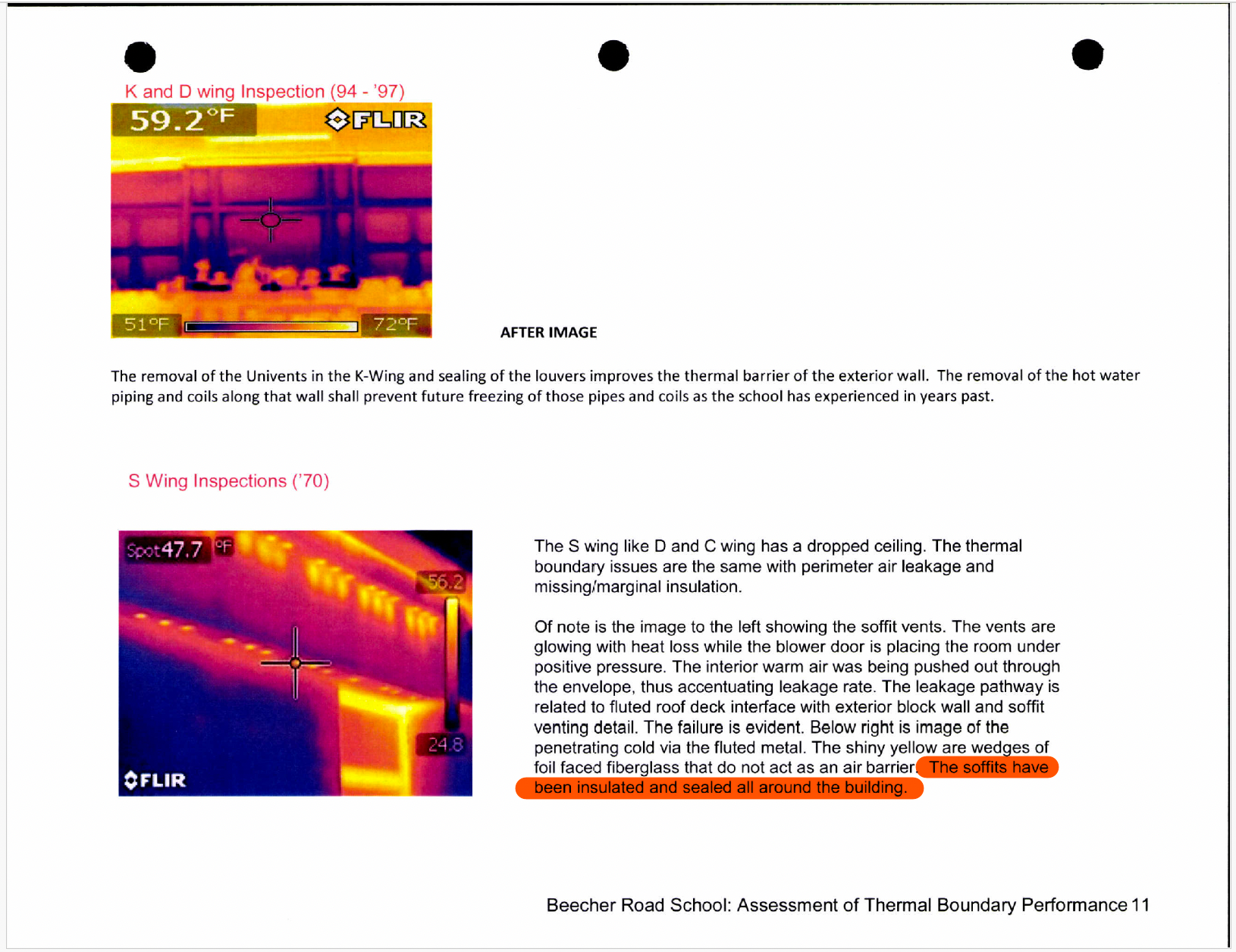
But the Town’s records show that the soffit insulation and sealing Montini described as a current deficiency had already been addressed throughout the school during the 2014–16 Beecher project. Closeout documentation following that work states specifically: “The soffits have been insulated and sealed all around the building.” That documented history did not surface during the Finance Board discussion and it is unclear whether the project team reviewed the 2016 closeout records as part of its assessment of the existing building.
Board member Thomas Handler tried to reconcile the current conditions with the earlier project. He recalled that the previous work had included soffits and windows and asked whether the deficiencies Montini was describing were in portions of the building that had not been addressed then, or whether work completed during that project might eventually need to be replaced.
Handler then sought to clarify the extent of the problem: when Montini described the envelope as being in disrepair, he was not saying the entire envelope was affected, but rather that “there’s certain areas that are worse than others?” he asked. Montini replied, “That is correct.”
Board member Christina Baker, who had toured Beecher two days earlier, provided a visible example. She said she had seen “active bird nests within the soffits” and “very clear instances of disrepair” — conditions she said she had not previously noticed despite bringing her children to the school daily.
Photographs taken recently by the Chronicle show the kind of localized deterioration Baker described: portions of the exterior soffit material are missing, leaving visible openings.
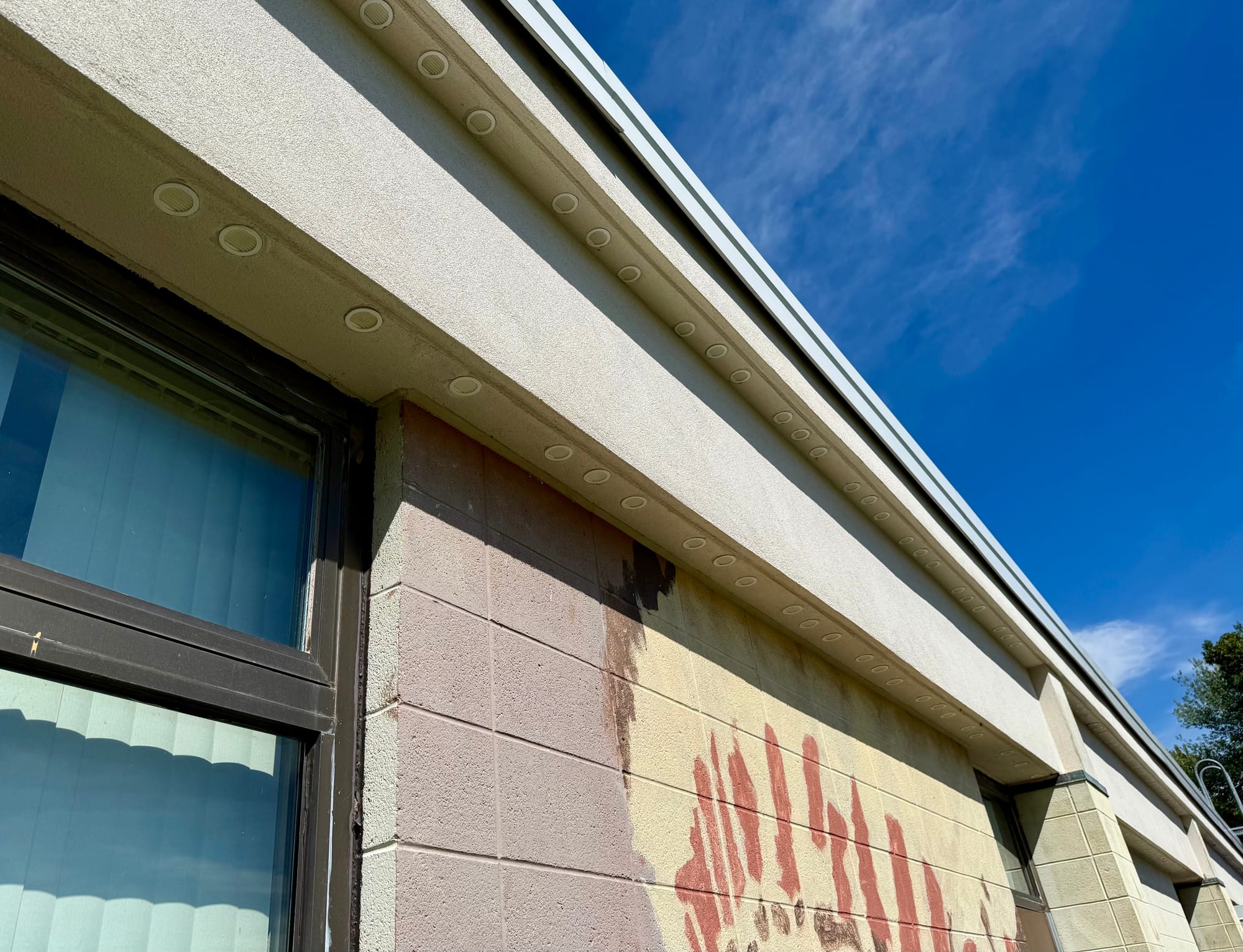
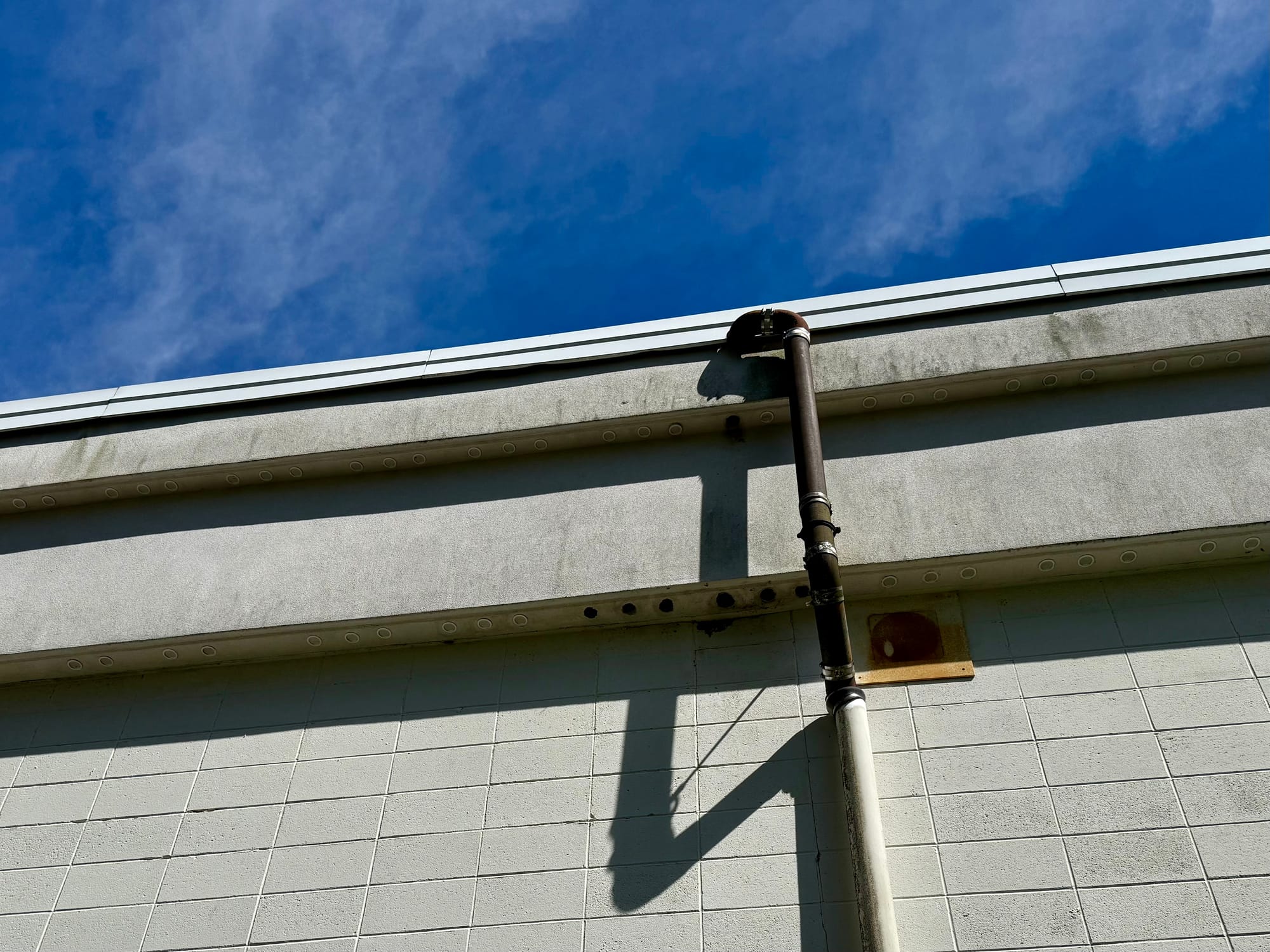
Photographed Sept. 19, 2026: Soffits along the Beecher South roof overhang, at left, and along the pool-area roof, where some covers appear to be missing, at right.
The photographs above do not establish the condition of every soffit or of the entire building envelope. But they do document what appears to be a current repair and maintenance need. And the earlier project records provide important context: the Town’s closeout records say the underlying soffit insulation and sealing were completed throughout the building.
That changes the question. Rather than treating damaged or missing soffit material today as evidence that the building envelope was not addressed a decade ago, the question is what has happened since — and whether damaged exterior material has been repaired to protect work taxpayers already funded. Localized exterior failures left uncorrected can turn a relatively limited maintenance problem into a larger repair need over time.
That distinction matters as the Town weighs replacement against alternatives for retaining portions of the existing school. The Finance Board is trying to understand — so voters can also know — what taxpayers already paid to improve, what remains serviceable, what now needs repair or routine maintenance, and what actually requires replacement.
In the case of the soffits, the historical record supplies at least part of that answer: the building-envelope work was done. The unanswered question is what condition that work is in today and whether maintaining and repairing it has been adequately considered before its current condition is used to support a much larger replacement project.
Looking beyond Beecher
The Finance Board’s review also placed Beecher into a broader financial context. Board members discussed other significant Town needs, including the Police Station renovation and other municipal facility needs across the Center Campus.
Concerns about the potential effect of the additional borrowing on Woodbridge’s credit rating had also been raised during public comment. During the meeting, the Town’s municipal financial adviser cautioned against using a rating-agency scorecard or any single formula to predict a particular rating change.
He explained that rating agencies consider a broader set of factors, including the Town’s tax base, wealth, fund balance, liabilities and overall financial condition. While additional debt is part of that analysis, whether the Beecher borrowing ultimately contributes to a rating change cannot be known in advance and would depend on the Town’s overall financial position when the debt is issued.
Finance Board members also returned to Woodbridge’s relatively slow Grand List growth and limited commercial tax base — factors that affect how additional debt ultimately falls on residential taxpayers.
What became clearer — and what did not
After nearly four hours, several important points were clearer. The proposed referendum would authorize the full $118.5 million appropriation, not the smaller projected local share after state reimbursement.
The reimbursement figures used to calculate that local share and the projected tax impact remain estimates, dependent on eligibility determinations and reimbursement assumptions that will ultimately be administered through the state grant process. And the repair figure appearing in the Town’s long-range financial analysis is a planning scenario, not a developed repair plan.
Other questions remained unresolved at the meeting. The Board did not have written DAS confirmation addressing the reimbursement assumption Prudhomme raised. Questions remain about how the prior state-assisted project affects portions of the existing building beyond the roof. And no detailed, prioritized repair program has been developed and priced.
In addition, the renovation-and-addition alternatives studied during the feasibility process involved considerably more than retaining the existing school and repairing what is deficient, because retained areas were generally assumed to undergo extensive Renovate as New work. As a result, the Town has not produced a costed alternative based on a different premise: retaining serviceable existing construction, selectively repairing or replacing deficient components, and adding only the space required.
The calendar for resolving those questions is now short. The Board of Selectmen is expected to act Sept. 23 on a resolution calling an Oct. 6 Special Town Meeting, followed by an Oct. 13 referendum. For the Finance Board, the Sept. 17 meeting marked the beginning of a much closer examination of the proposal it is now being asked to help place before voters — but they apparently must take a vote to approve or reject the proposal before the Selectmen can act on Sept. 23 (as of publication, no additional Board of Finance meeting notice has been posted to the Town website).
And for voters, the discussion provided a clearer view not only of the numbers attached to the $118.5 million project, but of which of those numbers — and which assumptions behind them — still require clarification.
Board of Finance meetings are open to the public and usually streamed live on the town's YouTube channel, WGATV79. Click below to watch the full recording of the Sept 17, 2026 BOF meeting.